FLOWERY BRANCH, Ga. (AP) — Atlanta Falcons coach Kevin Stefanski said Wednesday quarterback Michael Penix Jr., who joined team drills for the first time on Monday, will not play in the team's final preseason game at Miami on Friday night.
The decision could have strong implications on Penix being available for the start of the regular season. The much-anticipated competition between Tua Tagovailoa and Penix for the starting job was put on hold through much of training camp as Penix continued his recovery from his 2025 season-ending injury to his left knee. Penix was limited to seven-on-seven and individual drills before his first 11-on-11 work this week.
Though Penix will not have played in any of the team's three preseason games, Stefanski insisted he was encouraged by the quarterback's progress.
“I thought he did well,” Stefanski said of Penix's performance in practice on Wednesday. "I thought he looked good. He moved around well. I think all that work, like I’ve told you guys the whole time, and you’ve seen it with your own eyes, like he’s put a lot of work into this. I think you see that in his getting away from center, making throws, etc.”
Stefanski said Tagovailoa will start at Miami, followed by Cooper Rush and undrafted rookie Jack Strand.
Tagovailoa would appear to be the favorite to open the season as the starter, but Stefanski would not rule out the possibility Penix will play.
“I’m not going to get into Week 1," Stefanski said. "Obviously, I’m best served and we’re best served by keeping it day to day and focusing on what’s in front of us.
"Really, this was an important week for Mike. First time out there with people around you and the offensive line, the defensive line. I think going through a drill where you got to move up in the pocket or get chased out of the pocket, whatever it is. So, I thought a really good first step for Mike in that regard. But outside of this week, I don’t think it’s fair to go further.”
See AP’s full NFL coverage here

Atlanta Falcons quarterback's Michael Penix Jr. (9) Tua Tagovailoa (1) run drills during an NFL football training camp practice on Monday, Aug. 17, 2026, in Flowery Branch, Ga. (AP Photo/Brynn Anderson)

Atlanta Falcons quarterbacks Michael Penix Jr. (9) Jack Strand (18) and Tua Tagovailoa (1) run drills during an NFL football training camp practice Monday, Aug. 24, 2026, in Flowery Branch, Ga. (AP Photo/Brynn Anderson)

Atlanta Falcons quarterback Michael Penix Jr. (9) runs drills during an NFL football training camp practice Monday, Aug. 24, 2026, in Flowery Branch, Ga. (AP Photo/Brynn Anderson)
WASHINGTON (AP) — The U.S. Army announced Wednesday that it plans to add nuclear microreactors at five military bases from New York to Texas as a reliable source of energy independent of the commercial electric grid.
The announcement comes as the Trump administration pushes hard to develop the next generation of nuclear power, including billions in loans for large nuclear reactors to meet skyrocketing power demand from data centers and a pilot program to boost advanced reactor designs and projects for military and civilian use. No nuclear microreactors are supplying power to the commercial electric grid in the United States today.
Five companies selected by the Army will be awarded up to $2.2 billion in total over five years to own, construct and operate the microreactors, if they hit set milestones along the way for their performance. The Army expects that more than 20 nuclear microreactors will be built and operated.
Army and industry officials say microreactors offer a resilient power source for critical infrastructure at military installations in case the grid fails. Reactors can run for years without refueling.
Army Secretary Dan Driscoll said the awards will accelerate the military’s ability “to deliver safe, reliable baseload power directly to our installations. We are building the energy resilience necessary to project combat power globally, without relying on potentially vulnerable external grids,” he said.
The grants are part of the Army's “Janus Program” launched last year to deliver next-generation nuclear energy. Officials hope to push nuclear development forward so that advanced reactor designs move beyond experiments and prototypes to provide power for years to come. This will be the “spear tip,” said Jeff Waksman, principal deputy assistant secretary of the Army for installations, energy and environment.
“That is the transition that we are trying to effect here,” he said on a call with reporters Wednesday. “These are not meant to be Army-specific designs.”
Critics of building more nuclear reactors say they’re too expensive and riskier than other energy sources. Waksman said these reactors will shut down safely in case of a failure, they're small and the Army wouldn't add them to installations without being certain they are safe. He said the Army is working on a deal with the Energy Department to remove radioactive waste, and there won't be any long-term storage on these installations.
President Donald Trump signed executive orders in May 2025 to speed up the development of nuclear power. The Army was tasked with ensuring that an advanced reactor would start operating at a domestic military installation no later than Sept. 30, 2028. The Janus program is named for the ancient Roman god of transitions.
Officials know that delivering nuclear power to a military base will be a challenge, so they picked five companies in case one or more fail, Waksman said. The selected companies are: Antares Nuclear at Fort Bragg in North Carolina; BWXT at Fort Campbell in Kentucky; General Atomics Electromagnetic Systems at Fort Hood in Texas; Radiant Industries at Fort Benning in Georgia; and Westinghouse Government Services at Fort Drum in New York.
Senate Minority Leader Chuck Schumer asked the Army to select Fort Drum. The critical missions Fort Drum supports require secure, reliable and resilient power generation, the New York Democrat said.
The reactors will be licensed by the Army, rather than the U.S. Nuclear Regulatory Commission, which licenses commercial nuclear reactors. The Army is working to align its regulatory processes as much as possible, Waksman said, so that companies won’t need major changes to their designs to be later licensed by the NRC. Along with federal funding, the Army expects billions of dollars in private capital investment.
The military installations will remain connected to the grid. The reactors would not completely power them. Each reactor will provide between 1 megawatt to 20 megawatts of power, depending on the company's design. Major bases use as much power as a small city. Antares and Radiant are planning to deliver their reactors in three-packs, Waksman said.
The Army now uses diesel as a primary backup for critical infrastructure. But in a conflict, Waksman said, the Army may not be able to move fossil fuels easily wherever it needs them.
“That makes nuclear energy just a natural game changer,” he said. “It makes sense for the Army to take the lead here.”
A reactor at Fort Belvoir in Virginia, completed in 1957, was the first nuclear power reactor to provide electricity to a commercial power grid in the United States for an extended period, according to the U.S. Army Corps of Engineers.
California-based Antares reached a crucial milestone under the U.S. pilot program that could allow it to produce electricity at Idaho National Lab next year. The company said the Army's announcement extends its momentum. Westinghouse Government Services said it’s proud to support the Army’s efforts to strengthen energy security and innovate.
Tori Shivanandan, president and chief operating officer of California-based Radiant, said the Army’s $750 million award “shows confidence in Radiant’s product and ability to manufacture, deploy and safely operate nuclear microreactors for the American military.” The Janus program “will build a stronger and more resilient America,” she said.
General Atomics Electromagnetic Systems said its reactor is designed to operate in remote, off-grid and extreme environments for 40 years. It said it will draw on more than 70 years of nuclear expertise to provide safe, dependable and independent power for the military.
Rex Geveden, BWXT's president and chief executive officer, said, “As we commence work on the Janus program, we are delivering the nation’s most credible and reliable path to deployable nuclear power.”
McDermott reported from Providence, R.I.
The Associated Press’ climate and environmental coverage receives financial support from multiple private foundations. AP is solely responsible for all content. Find AP’s standards for working with philanthropies, a list of supporters and funded coverage areas at AP.org.
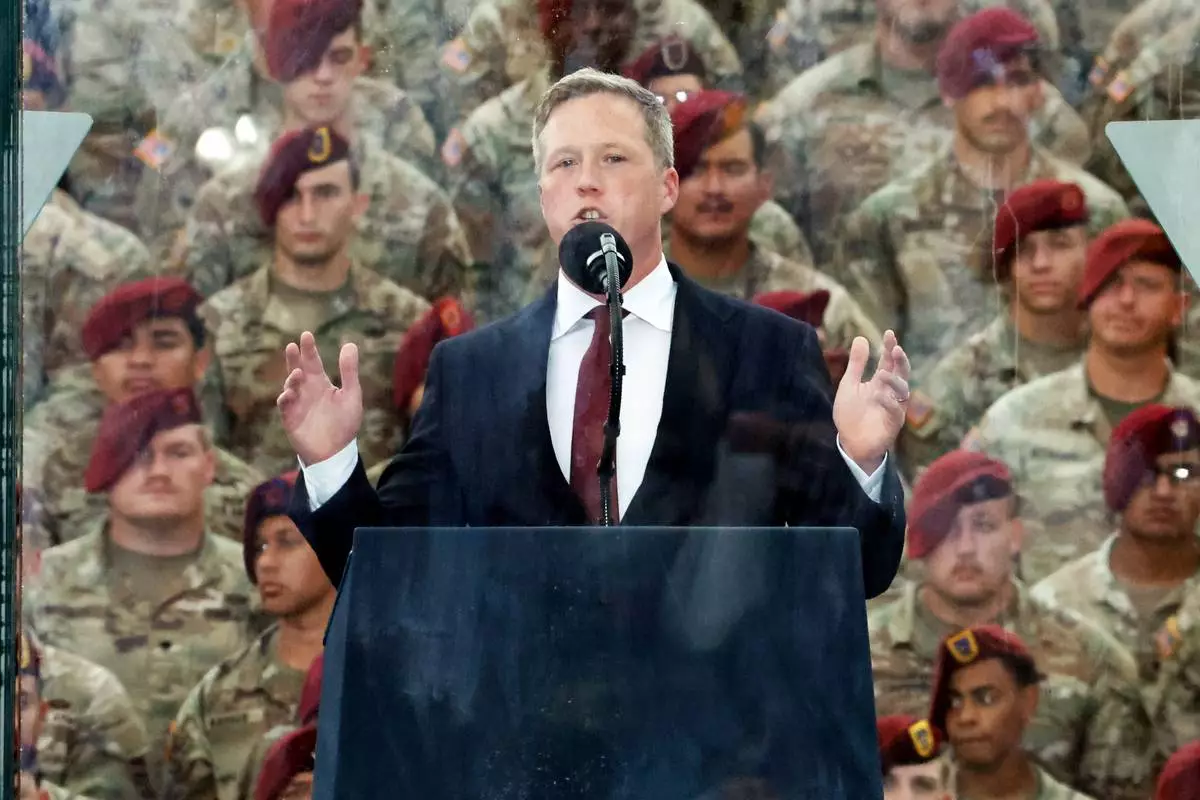
FILE - U.S. Army Secretary Dan Driscoll speaks at the America 250 celebration at Fort Bragg in Fayetteville, N.C., June 10, 2025. (AP Photo/Karl DeBlaker, File)

FILE - Members of the Army military stand behind a new sign at Fort Benning during a ceremony, April 16, 2025, in Fort Benning, Ga. (AP Photo/Brynn Anderson, File)

FILE - A sign at Fort Bragg, N.C., is seen, Jan. 4, 2020. (AP Photo/Chris Seward, File)