Prolonged heat and low rainfall have caused water levels on the Danube River in Bulgaria to drop sharply since early summer, leaving most sections unnavigable by late August and forcing many farmers to struggle to get their grain to market.
Zarko Ivanov, a grain producer from northwestern Bulgaria, said his wheat harvest was good this year, but he was unable to ship it because vessels could not navigate the Danube River.
"The Danube River is normally our main route for transporting grain. This year, because ships cannot travel on the river, we have to use trucks. But trucking is too expensive. So even though we had a good harvest, we lost money," said Ivanov.
"This year's weather has been too dry. Both our spring and autumn harvests were good, but we couldn't transport them. We don't know whether the weather will get better after summer," said Ivan Parvanov, another grain producer from northwestern Bulgaria.
Grain exports are an important part of Bulgaria's foreign trade. The country's wheat, corn and sunflower seeds are sold in large quantities to Greece, Germany and Nordic countries.
In 2025, Bulgaria's agricultural exports exceeded 7 billion euros (about 8.2 billion U.S. dollars). Most of Bulgaria's grain-producing areas are in the north and west, while its main export ports are on the Black Sea coast in the south. In previous years, most grain from production areas to ports was transported via the Danube, but this year the vital artery has been blocked by drought.
With the sunflower seed harvest approaching in autumn, Ivanov is becoming even more anxious.
"In all my years of farming, this is the first time I have had a good harvest but could not move it. Now I am losing money by using trucks just to empty the warehouse, because the sunflower seeds will be harvested soon," said Ivanov.

Drought halts Danube River shipping, stranding Bulgarian grain
China's auto exports are on track to surpass 10 million units in 2026 as export volumes continue to expand, with new energy vehicles emerging as the main driving force, according to the latest data released by the China Association of Automobile Manufacturers (CAAM) on Monday.
CAAM data showed that China exported 8.2 million vehicles in the January-September period, up more than 65 percent year on year, putting annual exports on course to break the 10-million-unit mark for the first time.
This expansion has been accompanied by strong performances from several domestic automakers. Chery Group exported a cumulative 1.5 million vehicles in the first three quarters, a 65 percent increase year on year, while MG, the British brand under SAIC Motor, sold more than 280,000 units in the European market during the same period, up 23 percent.
At the same time, the geographic reach of Chinese auto exports has continued to widen, with Europe, South America, Southeast Asia and the Middle East becoming the main destination markets.
Behind these figures, new energy vehicles are turning into the key engine of export growth.
In the first nine months of the year, China exported over four million new energy vehicles, up 1.3 times year on year. Starting in June, the share of new energy vehicles in total auto exports has exceeded 50 percent for four consecutive months.
Industry observers noted this rapid rise reflects how Chinese automakers are leveraging their advantages in electrification and intelligent technologies.
Liu Yan, deputy secretary-general of the CAAM, said the export boom reflects a fundamental shift in the source of China's automotive competitiveness.
"The global competitiveness of China's automotive industry has evolved from cost-effectiveness to a systemic competitiveness centered on new energy. This is not only injecting new momentum into global green and low-carbon development, but also securing new long-term competitive advantages for Chinese automakers," she said.
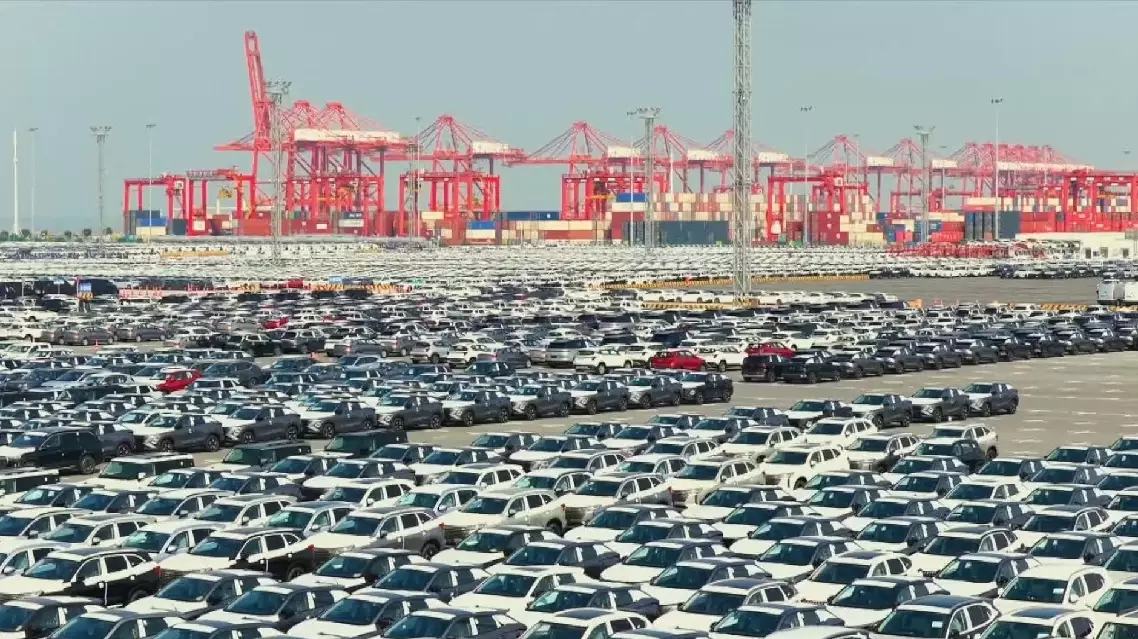
China's auto exports projected to top 10 million units in 2026