LOS ANGELES--(BUSINESS WIRE)--Aug 27, 2026--
Cathay Bank celebrated a significant milestone in its expansion throughout the Asia-Pacific region with the grand opening of its Vietnam Representative Office on August 21 at Ho Chi Minh City. The new office is located in the Royal Center Building, Unit 606, 6th Floor, Royal Tower A, Royal Center Building, 235 Nguyen Van Cu, Cau Ong Lanh Ward, Ho Chi Minh City, 700000.
This press release features multimedia. View the full release here: https://www.businesswire.com/news/home/20260827517075/en/
With this new office, Cathay Bank now has a total of four representative offices, including ones in Beijing, Shanghai, and Taipei, along with over 60 branches across the United States and a branch location in Hong Kong.
"We are pleased to expand our presence in Vietnam with the establishment of this Representative Office," said Dunson K. Cheng, Executive Chairman of the Board of Cathay General Bancorp and Cathay Bank. "This opening marks an important step in the Bank's ongoing international growth and demonstrates its long-term commitment to building meaningful relationships and serving communities across the Asia-Pacific region.”
For representative office inquiries, Hoai Anh Nguyen, Chief Representative of the Vietnam Office, can be reached directly at +84-283-622-5856 during normal business hours which are: Monday through Friday from 9:00 a.m. to 5:00 p.m.
About Cathay Bank
Cathay Bank, a subsidiary of Cathay General Bancorp (Nasdaq: CATY), opened its doors in 1962 in Los Angeles to serve the growing immigrant community. Today, we operate over 60 branches across the U.S., with a branch in Hong Kong, and representative offices in Beijing, Shanghai, Taipei, and Ho Chi Minh City. Learn more at cathaybank.com. FDIC insurance coverage is limited to deposit accounts at Cathay Bank’s U.S. domestic branch locations.

The grand opening ceremony was attended by senior leadership and community members who gathered to commemorate this significant occasion for Cathay Bank.
BELGRADE, Serbia (AP) — Ratko Mladic, the bullish Bosnian Serb general whose forces besieged the Bosnian capital for several years in the 1990s and carried out the worst massacre in Europe since World War II, died Thursday while serving a life sentence for his crimes, U.N. officials said. He was 84.
Mladic died at a hospital in The Hague, Netherlands, U.N. court officials said. A Mladic relative who spoke to The Associated Press on the condition of anonymity because of the sensitivity of the situation confirmed the reports and said Mladic’s son, Darko Mladic, was on his way to the Dutch city.
The U.N. tribunal for war crimes committed during the wars in the former Yugoslavia in the 1990s sentenced Mladic to life in prison in 2017 in what was considered a key step toward bringing justice to the victims. He had been in custody since 2011 after many years on the run.
The ruthless, blue-eyed former communist officer-turned nationalist warlord was one of the most notorious figures of the conflict that left more than 100,000 people dead and over 1 million homeless. He commanded his troops to “scorch the brains” of the Bosnian Muslims and boasted of being a “Serbian God.”
When the ethnic war in Bosnia and Herzegovina started in 1992, Mladic became the commander of the Bosnian Serb troops and took control of large swaths of the country to form a Serb mini-state.
Serbs under Mladic’s control laid siege to the Bosnian capital, Sarajevo, and other cities and villages, established concentration camps for detained non-Serb civilians and enemy soldiers, and systematically killed prisoners.
In Sarajevo, Serb troops kept the city isolated while killing civilians with snipers and heavy artillery. In 1995, Mladic’s troops slaughtered more than 8,000 Muslim men and boys in Srebrenica — the first case of genocide in Europe since WWII.
But Mladic and his admirers have never repented. He was seen by many as a patriot fighting for the first pan-Serbian state. Defiant, Mladic acted bullishly during his trial and yelled at the judges when sentenced to life in prison.
Munira Subasic, from the Mothers of Srebrenica group, said she had mixed feelings about Mladic’s death and deplored that Mladic’s crimes are still being denied by many Bosnian Serbs.
“Today, a major war criminal died, the criminal of the Balkans,” Subasic said. But while mothers of victims “are still carrying the pain in our souls" 31 years later, “we are still listening to denials, we are still listening to how Ratko Mladic was a hero for the Serbs,” she said.
“I am sorry that he died and that he did not suffer for a little while longer, that he didn’t wait for more and dream about the eyes of our children,” she said.
Residents of Pale, a Bosnian Serb stronghold just outside of Sarajevo, mourned Mladic.
“He was murdered there, in those dungeons,” said Janko Seslija, a former Bosnian Serb soldier. “I feel sorry for Gen. Mladic. He was an honorable man, honorable soldier and commander.”
Mladic was born March 12, 1942, in the tiny Bosnian village of Bozinovici, in the hills 40 kilometers (25 miles) south of Sarajevo. Like other protagonists in the Yugoslav conflict, he imbibed nationalism from his family’s fate in WWII — his own father was killed by Croats.
A communist-era officer, Mladic sided with the Serbs as Yugoslavia disintegrated into war. Mladic first led a Serb insurgency in Croatia before taking over the Bosnian Serb army that was backed by Serbia and then-President Slobodan Milosevic, who also died in the custody of the Hague court in 2006 while on trial for genocide.
Mladic was known for his obsession with his nation’s history. He saw Bosnia’s war as a chance for revenge against the onetime 500-year-long Ottoman occupation of Serbia. He often referred to Bosnia’s Muslims as Turks and boasted of revenge when his troops overran the protected U.N. enclave of Srebrenica in 1995.
Carried away by Serb dominance in firepower and international ignorance, Mladic was convinced of his final victory.
“The time has come ... for revenge against Turks in these regions,” Mladic said after taking over Srebrenica.
A U.N. “safe haven” for Muslims, Srebrenica ended up overrun by Serbs who separated the men and boys, forced them to strip, killed them and bulldozed their bodies into mass graves in a brutal rampage that lasted for over a week.
The Srebrenica survivors said one image forever will be imprinted in their minds: Mladic handing out candy to Muslim children who had been rounded up on the town’s square and reassuring them that everything would be all right — even patting one child on the head.
Convinced of the power of his army, he used to tell his soldiers: “When I give you guarantees, it’s as if they are given by God.” To clear the way for his helicopter to land, he would tell air traffic controllers: “Here speaks Ratko Mladic — the Serbian God.”
Sarajevans still remember his commands to the Serb gunmen pounding the Bosnian capital in early 1992. He issued his orders through a military radio system, not bothering to scramble the signal, which was picked up and taped by the Sarajevo police.
“Turn toward Velesici, there are no Serbs there,” Mladic said as he ordered his artillery to pound the Sarajevo suburb.
“Scorch their brains,” he told his gunmen.
Faced with the U.N. tribunal’s genocide indictment, Mladic in 1996 began his fugitive years in Han Pijesak, a military compound in eastern Bosnia built for Yugoslavia's longtime communist leader, Josip Broz Tito, and designed to withstand a nuclear attack.
With his wife, Bosa, Mladic settled down to imposed domesticity, passing the time caring for bees and goats. His 23 goats reputedly bore the names of foreign dignitaries he despised, such as Madeleine Albright, the former U.S. secretary of state.
Surrounded by security guards, he occasionally ventured out of the dense pine forest to mark events such as the anniversary of the Bosnian Serb army and St. Vitus Day, a religious festival marking the 1389 Serb defeat by the Turks at Kosovo.
When his trail grew too hot in Bosnia in the late 1990s, Mladic moved with family to a villa near the Serbian capital, Belgrade. There, he was seen at his son’s wedding, soccer games and fancy restaurants, refusing to give interviews and smiling quizzically when photographed.
When Milosevic was ousted from power in 2000, and Serbia's new pro-democracy authorities signaled they might hand Mladic to the tribunal, tabloids reported he had left Belgrade for Bosnia.
But true to his style, Mladic countered those rumors and others that said he was terminally ill, and before going underground in 2002, he was repeatedly seen driving around the Serbian capital in a Yugo.
He completely disappeared from public view in 2008 and was finally arrested in May 2011 in a village near Belgrade where he was hiding at a relative’s house.
The frail-looking old man who appeared in court at the Hague was a far cry from the robust image Mladic exuded in wartime. But his defiance was intact.
“Everything you said is pure lies. Shame on you!” he yelled at the U.N. judges when they handed down the conviction.
Already in poor health upon arrest in 2011, Mladic is believed to have suffered multiple strokes during his years on the run and was hospitalized on several occasions while in custody.
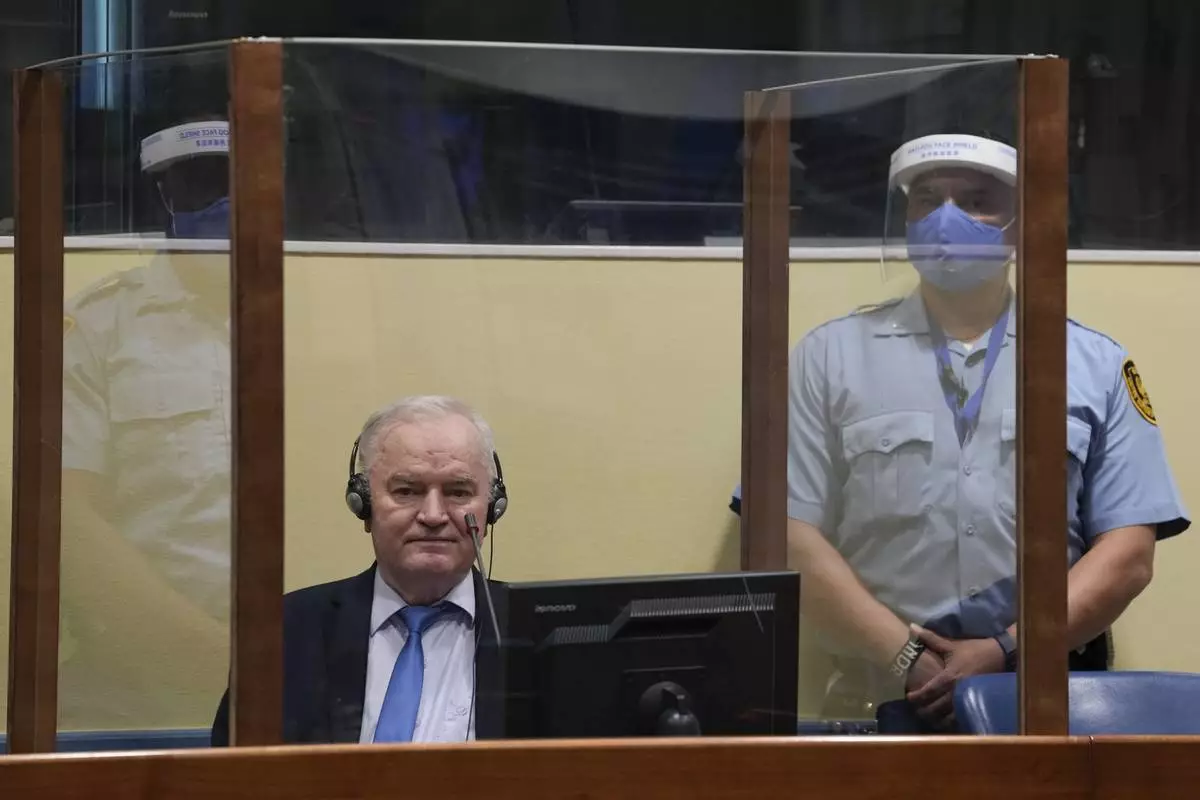
FILE - Former Bosnian Serb military chief Ratko Mladic sits in the court room in The Hague, Netherlands, Tuesday, June 8, 2021, where the United Nations court delivers its verdict in the appeal of Mladic against his convictions for genocide and other crimes and his life sentence for masterminding atrocities throughout the Bosnian war. (AP Photo/Peter Dejong, Pool, File)
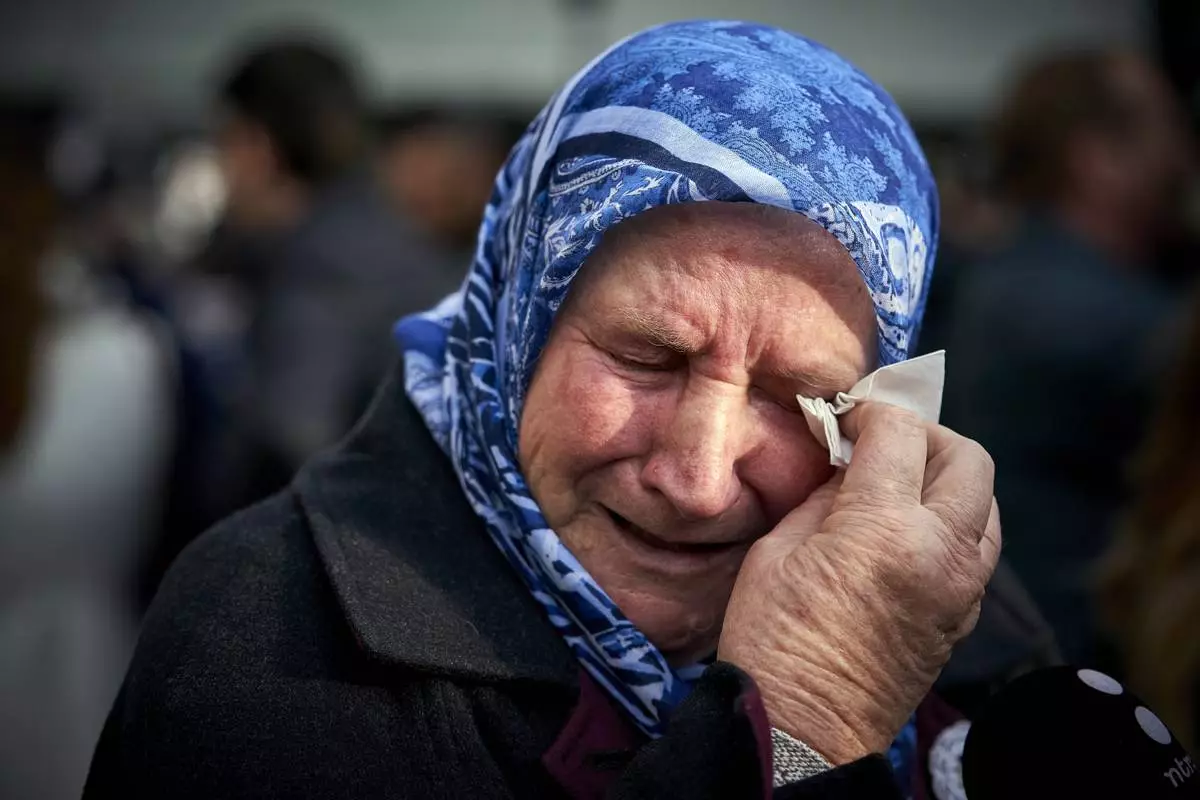
FILE - Nura Mustafic, one of the Mothers of Srebrenica and other Bosnian organizations, wipes away tears as she reacts to the verdict which the Yugoslav War Crimes Tribunal, ICTY, handed down in the genocide trial against former Bosnian Serb military chief Ratko Mladic, in The Hague, Netherlands, Wednesday Nov. 22, 2017. (AP Photo/Phil Nijhuis, File)
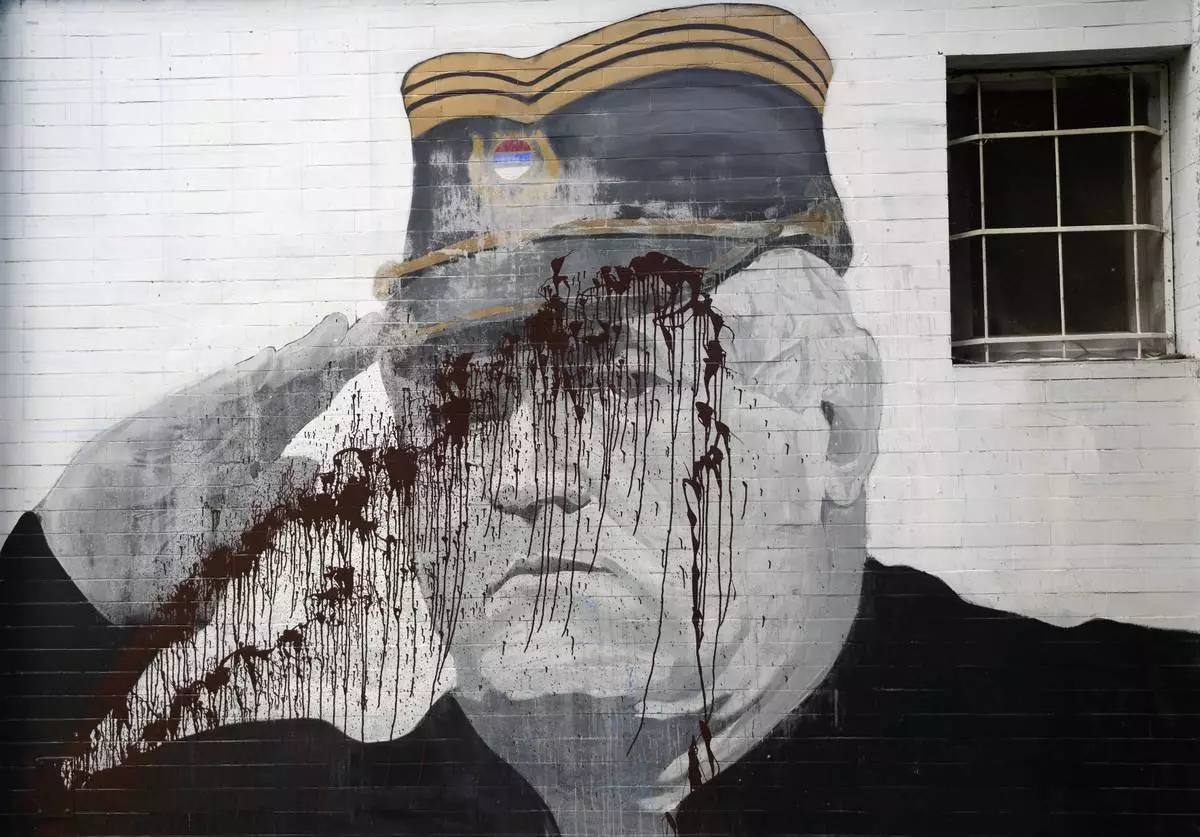
FILE - A mural of former Bosnian Serb military chief Ratko Mladic vandalized with paint in Belgrade, Serbia, Tuesday, Sept. 20, 2022. (AP Photo/Darko Vojinovic, File)
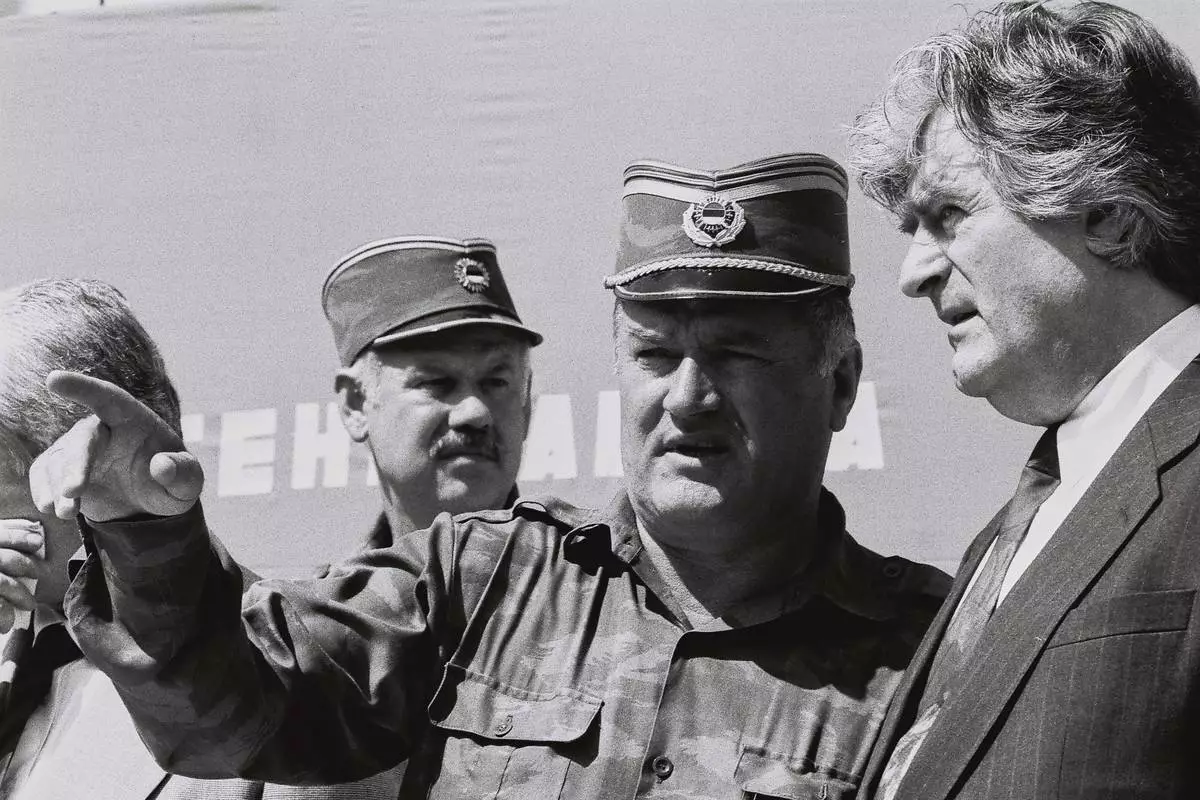
FILE - Bosnian Serb General Ratko Mladic, center, speaks with Bosnian Serb President Radovan Karadzic, right, in the Bosnian town of Banja Luka, in 1994. (AP Photo/Radivoje Pavicic, File)
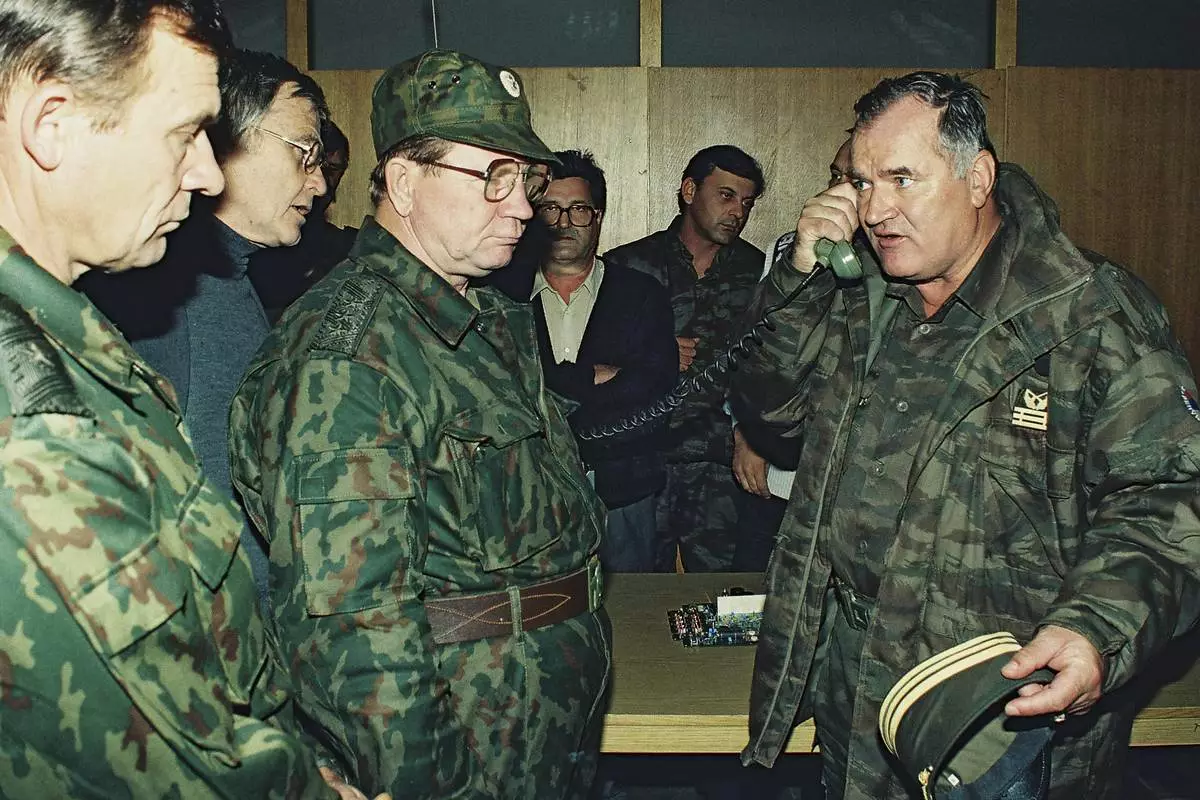
FILE - Bosnian Serb General Ratko Mladic, right, talks on the phone next to Russian Army General Vladimir Zurbenko, center, during the visit of a Russian Army delegation to the Bosnian town of Banja Luka in Oct. 1995. (AP Photo/Radivoje Pavicic, File)