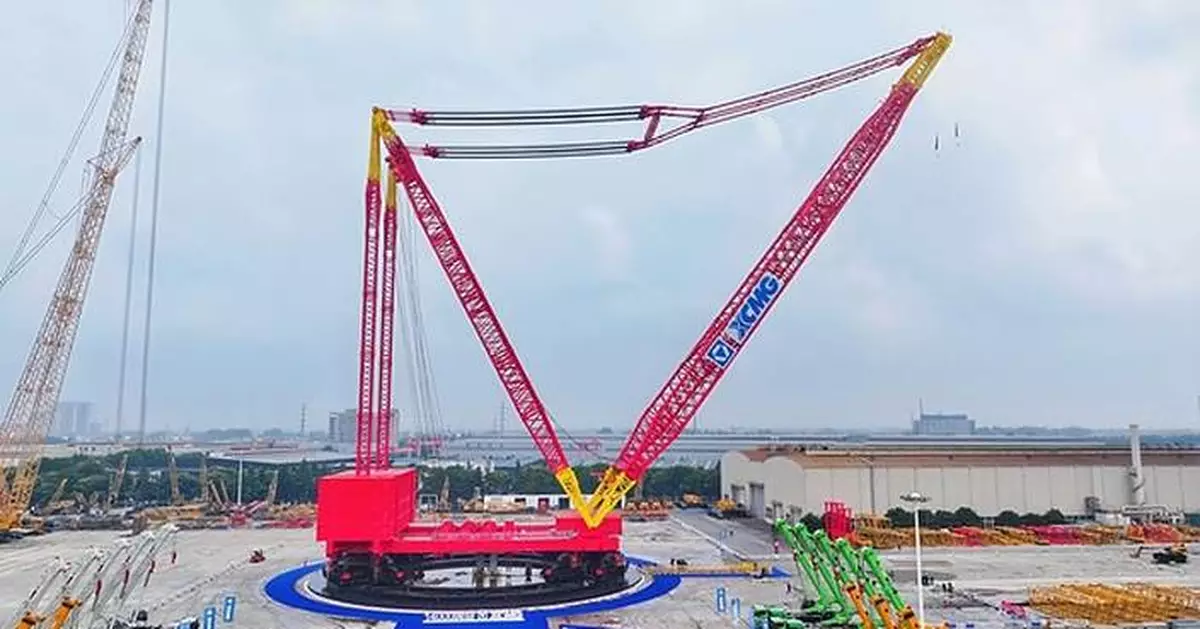
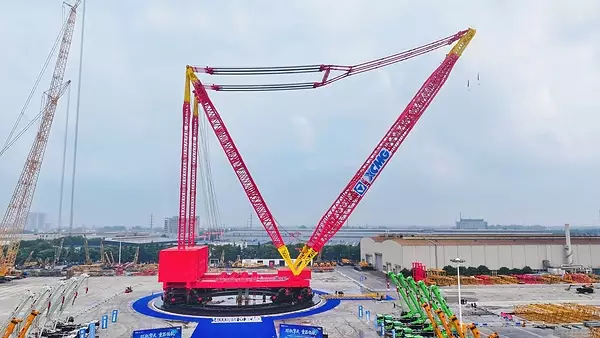
XUZHOU, China, Aug. 28, 2026 /PRNewswire/ -- XCMG has announced that the first main unit of the world's first 14,000-ton ring crane has rolled off the production line, marking a historic breakthrough in ultra-heavy lifting technology. Jointly developed by XCMG and Sinopec Heavy Lifting & Transportation Co., Ltd., the crane will be the largest-capacity ring crane ever built, setting a new benchmark for major construction projects worldwide.
The crane features a modular configuration comprising two main units that work in tandem. The first main unit has completed final assembly and can independently perform lifting operations. Once both units are completed and integrated, the crane will have a maximum lifting capacity of 14,000 tons and a maximum lifting moment of 700,000 ton-meters, with several key performance specifications expected to lead the industry.
"This crane is more than an incremental improvement; it represents a transformative leap for the global heavy-lifting industry," said Yang Dongsheng, chairman of XCMG Group and XCMG Machinery. "Our partnership with Sinopec has created a new integrated model spanning R&D, manufacturing and application, setting an industry benchmark for independent innovation and engineering application of major technical equipment."
The ring crane also features a pioneering electric direct-drive system that converts electric power directly into motion, delivering energy savings of more than 30%, boosting operating efficiency by 20%, and reducing fuel costs and carbon emissions.
As nuclear power projects worldwide become larger and more modular, demand is rising for ultra-heavy lifting equipment. The 14,000-ton ring crane marks a major step in the growing role of Chinese-developed high-end lifting equipment in nuclear power construction worldwide. It can serve conventional energy, nuclear power and wind power projects. For conventional energy, it can lift a range of large towers and vessels as complete units, replacing sectional lifting and reducing risks in assembly, pressure testing and other installation work. In nuclear power construction, it delivers a world-first capability: from a single crane position and using a single boom configuration, it can handle plant modules and major equipment for two nuclear islands. For offshore wind, its lifting height and capacity enable the installation of larger-capacity turbines.
Yang added: "XCMG will continue to advance the independent development of ultra-large engineering equipment, bring proven, reliable solutions to a wider range of engineering applications, and provide customers worldwide with safer, more efficient and energy-saving construction solutions."
** This press release is distributed by PR Newswire through automated distribution system, for which the client assumes full responsibility. **
XCMG Unveils World's First 14,000-Ton Ring Crane, Redefining Ultra-Heavy Lifting
New CorroCool coating extends passive radiative cooling technology to outdoor electrical cabinets, industrial equipment and metal infrastructure
HONG KONG, Aug. 28, 2026 /PRNewswire/ -- Hong Kong climate technology company i2Cool has expanded its electricity-free cooling portfolio with the launch of CorroCool, a cooling and anti-corrosion coating developed for metal structures, outdoor electrical cabinets and industrial equipment.
The new product extends i2Cool's passive radiative cooling technology beyond rooftops and windows into industrial and infrastructure applications, where prolonged solar exposure can raise surface and internal operating temperatures.
Together with the company's existing electricity-free cooling coatings, membranes, window films and textiles, CorroCool forms part of a multi-surface cooling portfolio designed for buildings, infrastructure and everyday environments.
The launch comes as repeated heatwaves place growing pressure on buildings, public health and energy systems across Europe.
Europe's Heatwaves Highlight a Growing Cooling Gap
Western Europe experienced an unusually early and intense heatwave between 21 and 30 May 2026. In parts of western France, England and Wales, daily average temperatures rose more than 10°C above seasonal norms, according to the Copernicus Climate Change Service.
The heat intensified in June, which became the hottest June recorded in Western Europe. High daytime and nighttime temperatures increased heat stress while preventing many buildings from releasing the heat accumulated during the day.
Europe's existing building stock was largely designed to retain warmth. With air conditioning still absent from many homes and older buildings often difficult to retrofit, the region faces a growing need for cooling approaches that can complement mechanical air conditioning without placing further pressure on electricity systems.
Cooling Without Electricity or Refrigerants
i2Cool's electricity-free cooling technology is based on passive radiative cooling. Its materials reflect incoming solar radiation while releasing thermal energy through the mid-infrared atmospheric window.
This allows treated surfaces to dissipate heat continuously without consuming electricity or using refrigerants.
Rather than replacing air conditioning, the technology can work alongside existing systems by reducing solar heat gain and lowering the cooling load placed on buildings and equipment. It can also provide passive thermal protection in locations where mechanical cooling is unavailable, impractical or too costly to operate continuously.
"Extreme heat is no longer limited to regions traditionally associated with hot climates," said Prof. Martin Zhu, Co-founder and CEO of i2Cool. "As heatwaves become more frequent, cooling solutions must be accessible, energy-efficient and adaptable to existing buildings and infrastructure. Electricity-free cooling can become part of a broader heat-resilience strategy."
From Rooftops and Windows to Industrial Infrastructure
i2Cool has developed its passive radiative cooling technology into materials for different surfaces and application environments:
- Electricity-free cooling coatings and membranes can be applied to rooftops and external surfaces, supporting both new construction and existing-building retrofits.
- Electricity-free cooling film can be installed on windows, glass façades, skylights and sunrooms to reduce heat entering through glazing while retaining natural daylight.
- CorroCool cooling and anti-corrosion coating combines passive cooling with protection for metal structures, outdoor electrical cabinets and industrial equipment.
- Electricity-free cooling textiles extend the technology to awnings, tents, outdoor products, protective clothing and other everyday applications.
Across completed i2Cool projects, these solutions have delivered rooftop surface-temperature reductions of up to 42.9°C, indoor temperature reductions of up to 10°C and air-conditioning energy savings of up to 42%. Actual performance varies according to climate, building conditions and application type.
Supporting More Heat-Resilient Environments
The World Health Organization identifies heat stress as the leading cause of climate-related death in its European Region, which is warming at approximately twice the global average rate.
Responding to rising temperatures will require a combination of heat-warning systems, public cooling spaces, improved ventilation, shading, insulation, efficient air conditioning and passive cooling materials.
By reducing heat gain directly at exposed surfaces, electricity-free cooling can help improve thermal comfort, protect temperature-sensitive infrastructure and reduce the additional electricity demand created by more frequent extreme heat.
Through the expansion of its product portfolio, i2Cool aims to make passive cooling applicable across a wider range of buildings, industrial facilities and everyday environments.
About i2Cool
i2Cool is an energy-saving new materials company specialising in electricity-free cooling technology. Inspired by nature, the company develops passive radiative cooling materials and solutions for buildings, industrial facilities, transportation and everyday applications.
Its technologies are designed to provide continuous cooling without electricity or refrigerants, helping reduce energy consumption and carbon emissions.
Media Contact
i2Cool Limited
Email: pr@i2cool.com
Website: www.i2cool.com
** This press release is distributed by PR Newswire through automated distribution system, for which the client assumes full responsibility. **

i2Cool Expands Electricity-Free Cooling Portfolio as Europe Faces Intensifying Heatwaves