U.S. President Donald Trump claimed Thursday that the Strait of Hormuz had reopened, but Iran said the strait would reopen only if the United States met its conditions.
Addressing Iran's situation, Trump said the U.S. controlled the strait and that the blockade remained in place, adding that the U.S. moved 24 ships through the waterway the previous night.
He also stated that millions of barrels of oil were transiting the strait daily and that U.S. forces had fully cleared the strait of mines.
Trump further claimed that American forces were capable of detecting any vessel attempting to lay mines and could respond immediately.
On the Iranian side, Secretary of Iran's Supreme National Security Council Mohsen Rezaei said Thursday that the U.S. must first take practical steps to fulfill Iran's conditions before Tehran would move to reopen the strait.
Speaking during a meeting with Qatari Prime Minister and Foreign Minister Sheikh Mohammed bin Abdulrahman Al Thani in Tehran, Rezaei said Iran does not trust the United States.
He also warned that if the U.S. launches any hostile action against Iran, Tehran would inflict damage on American military and economic interests that will be recorded in history.
In a separate interview on the same day, Rezaei said Iran was preparing a list of conditions for reopening the strait at the request of mediators.
Meanwhile, a report jointly issued by the United Kingdom Maritime Trade Operations and Joint Maritime Information Center on Thursday indicated that an oil tanker was struck in the strait on Tuesday.

Trump claims Hormuz Strait reopened, Iran says conditions must be met
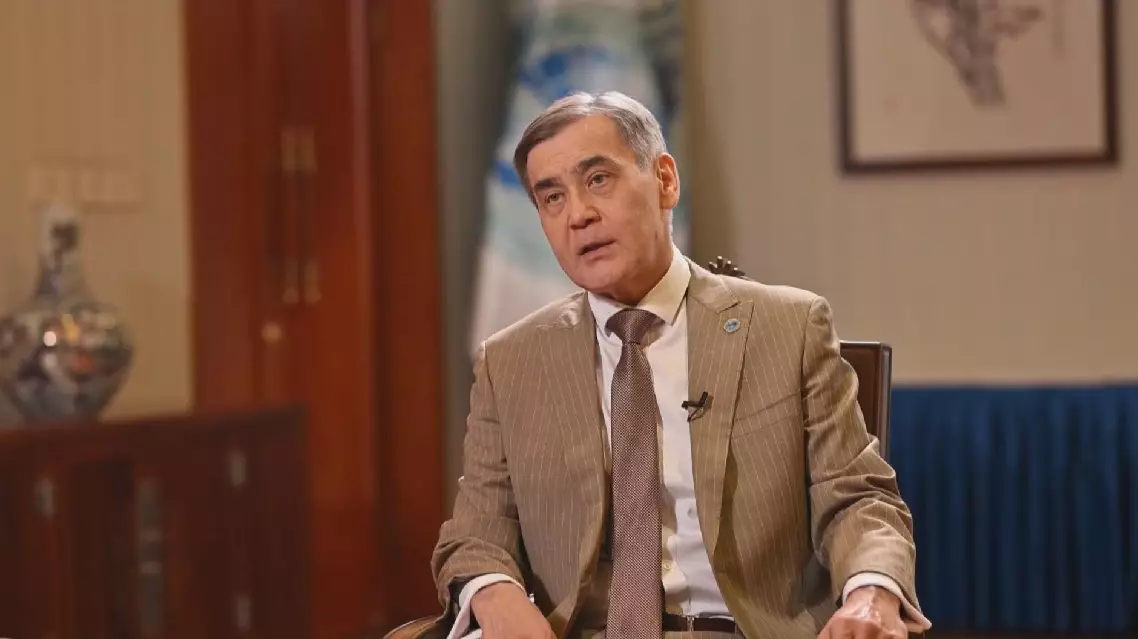
Sustainable development remains a shared priority for all member states of the Shanghai Cooperation Organization (SCO), as Kyrgyzstan's presidency carries forward the theme set by China last year, SCO Secretary‑General Nurlan Yermekbayev has said.
In an interview with China Global Television Network ahead of the upcoming SCO summit 2026 in Bishkek, Kyrgyzstan, Yermekbayev said that during China's 2025 rotating presidency, "sustainable development" was chosen as the theme, a focus that has continued into this year.
"When China was the rotating chair, it made 'sustainable development' the theme of its presidency. Since assuming the SCO's rotating presidency in September last year, Kyrgyzstan has adopted the theme '25 Years of the SCO: Together Towards Sustainable Peace, Development and Prosperity.' I personally find this slogan very appealing, and it is profoundly meaningful," Yermekbayev said.
"On the one hand, it reflects the 25‑year development journey of the SCO. On the other, every word carries significant meaning. 'Together' means we cooperate closely to tackle various challenges. 'Together Towards Sustainable' continues last year's theme of sustainable development. And peace, development and prosperity are the core goals that the SCO has always pursued," he said.
Founded in 2001 to address regional security concerns, the SCO has evolved into a broad-based organization covering security, economic cooperation, connectivity, digital development and cultural exchanges. Its 25th founding anniversary this year comes at a time when countries across the world are facing growing uncertainties, making regional cooperation and stability increasingly important.
For many observers, the SCO's biggest achievement over the past 25 years is not simply its expansion in size, but its demonstration that countries with different political systems, economic models and cultural traditions can find common ground through dialogue and cooperation.
Experts said the upcoming Bishkek summit will provide a new opportunity for member states to strengthen consensus, align development strategies and explore fresh areas of cooperation, helping bring more stability and certainty to the region and beyond.
Against this backdrop, Yermekbayev emphasized the importance of sustainable development for the SCO's next phase.
"During Kyrgyzstan's presidency, 'sustainable development' remains a key priority for all member states, because it is a broad issue that touches on many different areas," he said.
Sustainable development remains SCO priority under Kyrgyzstan presidency: secretary‑general