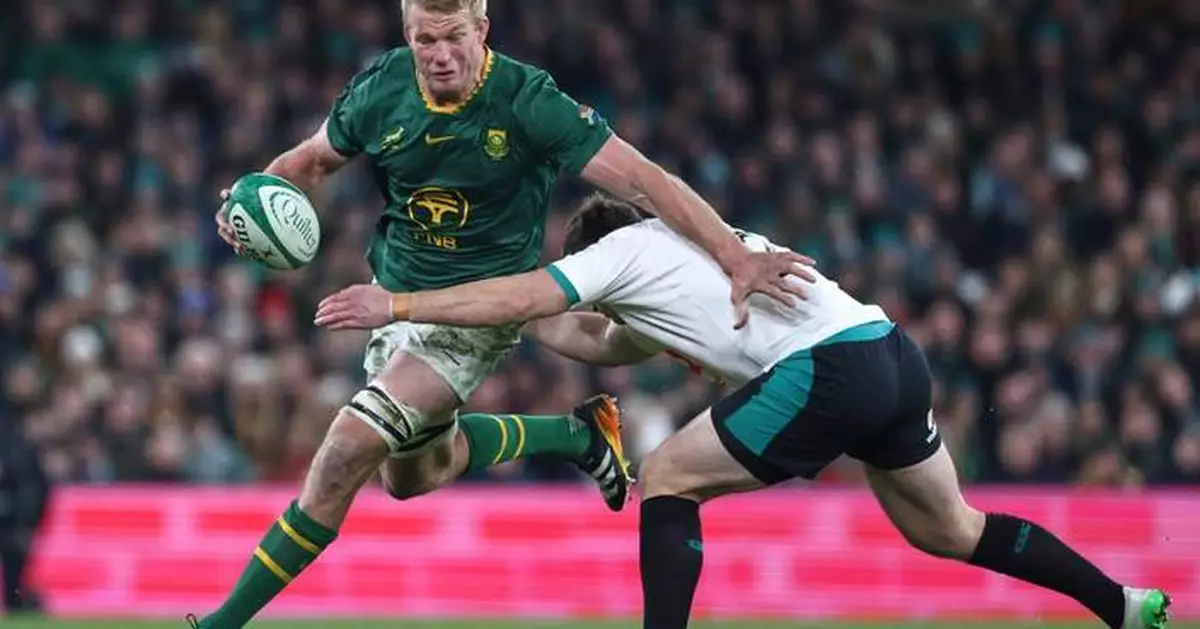
When Pieter-Steph du Toit came into the orbit of Rassie Erasmus, the new South Africa coach was not impressed.
It was 2018. Du Toit had already been a Springbok for five years and collected one domestic player of the year award. But Erasmus had never worked with or met him.
His take on Du Toit was someone who missed or slipped off too many tackles and ran too upright as a ball-carrier. Erasmus also took Du Toit's nonchalance as uncaring. At best, Erasmus thought Du Toit had utility value on the bench.
“I have never been as wrong about a player as I was with Pieter-Steph, and I have never been as pleased to be so wrong,” Erasmus told SA Rugby magazine.
On Saturday against New Zealand in Cape Town, Du Toit becomes the 11th man to play 100 tests for the Springboks and the sixth on Erasmus' watch as coach or director.
Erasmus was appointed in 2018 to resurrect South Africa after two humbling years. He wanted players who could make the Springboks respected and revered again, and it took only two training sessions for him to realize Du Toit was one of them.
Erasmus was gladly taken aback by Du Toit's commitment to the jersey, knowledge of the game, contributions, enthusiasm to learn and be challenged. He was first on, last off. He had to be forced to take a day off. Married to that were sharp instincts on the field, a willingness for dirty work, ability to get over the gainline and disrupt attacks with tackles that punished carriers.
The clincher for the coach was in September that year when, almost a year to the day after a 57-0 hiding from New Zealand in Auckland, they won in New Zealand for the first time in nine years. Du Toit made 24 tackles and cameras caught him in tears after the game.
Now, Erasmus can't drop him. His Bomb Squad packed with reserve forwards will replace captain Siya Kolisi before Du Toit, if at all. Du Toit's engine is legendary. He rarely plays less than the full 80 minutes in a test.
Du Toit wanted to be a great Springbok from a young age. He grew up on tales and mementos of his grandfather, Piet du Toit, nicknamed “Spiere,” or “Muscles” in Afrikaans. Piet anchored the Boks scrum in the successful home series against the 1960 All Blacks and on the 1960-61 Grand Slam tour of the home nations.
Du Toit was raised on the vineyard and olive groves bought by Piet in the 1950s and still farmed by the family an hour outside of Cape Town.
But his journey to greatness has been far from plain sailing.
He would have got to 100 tests much earlier but for a cracked sternum, lots of shoulder injuries and two reconstructed ACLs, the second for which he got a hamstring tendon from his father to hasten recuperation in time for the 2015 Rugby World Cup in England.
His World Cup debut was the infamous loss to Japan, the Miracle of Brighton. Du Toit was part of the fallout for being played out of position.
His worst injury was almost career-ending. A thigh hematoma in February 2020 became unbearably painful and he was under the knife that night. He had acute compartment syndrome, a dangerous buildup of pressure inside muscles.
The doctors' cut in his thigh was 40 centimeters long. Later, when nerves weren't responding, leg amputation was considered. But losing 10 kilograms helped to ease a fourth operation to close the wound.
At the time, Du Toit was a new World Cup champion and world player of the year.
In the 2019 final win over England, he made 20 tackles and asked forwards coach Matt Proudfoot afterward what he could improve.
“He's a no-nonsense guy who doesn't seek validation,” Proudfoot said. “He just wants to know what he's got to do. He doesn't say much but the group listens. He just puts it out there. Being a Springbok matters to him.”
Du Toit easily admits he's not a talker.
“I'm a strong believer in actions speak louder than words,” he said. “The way you perform on the field or the way you live your life must tell your story, ‘Okay, these are the morals of this guy.’ And if you can do that, nothing has to be said.”
But one time he did speak up was captured on video and proved inspirational.
South Africa was trailing England 12-6 at halftime in the 2023 World Cup semifinals in Paris. Erasmus left the changing room which fell unnaturally quiet. Du Toit stood up and asked his teammates if they were scared or wanted to fight, laced with obscenities.
When the speech appeared in “Chasing the Sun 2,” documenting South Africa's run to the title, Du Toit was worried his foul language might make kids think he wasn't a good role model.
In the final against New Zealand, Du Toit made a staggering 28 tackles without a miss and was named the player of the match.
Then-Springboks coach Jacques Nienaber joked, “If there's a white plastic bag that blows over the pitch, he'd probably chase that down as well.”
See AP’s full rugby coverage here
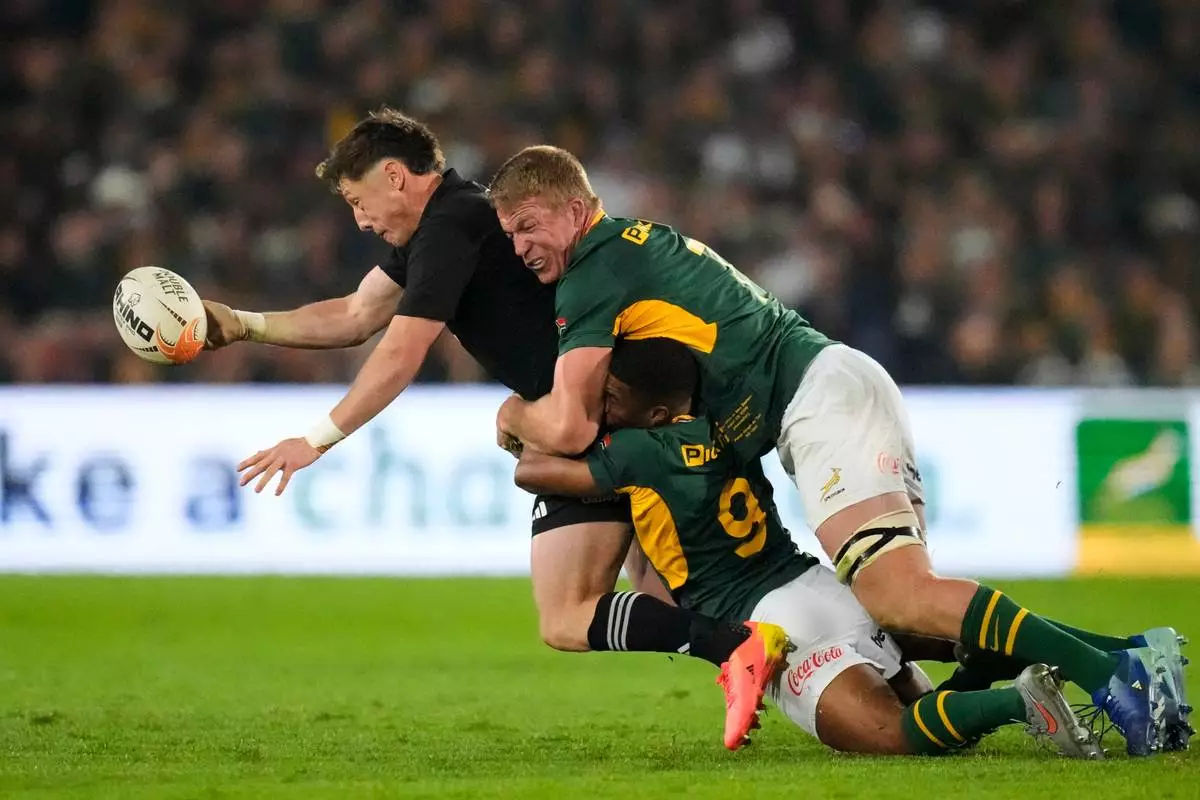
New Zealand's Cam Roigard, left, is tackled by South Africa's Grant Williams, center, and his teammate Pieter-Steph du Toit during a Test rugby match between South Africa and New Zealand, in Johannesburg, South Africa, Saturday, Aug. 22, 2026. (AP Photo/Themba Hadebe)

FILE - South Africa's Pieter-Steph du Toit is tackle by Ireland's Dan Sheehan during the rugby union Nations Series match between Ireland and South Africa in Dublin, Ireland, Nov. 22, 2025. (AP Photo/Peter Morrison, File)