Skip to Content Facebook Feature Image

Hospital Authority Clarifies $250 Fee for Diabetic Patients' Personalised Treatment Services Amid Social Media Criticism.

HK

Hospital Authority Clarifies $250 Fee for Diabetic Patients' Personalised Treatment Services Amid Social Media Criticism.
HK

HK

Hospital Authority Clarifies $250 Fee for Diabetic Patients' Personalised Treatment Services Amid Social Media Criticism.

2026-08-29 11:13 Last Updated At:11:28

Hospital Authority clarifies on social media post

The following is issued on behalf of the Hospital Authority:

In response to a social media post criticising a $250 fee charged to diabetic patients attending a talk and alleging overcharging, the spokesperson for the Hospital Authority (HA) made the following clarification today (August 29):

The $250 fee is not an admission fee for attending a talk, but rather a charge for personalised treatment services. Personalised treatment is an integral part of clinical services. The HA provides relevant services based on patients' clinical needs and charges according to the fee schedule gazetted by the Government. There is absolutely no overcharging involved.

Public hospitals provide different services tailored to patients' needs. The vast majority of health education services delivered through talks or activities fall under general health education services and are free of charge. For patients referred by doctors for personalised treatment, talks may be arranged as part of the treatment process, and such services are charged according to the established arrangements.

The relevant services are outlined below:

1. General Health Education Services — Free of charge

Organised by Patient Resource Centre in hospitals, health education talks and patient support group activities are held regularly to impart health and nursing knowledge. These activities are open to all patients, carers, and interested members of the public at no charge.

2. Personalised Treatment Services — $250 per follow-up consultation

Diabetic patients referred by doctors to allied health clinics for follow-up (such as dietetic services) fall under this category. Dietitians arrange appropriate assessments according to the patients' clinical conditions, formulate personalised dietary advice based on the assessment results, continuously monitor patients' compliance, and follow up on the treatment.

Generally, before receiving the service, patients are arranged to attend a talk where a dietitian explains essential dietary knowledge. Immediately following the talk, patients are seen by the dietitian to begin assessment and treatment. In other words, the talk is only the first step of the entire treatment process. Patients are subsequently provided with a series of services, including assessments, personalised advice, and continuous follow-up. This differs significantly from general online health information. The services provided by the HA incude clinical assessment for individual patients, tailor-made dietary advice, and progress monitoring.

In addition to dietetic services, Diabetic Nurse Clinics and Family Medicine Clinics also provide similar personalised treatments covering clinical assessment, exercise, personal health, and weight management. Talks are likewise arranged during the process to teach essential treatment and care knowledge.

Source: AI-found images

Source: AI-found images

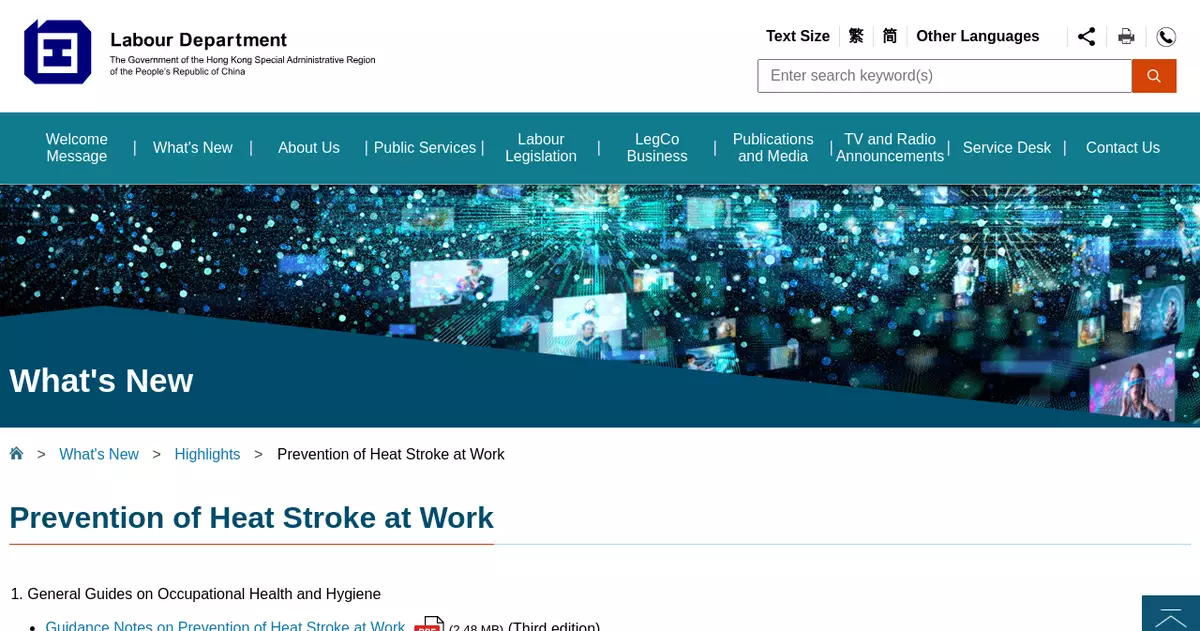
LD reminds employers and employees to take heat stroke preventive measures in times of Heat Stress at Work Warning

As the Heat Stress at Work Warning is now in effect, the Labour Department (LD) reminds employers and employees to take appropriate measures during the effective period of the warning to prevent heat stroke when working in hot weather or hot environments.

Employees who work outdoors or in non-air-conditioned indoor environments face high levels of heat stress and are at a relatively higher risk of heat stroke. Employers should assess the risk factors of heat stress for employees at work and, based on the identified risk factors, take necessary preventive and control measures, including rescheduling work periods, setting up shading covers, providing ventilation and heat dissipation equipment, and reminding employees to replenish water and rest in a timely manner.

The Heat Stress at Work Warning is formulated by the LD based on the Hong Kong Heat Index, measured temperatures generally over Hong Kong, and the "Extremely Hot Weather" Special Alert. There are three levels of the warning: Amber, Red and Black, which help employers and employees better understand the level of heat stress while working outdoors or indoors without air-conditioning systems.

A spokesman for the LD said that when the department issues the Heat Stress at Work Warning, employers must refer to the criteria and recommendations provided in the "Guidance Notes on Prevention of Heat Stroke at Work" to conduct risk assessments, according to the workloads and other relevant heat stress risk factors, for employees who work outdoors or in non-air-conditioned indoor workplaces. Appropriate rest breaks should be arranged every hour, as far as reasonably practicable, based on various levels of the Heat Stress at Work Warning, to reduce employees' risk of heat stroke.

Employees must also follow instructions to rest on time. Whenever there are any symptoms of heat-related illnesses, such as headache, dizziness, thirst, and nausea, they should rest in a cool and shady place, drink water, and inform employers/supervisors to take appropriate action immediately.

The LD issued the "Guidance Notes on Prevention of Heat Stroke at Work", detailing the various risk factors that should be considered when conducting heat stress risk assessments and recommending corresponding control measures for identified risk factors for employers' and employees' reference. For the Heat Stress at Work Warning and related guidelines, please refer to the department's thematic webpage: www.labour.gov.hk/eng/news/prevention_of_heat_stroke_at_work.htm.

Source: AI-found images

Source: AI-found images

Recommended Articles