Experts are sounding the alarm over an escalating "chain effect" of glacier-related disasters on the Qinghai-Xizang Plateau, where accelerating ice loss is turning isolated collapses into cascading catastrophes that demand stronger forecasting and better-coordinated response.
The alert follows an ice-rock avalanche originating from a high-mountain glacier in Nepal that triggered a devastating mudslide striking Gyirong Port in southwest China's Xizang Autonomous Region on Wednesday.
Glacier-related hazards are emerging as a critical challenge on the plateau. As of 2025, the region hosts over 109,000 glaciers, more than half within China, according to results from the country's second scientific expedition to the plateau. However, global warming is steadily shrinking them, and that retreat brings new dangers.
"Historically, this region had much larger glaciers, but as the climate warms, they've been steadily retreating. When a glacier withdraws to higher, steeper ground, gravity-driven fractures grow, deformation accelerates, and meltwater seeping into the ice-rock interface drives increasingly rapid slides downhill," said Hu Kaiheng, researcher at the Institute of Mountain Hazards and Environment under the Chinese Academy of Sciences.
Research by the Chinese Academy of Sciences shows that global warming-driven glacial lake outburst floods averaged 15.2 per year from 2011 to 2020, triple the annual average of 5.2 recorded in the 1980s. As glaciers retreat and lakes swell, the risks of outburst floods and collapses are rising in tandem.
"We've observed that the Qinghai-Xizang Plateau is warming at twice the global average. It's extremely sensitive to global climate change --- effectively a sensor and amplifier of it. Over the past few decades, glacial lakes in the region have grown by about 20 percent, in both number and area. So going forward, we need to keep a close watch on lakes that are at risk of bursting, especially those that could potentially trigger a chain of mudslides and floods. Those should be our top priority," said Fan Xuanmei, director of the State Key Laboratory of Geohazard Prevention and Geoenvironment Protection.
Fan stressed the need to shift from single-disaster response to integrated chain monitoring.
"We're no longer dealing with single disasters. This is a chain-reaction problem. So we must develop monitoring and early warning systems that cover the entire process, from source to downstream, and install monitoring at every link to enable full-process surveillance and alerts," said the expert.

Experts warn of cascading glacier hazards as melt accelerates on Qinghai-Xizang Plateau
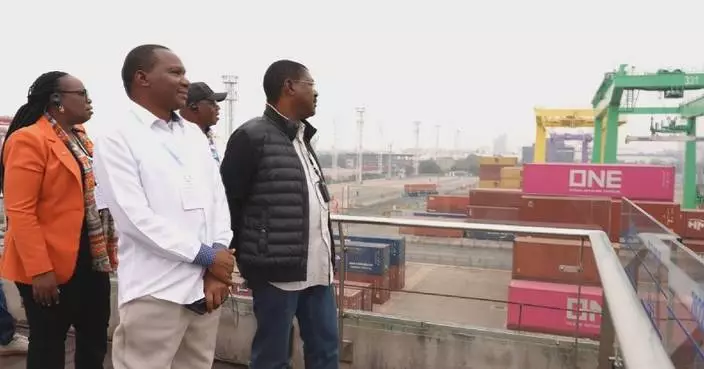
Kenya's National Assembly Speaker Moses Wetang'ula has highlighted the transformative impact of infrastructure cooperation with China, noting how projects like the Mombasa-Nairobi Standard Gauge Railway and the Port of Lamu are reshaping trade and creating new opportunities for local talent.
Built by the China Road and Bridge Corporation, the roughly 480-kilometer railway links the coastal city of Mombasa with the capital Nairobi, cutting passenger travel to under five hours and speeding the flow of cargo to and from the country's main seaport. The Port of Lamu, on Kenya's northern coast, is the centerpiece of a planned transport corridor connecting Kenya with South Sudan and Ethiopia.
Wetang'ula made the remarks in an interview with China Media Group (CMG) in north China's Tianjin Municipality, where he attended the 2026 Legislators Forum for Friendly Exchanges.
He stressed that a port alone cannot drive an economy without proper supporting infrastructure. The Port of Mombasa, he said, serves a vast and resource-rich hinterland, yet cannot function effectively without an efficient rail system, a well-developed road network and adequate airport links.
For decades, he noted, the port had relied on an aging railway built in 1896 by the colonial authorities before Kenya's independence. It was against this backdrop that Kenya sought a partnership with China.
"With the changing times, the growth of international trade, the expansion of our exports, the growing volume of our imports and our neighbors imports, it came to our attention that, one, we need to expand in the port of Mombasa, which we have done consistently. But when we found that the room for expansion was running out, we teamed up with China as a partner to develop a new port, port of Lamu, better located, with a natural deep harbor. That means no dredging. And it is now operational. Second, it dawned upon us that for us to have quick movement of stocks, goods and everything, you need a modern efficient rail line. We then engage with China to develop a standard gauge railway. From Mombasa to Nairobi and beyond to Uganda. This will then serve the new port of Lamu, the old port of Mombasa and any other requirements for export facilities that we may create along our coastline," he said.
The speaker also highlighted the human dimension of the cooperation, recalling that Chinese experts had worked alongside their Kenyan counterparts on the railway until local staff were ready to take over.
"Chinese experts who are on the rail line working hand in hand with Kenyans. To pilot the trains from Mombasa to Nairobi, whether there are goods trains or passenger [trains]. The last time I used the standard gauge railway from Nairobi to Mombasa, that's in December 2024, there were no more Chinese experts. The transition was over. And now we have Kenyan train pilots with Kenyan coxswains. We have Kenyan attendants on the train. And how did it happen? A part of the engagement we had with China was to train our young people, so we recruited the young Kenyans who came to China on a class program to train as train drivers or train captains, as train attendants and in various sections where there is goods or passengers. And they are really good. They're really good, because I have tested their services and their services are good," he said.
Over the years, Chinese-built projects -- from the Mombasa-Nairobi railway to the Port of Lamu and the Nairobi Expressway -- have helped Kenya and its neighbors build more convenient trade corridors. Cooperation between the two countries has since expanded from infrastructure into manufacturing, technology and talent development, delivering tangible benefits to both peoples.
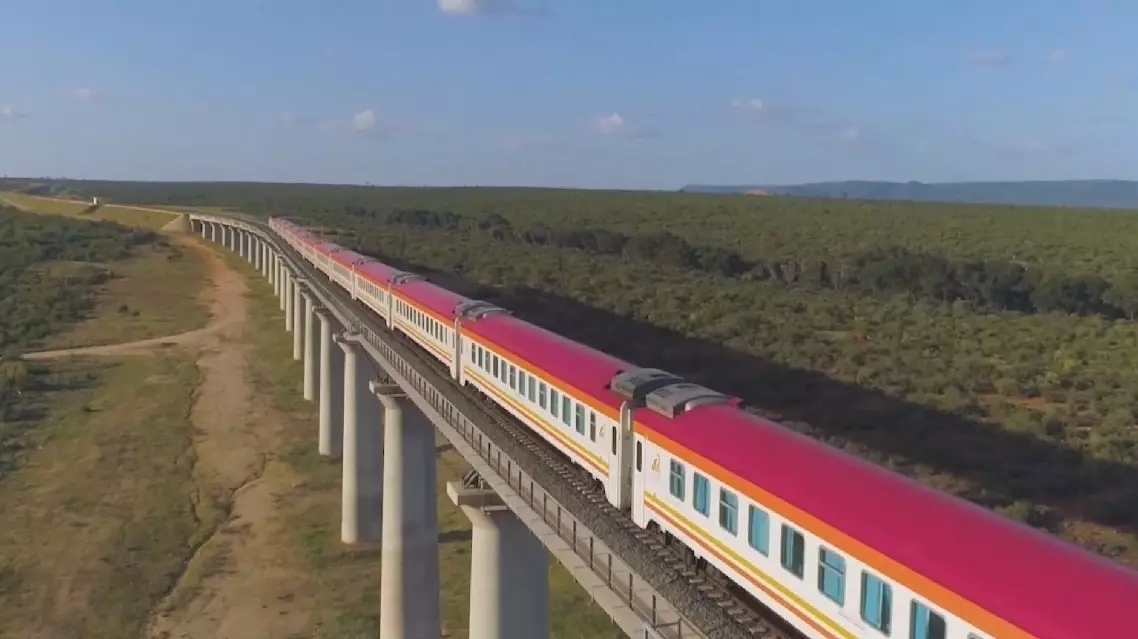
Kenya's National Assembly Speaker highlights transformative infrastructure cooperation with China