
MOESER, Germany (AP) — An election in eastern Germany on Sunday could produce the first far-right state governor in the country's post-World War II history as Chancellor Friedrich Merz and his unpopular national government struggle to dispel what he calls “widespread moroseness.”
Several polls show a large lead for the anti-migration Alternative for Germany, or AfD, ahead of the election to the state legislature in Saxony-Anhalt. Taking control of a state government would be the biggest prize in the party’s 13-year history, a political shock to Germany and at least a symbolic blow to Merz.
Click to Gallery
Supporters applause to Ulrich Sigmund, the top candidate for the "Alternative for Germany" (AfD) party in the state elections in Saxony-Anhalt, during his speech at a campaign barbecue hosted by the party in Moeser, Germany, Thursday, Aug. 13, 2026. (AP Photo/Markus Schreiber)

Ulrich Sigmund, the top candidate for the "Alternative for Germany" (AfD) party in the state elections in Saxony-Anhalt, speaks to The Associated Press at a campaign barbecue hosted by the party in Moeser, Germany, Thursday, Aug. 13, 2026. (AP Photo/Markus Schreiber)

Sven Schulze, the governor of Saxony-Anhalt state and the center-right Christian Democratic Union's top candidate in the upcoming state election, poses with a beer near Hop Queen Katharina at the Hop Day Photo in Beesenstedt, Germany, Aug. 19, 2026. (Heiko Rebsch/dpa via AP)

Ulrich Sigmund, the top candidate for the "Alternative for Germany" (AfD) party in the state elections in Saxony-Anhalt, takes photos with supporters at a campaign barbecue hosted by the party in Moeser, Germany, Thursday, Aug. 13, 2026. (AP Photo/Markus Schreiber)

Ulrich Sigmund, the top candidate for the "Alternative for Germany" (AfD) party in the state elections in Saxony-Anhalt, enters the stage at a campaign barbecue hosted by the party in Moeser, Germany, Thursday, Aug. 13, 2026. (AP Photo/Markus Schreiber)
“If AfD wins the election and forms the government, that would be kind of breaking a taboo in Germany,” said Wolfgang Merkel, a political science professor with the WBZ Berlin Social Science Center. Modern Germany so far has been “an exception” in Europe in having no radical right-wing party governing at the national, state or big-city level, he added.
Merz’s center-right Christian Democratic Union has led Saxony-Anhalt, a region west of Berlin that's among the country’s less prosperous and is home to 2.1 million of Germany's 83.5 million people, since 2002. But it faces strong headwinds.
In last year’s national election, AfD achieved the best postwar showing by a far-right party, with 20.8% of the vote. It became Germany’s biggest opposition party.
It was stronger in the ex-communist east, including Saxony-Anhalt. And with Merz's government struggling to convince voters it can turn around a stubbornly slow economy, it has gained in national polls as it harnesses discontent with issues beyond its signature theme of curbing migration.
In Saxony-Anhalt, AfD is seeking an absolute majority in the state legislature. That would overcome the so-called “firewall” of mainstream parties’ refusal to work with AfD, whose regional branch is one of several classified by the domestic intelligence agency as a proven right-wing extremist group. AfD vehemently rejects accusations of extremism.
AfD’s campaign slogan is “Everything is possible.”
“This is a historic opportunity that we have here in Saxony-Anhalt,” its candidate for governor, Ulrich Siegmund, told The Associated Press at a campaign event in the small town of Moeser, where supporters lined up to meet the charismatic 35-year-old over beer and sausages. “We will write history here."
Among his top priorities, Siegmund lists “the deportation of people who are illegal, a deportation offensive and above all dropping the incentives for why people come here and exploit our social system.” He wants to initiate a long process to withdraw Saxony-Anhalt from the regional public broadcaster, citing concerns about “disinformation.”
AfD’s first and so far only head of a county administration was elected in 2023 in neighboring Thuringia state. A state administration would be a far bigger prize, fueling the party's ambitions of further gains and one day governing at the national level.
Germany’s 16 states have extensive powers, for example in overseeing security matters and running the education system.
In Saxony-Anhalt, AfD wants to allow home schooling, which so far isn't permitted in Germany. It pledges to ban schools from officially raising the rainbow flag and ensure they fly the national flag. It opposes taxpayers' money being “given away” to Ukraine and says it would push to lift sanctions against Russia, but that isn't a matter state governments can decide.
“No one here needs to be afraid, quite the contrary,” Siegmund said. “Every honest person in Saxony-Anhalt will benefit from an AfD-led government.”
Siegmund's main opponent, incumbent governor Sven Schulze from Merz’s CDU, told the AP at his party's offices in Magdeburg, the state capital, that AfD “wants the past back” and the state would face “isolation” with AfD in power.
He pointed to major progress made in strengthening Saxony-Anhalt's economy and bringing down unemployment since Germany was reunited in 1990. The far right, he said, effectively “doesn't want to have anyone here who was born abroad and lives and works here.” With many immigrants working in hospitals and companies, for example, that would be “a huge problem for Saxony-Anhalt,” he said.
“AfD does one thing — it describes problems,” said Schulze, who said that he won't work with the party and his own CDU is “100%” behind him. “But it never has a solution for a problem.”
AfD's chances of governing are uncertain even if it does become by far the strongest party. If it doesn't win an absolute majority, Merkel said he doesn't see it governing for lack of any potential coalition partner.
That likely would leave Schulze trying to cobble together some kind of alliance with multiple smaller parties to his left. That would leave many people saying that “they are clinging to power,” Merkel said.
It remains unclear how an AfD victory in Saxony-Anhalt would affect the national government, particularly if Merz’s CDU and its coalition partners, the center-left Social Democrats, fare poorly in elections Sept. 20 in Berlin and Mecklenburg-Western Pomerania, another eastern state.
Merkel said he believes Saxony-Anhalt is too small to have “any particular impact.” But a significant loss of votes would amplify a narrative that the traditional big parties are in decline.
Merz's government needs to prove its ability to reform Germany and so far lacks “visible successes,” Merkel added, noting that “when the economy isn't running, basically all areas of politics are infected.”
Merz sought to spread optimism after his Cabinet met last week to underline its determination to push through reforms.
“We must get out of this climate of glumness and anger,” he said. “Together, we must shake off this widespread moroseness that has long paralyzed our country.”
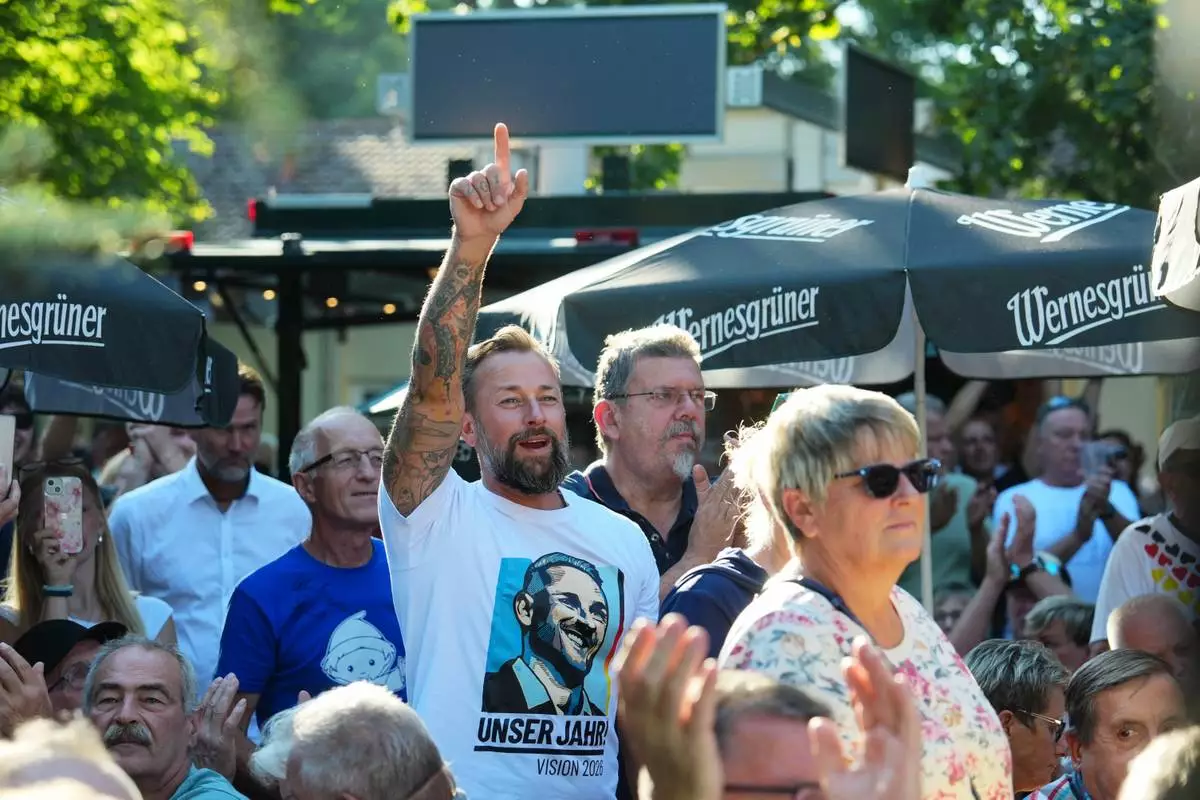
Supporters applause to Ulrich Sigmund, the top candidate for the "Alternative for Germany" (AfD) party in the state elections in Saxony-Anhalt, during his speech at a campaign barbecue hosted by the party in Moeser, Germany, Thursday, Aug. 13, 2026. (AP Photo/Markus Schreiber)
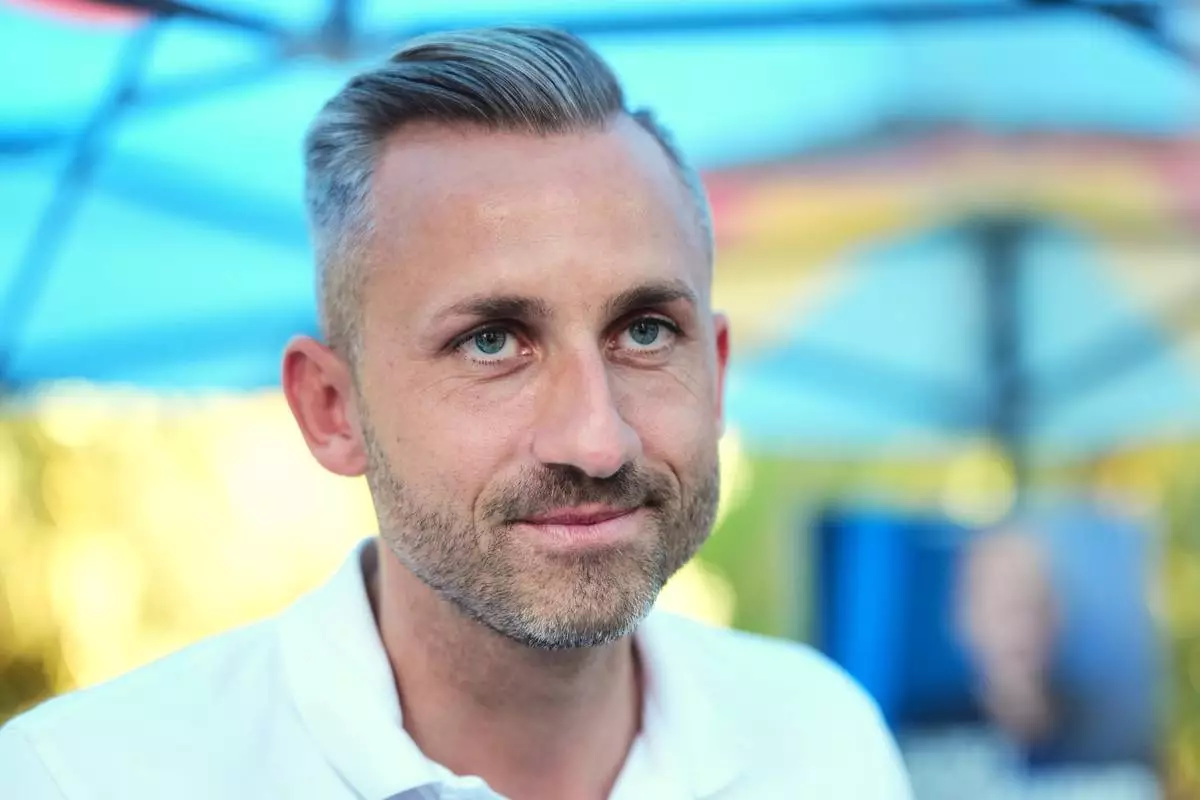
Ulrich Sigmund, the top candidate for the "Alternative for Germany" (AfD) party in the state elections in Saxony-Anhalt, speaks to The Associated Press at a campaign barbecue hosted by the party in Moeser, Germany, Thursday, Aug. 13, 2026. (AP Photo/Markus Schreiber)

Sven Schulze, the governor of Saxony-Anhalt state and the center-right Christian Democratic Union's top candidate in the upcoming state election, poses with a beer near Hop Queen Katharina at the Hop Day Photo in Beesenstedt, Germany, Aug. 19, 2026. (Heiko Rebsch/dpa via AP)

Ulrich Sigmund, the top candidate for the "Alternative for Germany" (AfD) party in the state elections in Saxony-Anhalt, takes photos with supporters at a campaign barbecue hosted by the party in Moeser, Germany, Thursday, Aug. 13, 2026. (AP Photo/Markus Schreiber)

Ulrich Sigmund, the top candidate for the "Alternative for Germany" (AfD) party in the state elections in Saxony-Anhalt, enters the stage at a campaign barbecue hosted by the party in Moeser, Germany, Thursday, Aug. 13, 2026. (AP Photo/Markus Schreiber)