Custom workflows help studios reduce repeated production steps while maintaining character and visual consistency across a full series
Project-specific pipelines can shorten turnaround times, lower production overhead and reduce unnecessary regeneration
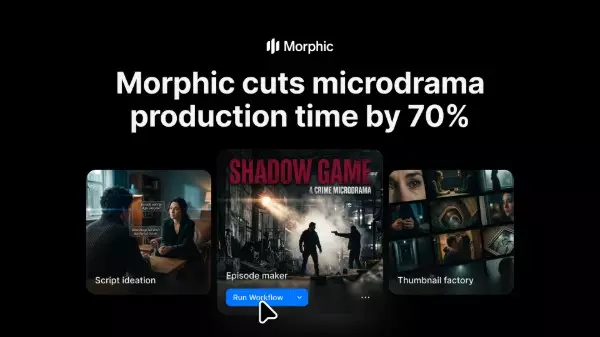
SAN FRANCISCO, Aug. 31, 2026 /PRNewswire/ -- Global AI video platform Morphic today reported that custom workflows built on its platform can reduce repetitive manual work by up to 70%, while helping studios maintain character and visual consistency across an entire series.
Microdrama seasons often span dozens of short-form episodes, commonly around 60 to 100. While generative AI has accelerated footage creation, many of the steps that follow remain highly manual: maintaining character consistency, realigning visual styles, repeating generation settings and preparing outputs for delivery. Across a full series, those repeated tasks can become a significant production bottleneck.
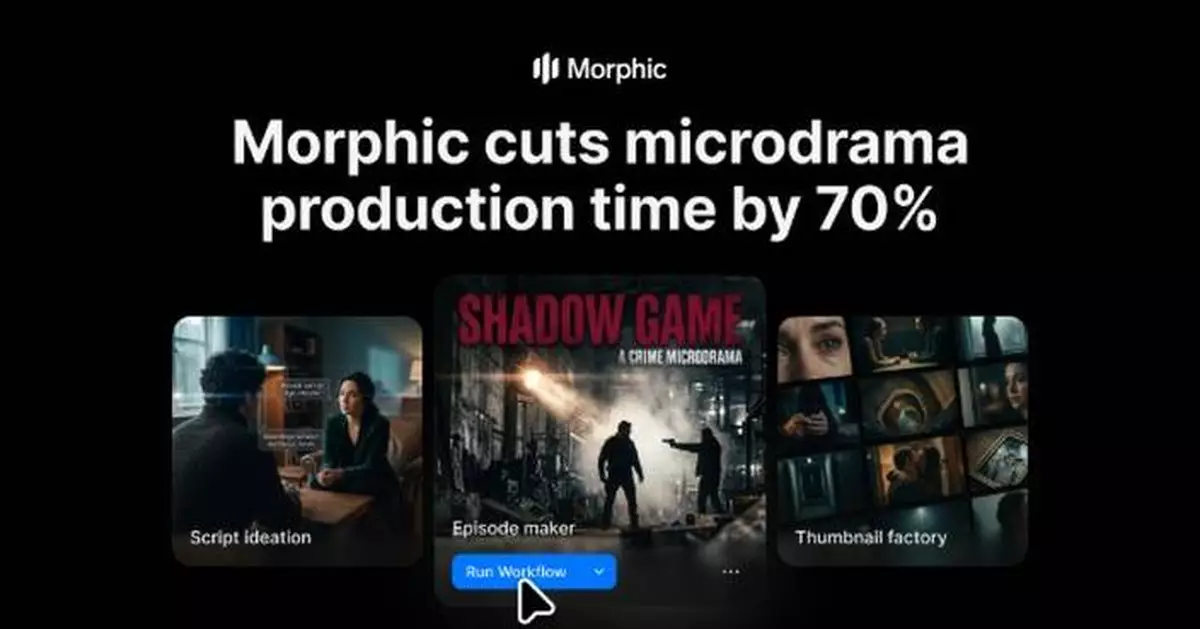
Morphic addresses this by allowing studios to turn recurring production steps into reusable workflows. Teams can define project-specific settings for character setup, scene composition, visual style and output requirements, then reuse those settings across episodes rather than rebuilding the process from scratch each time.
Once configured, a workflow allows teams to carry character, style and production settings across multiple episodes, reducing repeated prompting and manual adjustments. Changes to recurring elements can also be incorporated into the workflow itself, helping studios manage consistency across longer episodic runs.
For select studio engagements, Morphic's in-house creative team has also worked with clients to design project-specific workflows. The team produces Morphic original projects, including Lights Out and Pappu Express, using the platform in its own production process. That experience helps inform which production steps are useful to automate and where consistency is most likely to break across repeated episodes.
According to Morphic's internal production benchmarks, repetitive image-to-image, image-to-video and frame-to-video steps can be reduced by up to 70% in workflows designed around recurring episodic production. By reducing the number of manual passes required across a season, these workflows can shorten production turnaround and lower the operational cost of repeated generation and revision.
Internal customer data also shows roughly 20% less wasted credit usage on average in project-specific workflows, largely from reducing failed retries and unnecessary regeneration.
"In microdrama, the instinct is to compete on speed and volume," said J.D. Kanani, CEO of Morphic. "But viewers stay for consistency and quality across every episode. Studios often spend a significant amount of time repeating production steps rather than making creative decisions. Reusable workflows help remove that overhead and give production teams more time to focus on the story."
Microdrama producers in the United States, India and Korea are using Morphic workflows for episodic production. Work created on the platform has also received recognition and screenings at the World AI Film Festival (WAIFF), WAIFF Japan and the Mumbai AI Film Festival.
Morphic plans to continue expanding its capabilities for AI-assisted microdrama and film production, including workflows designed around specific production formats and recurring creative processes.
About Morphic
Morphic is a global AI video creation platform built for professional storytellers, animation studios, and enterprise production teams. Combining an infinite canvas, collaborative multi-agent workflows, and enterprise governance controls, Morphic provides an end-to-end pipeline that transforms creative concepts into commercial-grade final videos. For more information, visit morphic.com.
** This press release is distributed by PR Newswire through automated distribution system, for which the client assumes full responsibility. **
Morphic Cuts Microdrama Production Busywork by Up to 70% While Ensuring Series Consistency
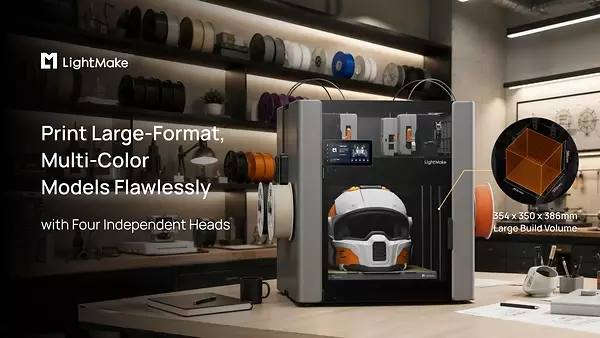
SHENZHEN, China, Sept. 1, 2026 /PRNewswire/ -- LightMake today has launched L4, a professional desktop 3D printer with four independent print heads powered by linear motors. It prints up to four models at once, blends four materials in a single print, and reaches travel speeds of 1,000 mm/s with a maximum print speed of 500 mm/s. The L4's optimized toolhead movements under vibration-damping mechanism also provide stability, resulting in a lower failure rate.
By replacing traditional belts with a vibration-damping linear motor system, the L4 delivers highly stable, low-failure printing.
Key Features
4 Independent Print Heads System
The L4's four print heads operate independently, allowing four copies of a model to be produced in the time a single-head printer takes to produce one. For multi-material work, the heads can combine up to four filaments in a single print.
Because each head carries its own material, the L4 provides zero filament waste during color changes, unlike a single-nozzle printer that must extrude materials to clear the previous color, reducing filament waste by over 79%. Toolhead changes take just one second, saving valuable time in the studios, as the latest market solutions need at least five seconds.
Industry-first Adoption of Linear Motors
In most 3D printers, stepper motors and rubber belts move the print head. The L4 uses electromagnetic force to drive each head directly along a track.
This allows the L4 to operate significantly faster at a travel speed of up to 1000mm/s, with a maximum print speed of 500mm/s.
The linear motors also deliver ±1μm motion precision to largely eliminate unwanted ghosting and ringing. With a stable 50,000-hours printing service life, it is also far more durable than traditional desktop printers.
Extra-Large Build Volume
With a 354 × 370 × 386 mm build chamber for single-colour jobs and 354 × 350 × 386 mm for full-colour output, the L4 is engineered for scale. To maximize throughput, users can also print four models in parallel, with each part measuring up to 177 × 195 × 386 mm.
Stability & Vibration-Damping
The L4's Vibration Cancellation Algorithm counteracts the forces generated at high speed by coordinating toolhead movement across the X and Y axes so that opposing motions cancel one another, thereby improving stability and print smoothness.
An integrated die-cast frame ensures high-speed precision, while four toolheads independently lift 5 mm to improve first-layer levelling success and reduces the risk of a failed print.
AI-Driven Smart Control
For print farm users, Smart Cluster Management and Smart AutoQueue tools can dispatch jobs to up to 1,000 machines, automatically allocating printers to meet a given deadline.
L4's integration with OpenClaw enables creators to build a one-person studio through WhatsApp. Users can manage print jobs across an entire print farm and fully leverage AI capabilities.
Pricing and Availability
Pre-orders for LightMake L4 are now available immediately on Kickstarter, starting at $1,299 for super early-bird discount. L1 is available at $1,099. Initial shipment date is expected to be in Q4 2026. Back the project during the early-bird stage and save up to $1,100 versus MSRP: claim your spot now while early pricing lasts, plus save on shipping in the first 48 hours of the launch.
About LightMake
LightMake Co., Ltd. is a technology company pioneering high-quality, streamlined desktop 3D printing solutions. The LightMake team brings together experienced professionals from 3D printing, consumer tech, and precision engineering backgrounds, along with founder Vic Wang who was formerly senior executive at Anker and Huawei. They operate with a global focus, empowering makers, studios, educational institutions and SMBs worldwide with professional-grade 3D printing technology. Guided by a design philosophy of efficiency, simplicity, and sustainability, LightMake develops streamlined applications that break down the barriers between inspiration and creation.
Visit: https://lightmake.tech/
** This press release is distributed by PR Newswire through automated distribution system, for which the client assumes full responsibility. **
LightMake Unveils L4: A Linear Motor-Powered, Independent Four-Head Desktop 3D Printer