BEDFORD, Mass.--(BUSINESS WIRE)--Aug 31, 2026--
Recent inquiries linking invisibility cloaks to reverse-engineering have prompted Fractal Antenna Systems’ (“FRACTAL”) CEO Nathan Cohen to issue a statement of record. Electromagnetic cloaking technology was not reverse engineered from extraterrestrial, recovered, or undisclosed technology, nor from any secret government program. While not tied into ETs, the cloaking story itself reads like science or detective fiction but is anchored in fact.
This press release features multimedia. View the full release here: https://www.businesswire.com/news/home/20260831562325/en/
Cohen is the inventor of the invisibility cloak. His unique scientific background may explain the speculation. An astrophysicist and retired Boston University professor, he conducted SETI efforts and doctoral research involving gravitational lenses and transcontinental antenna arrays at Cornell University, where Frank Drake was his Ph.D. advisor. He later became a pioneer in fractal antennas, metamaterials, and invisibility cloaking. Cohen has received nearly 100 U.S. patents and is an expert in innovation. His honors include the Arno Penzias and Lee DeForest awards and he continues cutting-edge research and technological development into the present day.
“This hard-earned background and experience overlap with several of the public touch points featured in recent UFO commentaries, documentaries and books,” Cohen said. “That overlap has apparently connected me and the invisibility cloak to claims involving hush-hush government reverse engineering programs. Incorrect. The invisibility cloak has a lineage and no ETs.”
Cloaking’s early path was sparse but founded on metamaterials: close-packed resonators engineered for unusual effects. Metamaterials have roots extending back more than a century, from a 1919 patent by Guglielmo Marconi and his colleague. Years later, partial concealment with repeated resonant metamaterials was a feature of a U-2 spy plane, an early attempt at stealth.
More than four decades later, Cohen conducted government-funded metamaterials research on close-packed antenna arrays, followed by a separate experiment where he curved a fractal-based metamaterial microwave array back on itself and saw substantial “front scatter”. Front scatter is the physical basis for cloaking. Thanks to fractal resonators, his invention documented in U.S. Patent No. 7,256,751, he recognized that the strong “evanescent surface-wave” mechanism could be engineered to route electromagnetic energy around an object across a broad frequency range.
The invisibility cloak was first claimed in 2006 by David Schurig and Duke/Imperial College colleagues. Their experiment was widely cited (a citation cascade) and publicly acclaimed. But doubts were justified: in 2007, Min Yan and colleagues in Sweden concluded the Duke device remained visible and thus unhidden. And replication of that Schurig-device by the Duke team showed a modest reduction in scattering of only 24 percent (1.2 dB) over 2.3 percent bandwidth. The Duke device had been called an invisibility cloak, but it did not achieve anything near invisibility. Curiously, despite these contrary results, the widely repeated claim of the ‘first invisibility cloak’ has never been formally corrected in the scholarly metamaterial or popular accounts. This uncorrected consensus is thus at odds with the corrected facts.
Cohen provides a perspective on this contradictory scenario (also see accompanying ‘Cohen’ image): “A submarine designed for 24% under water is not a submarine. Or take the airplane. We don’t credit Samuel Langley for the airplane for nosediving his Aerodrome into the Potomac River. Ultimately, inventions must deliver the goods. Airplanes need to fly. And think Harry Potter: invisibility cloaks need to cloak, at least letting the background substantially be ‘see through’ as it passes around an object. That is where invention—and credit—begin. The Duke device was not an invisibility cloak as no object was hidden.“
Put succinctly, Cohen says: “The Duke device was the first published cloak experiment, not the first experimental cloak. It failed as a cloak.”
Additional cloaking efforts by Varadan and colleagues, and by Smolyaninov et al., followed the Duke work, but neither established a functioning invisibility cloak. Varadan’s 2007 experiment used resonant metamaterial sheets to shield metal objects, while Smolyaninov’s 2008 plasmonic structure demonstrated wave diversion around a central region, but did not quantitatively demonstrate invisibility. These were important cloaking experiments, but not experimental invisibility cloaks meeting a functional requirement.
A cloak must perform the cloak function, not merely be called one.
Who was first then, if not the Schurig research team? Established guidance on priority reveals that attempting an invisibility cloak is not the same thing as its realization. Invention means an actual device that performs the invisibility-cloak function, not merely a theory or an unsuccessful approximation. The Duke device was an attempt but did not work for its intended purpose. There is no ‘24% cloak’. Oddly, patents for ‘perfect cloaks’ (restoration of the wave on the other side) were issued many years later but have never been demonstrated. These are patents on what can never be built, owing to physics restrictions shown by M. I. Abdelrahman and colleagues in 2021.
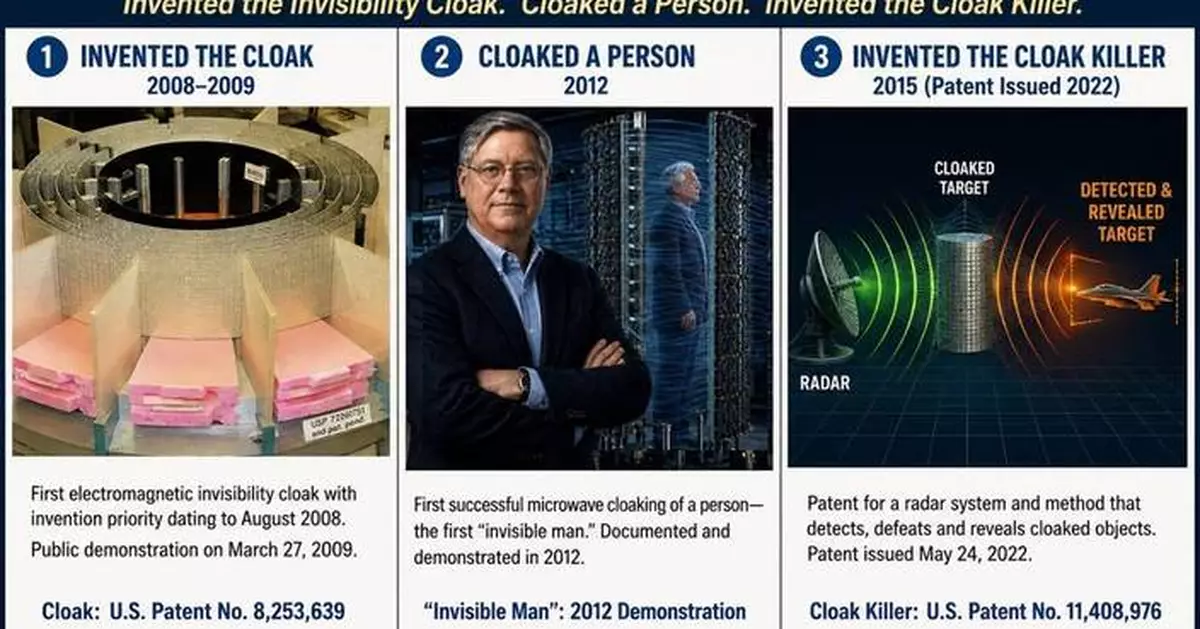
Cohen’s priority for the first realization of the electromagnetic invisibility cloak dates to 2008 with a fractal resonator array system that achieved good to excellent fidelity invisibility over a broad microwave frequency range. The working cloak was publicly disclosed in March 2009 (and witnessed by colleagues from the Air Force in April 2009), received wide media coverage, and was featured on a PBS television broadcast in that year. No prior, publicly disclosed electromagnetic invisibility cloak meeting the functional standard existed. Cohen puts perspective on the situation: “I delivered the goods: it performed the cloak function, and others followed.” Video of Cohen’s original invisibility cloak in operation is available here: Fractal Metamaterial Wideband Invisibility Cloak.
Cohen’s work was documented with patents, scholarly publications, follow-up publicly released videos, and public demonstrations. Cohen’s 2008 patent filing issued in 2012 as U.S. Patent No. 8,253,639. Remarkably, also in 2012, Cohen cloaked a person at microwaves, the first “invisible man”, realizing a fantasy previously confined to science fiction. See: CLOAKING A MAN--NOW A REALITY! The invisibility cloak invention and its development history are also described in Microwave Journal. See: Wideband Omnidirectional Microwave Cloaking — Microwave Journal https://www.microwavejournal.com/articles/23631-wideband-omnidirectional-microwave-cloaking.
Forgotten in the cloak story is the ethical dilemma of its use. Cohen also patented a radar countermeasure to invisibility cloaking with U.S. Patent No. 11,408,976. “Cloaking is a Pandora’s box. Counter-cloaking spells control over how cloaking technology is used. A human invented the cloak, and the same human forced the question of what it means to use one. Note ‘human’. Calling an invention ‘reverse engineered’ from extraterrestrials is over the top: the invisibility cloak did not arrive in a crate of a crashed UFO and it was created on my doorstep.”
Adds Cohen: “Discoveries and inventions are not determined by fantasy, opinions, or consensus, but by the clock and whether it executes the intended purpose. The facts shown here are final and without repeal. Inventors enhance the human condition, and people need to respect human talent and recognize its value without shifting the wonder into space and beyond who we are.”
About Fractal Antenna Systems: FRACTAL is based in Bedford, Massachusetts and develops advanced antenna, array, metamaterial, space, and electromagnetic technologies for commercial and government applications. Its OWL WORKS advanced concepts team provides innovative technologies for enhancing the human condition. Founded in 1995, the firm attained and retains a major footprint in technology advancement.
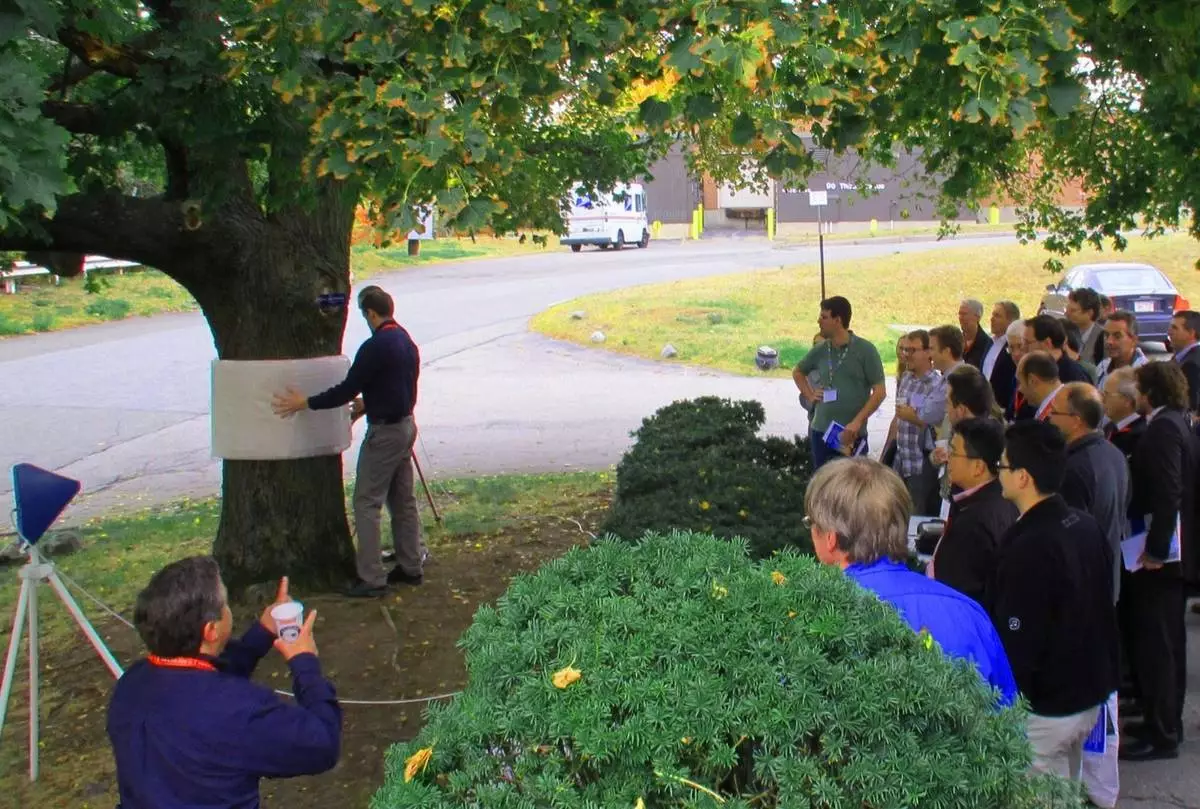
Public demonstration of a large invisibility cloak, showing the cloaking structure being positioned around a tree before an audience. This demonstration, where this portion of the tree disappeared at microwaves, was arranged and witnessed by radar boffin Dr. Eli Brookner, the IEEE Phased Array Conference participants -- and the mailman. Brookner championed Cohen’s invention until his death in 2021.
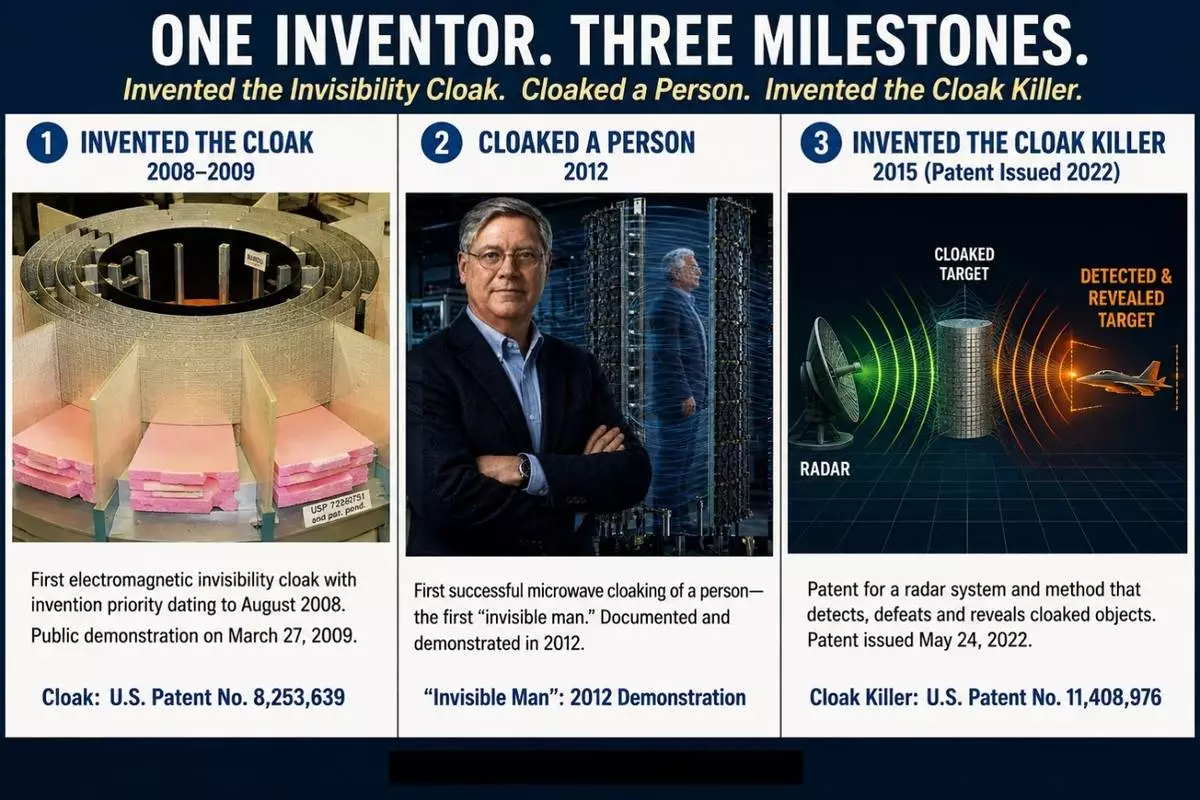
The invisibility cloak inventor, Nathan Cohen, created and shaped technology’s major milestones: inventing the cloak, cloaking a person, and developing the countermeasure. Here his image (middle) is shown as the ‘first experimental Nathan Cohen’ where AI rendered Cohen with 24% accuracy. His wife did not recognize him.