Skip to Content Facebook Feature Image

India’s power demand is surging, but some solar energy is going to waste

News

India’s power demand is surging, but some solar energy is going to waste
News

News

India’s power demand is surging, but some solar energy is going to waste

2026-09-02 09:31 Last Updated At:09:40

BENGALURU, India (AP) — When India’s power demand surged at the height of summer, the country struggled to meet evening needs as air conditioners ran longer amid hotter nights. Despite this demand, some renewable energy providers were told to limit their output because the country had more clean electricity available than its grid could safely handle.

In the last 15 months, India curtailed nearly 11 terawatt-hours of solar generation — enough electricity to power about 10 million homes, according to government data and research by energy think tank Ember. That solar power went unused even as extreme heat and poor monsoon rains drove up demand for power in India for cooling and pumping groundwater for agriculture.

More Images
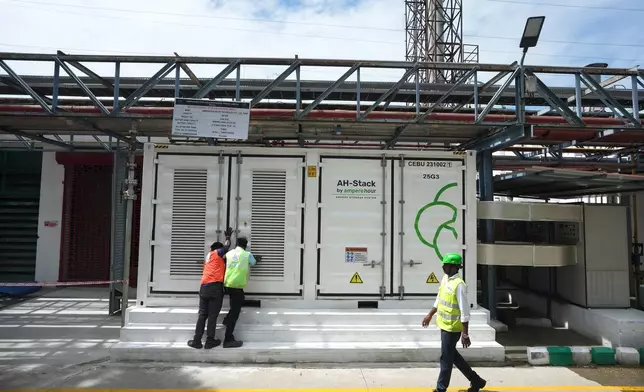
FILE - Team leader K. Sridhar, center, closes the doors after a routine check of lithium-ion batteries of 500-kilowatt battery energy storage system in Thiruvallur District, on the outskirts of Chennai, India, July16, 2024. (AP Photo/Mahesh Kumar A., File)
FILE - Team leader K. Sridhar, center, closes the doors after a routine check of lithium-ion batteries of 500-kilowatt battery energy storage system in Thiruvallur District, on the outskirts of Chennai, India, July16, 2024. (AP Photo/Mahesh Kumar A., File)

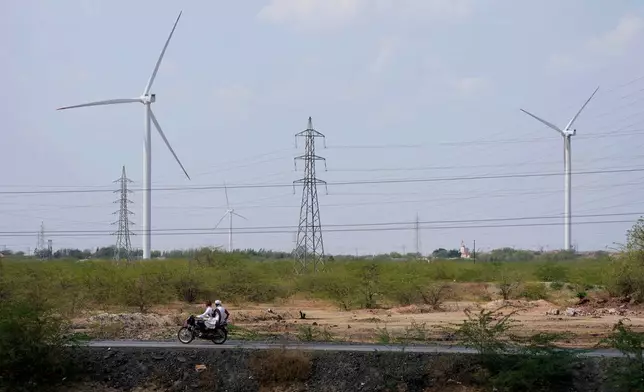
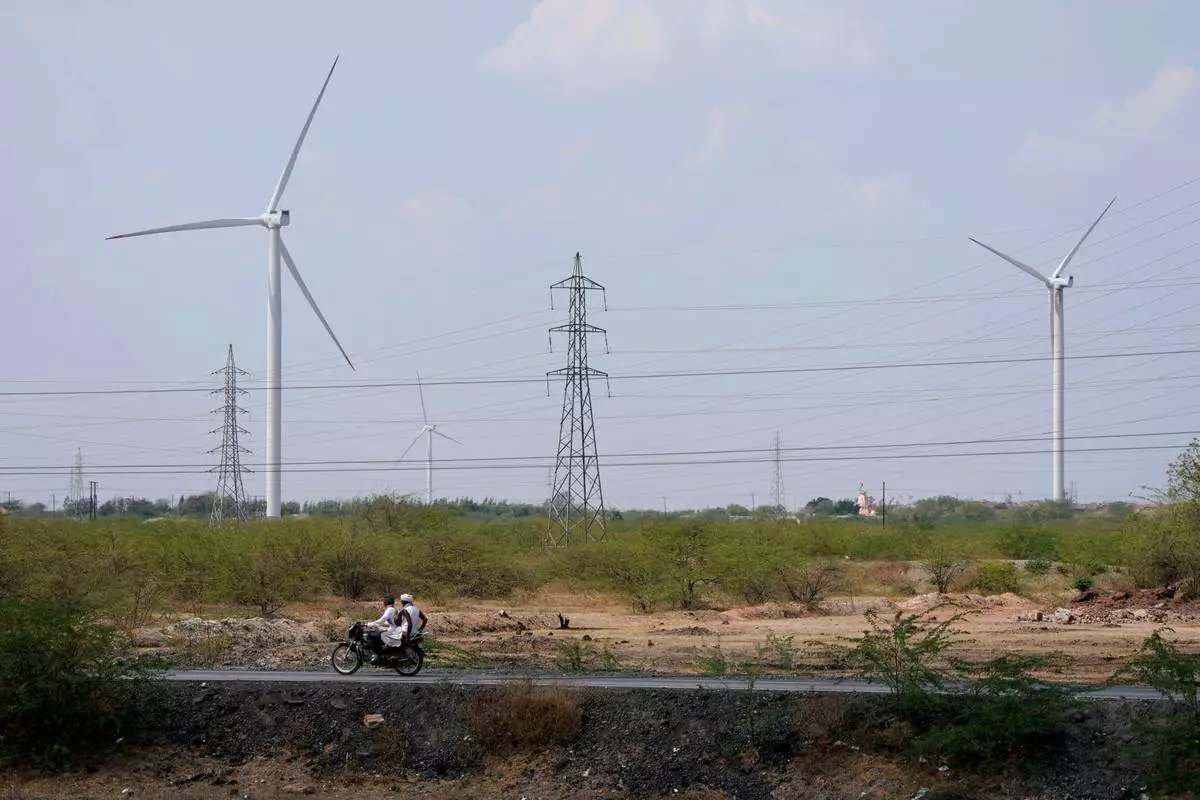
FILE - A motorcyclist ride past wind turbines, an Adani Group project, near Sadla village in Surendranagar district of Gujarat state, India, March 20, 2023. (AP Photo/Ajit Solanki, File)
FILE - A motorcyclist ride past wind turbines, an Adani Group project, near Sadla village in Surendranagar district of Gujarat state, India, March 20, 2023. (AP Photo/Ajit Solanki, File)

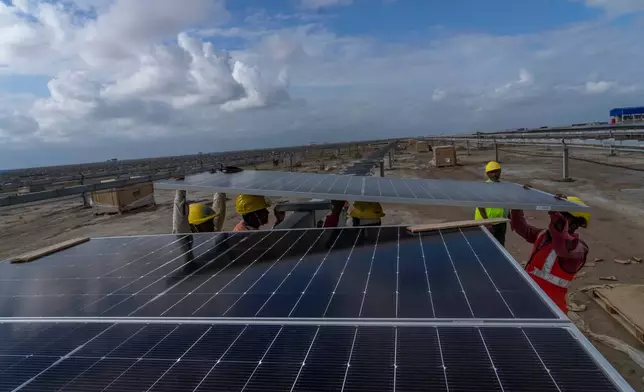
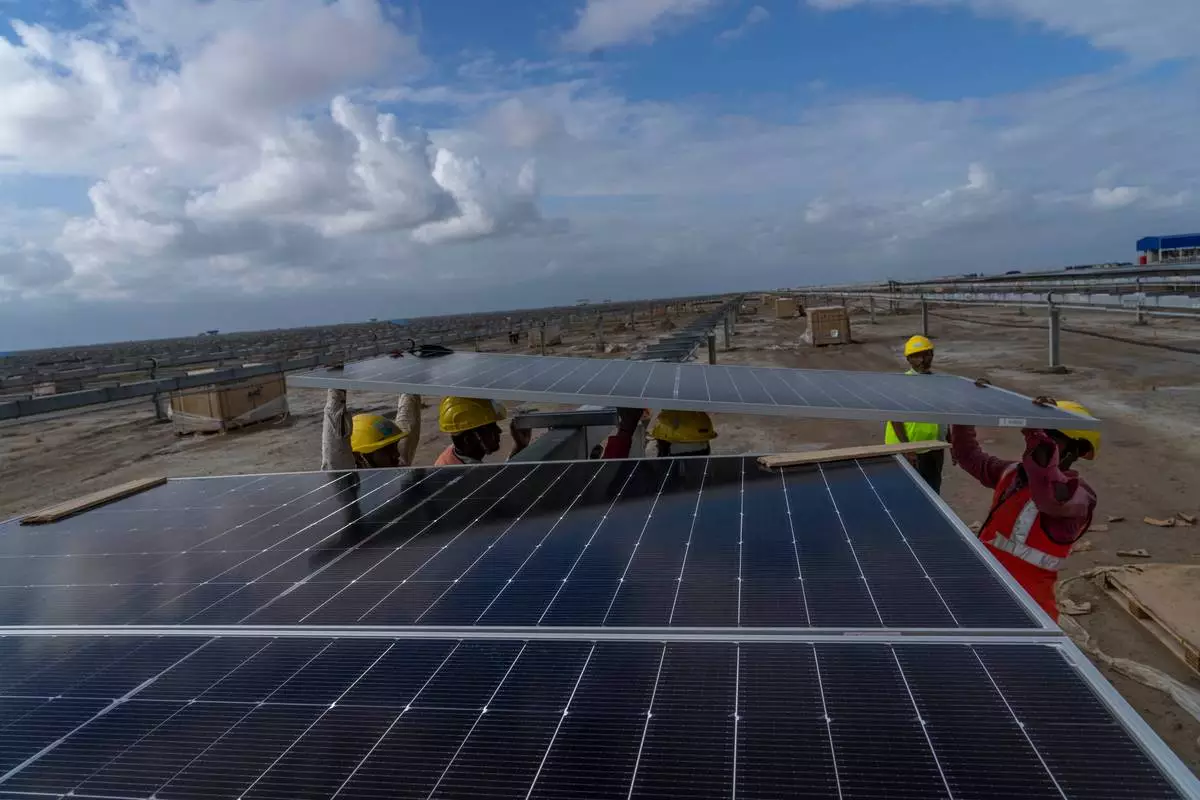
FILE - Workers install solar panels at the under-construction Adani Green Energy Limited's Renewable Energy Park in the salt desert of Karim Shahi village, near Khavda, Bhuj district near the India-Pakistan border in the western state of Gujarat, India, Sept. 21, 2023. (AP Photo/Rafiq Maqbool, File)
FILE - Workers install solar panels at the under-construction Adani Green Energy Limited's Renewable Energy Park in the salt desert of Karim Shahi village, near Khavda, Bhuj district near the India-Pakistan border in the western state of Gujarat, India, Sept. 21, 2023. (AP Photo/Rafiq Maqbool, File)

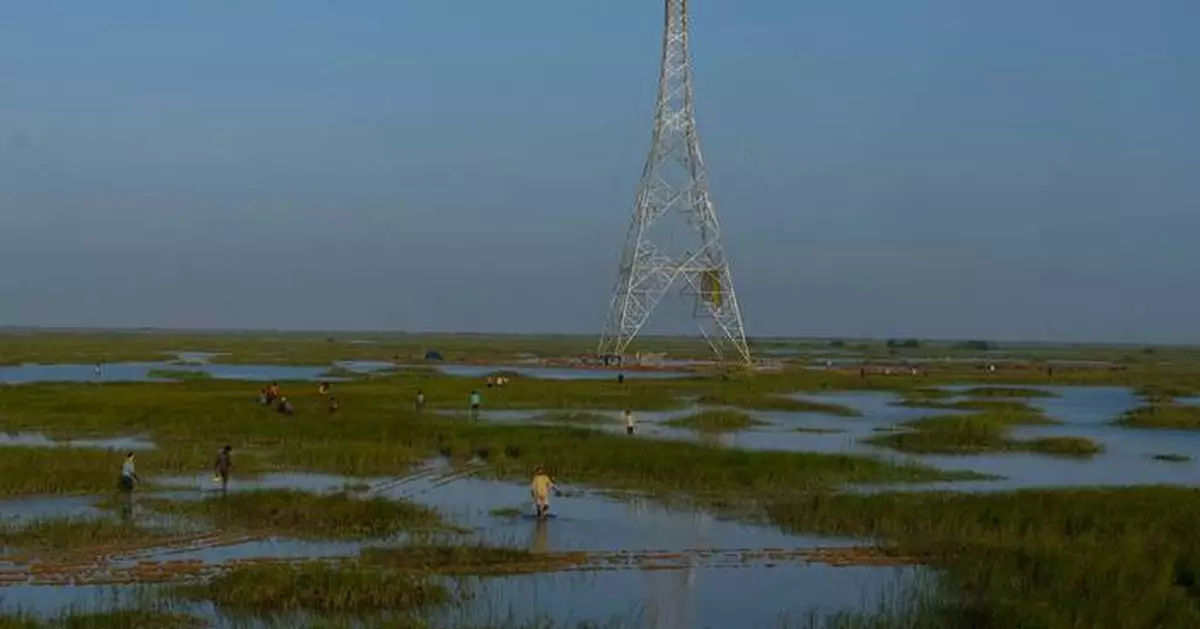
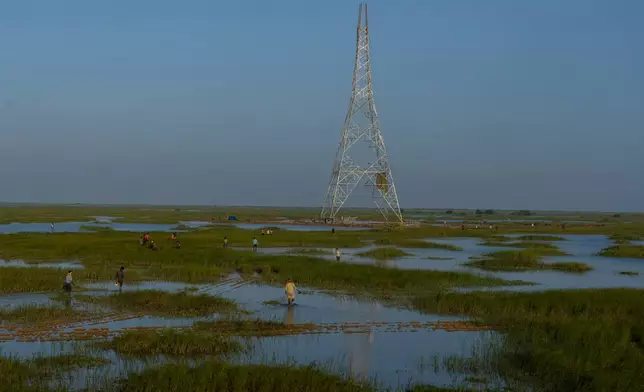
FILE - Workers walk through a swamp to install electric transmission towers for the Adani Renewable Energy Park near Khavda, Bhuj district, near the India-Pakistan border in the western state of Gujarat, India, Sept. 21, 2023. (AP Photo/Rafiq Maqbool, File)

FILE - Workers walk through a swamp to install electric transmission towers for the Adani Renewable Energy Park near Khavda, Bhuj district, near the India-Pakistan border in the western state of Gujarat, India, Sept. 21, 2023. (AP Photo/Rafiq Maqbool, File)

India, the world’s most populous country and one of the largest emitters of climate-polluting gases, is rapidly adding clean energy, especially solar, to its power mix. However, it can't use all the clean power it could generate because of insufficient transmission and storage capacity and the technical difficulty of shifting between fossil power and renewables.

Energy experts say that contradiction points to the next big challenge for India’s energy transition. Building solar and wind farms is no longer enough. India also needs more transmission lines to move electricity across the country, batteries to store renewable power until it is needed and a more flexible power system that can quickly adjust as wind and solar output rises or falls.

“We’re in a stage where some of the biggest hurdles in renewables are starting to hit us,” said Neshwin Rodrigues, an energy analyst at Ember.

India has more than 300 gigawatts of clean power capacity, more than half its total installed electricity capacity. But coal still produces most of the country’s electricity.

Experts said the main reason for this is curtailment — when a wind or solar plant could produce electricity but is ordered to reduce or stop generation as the grid cannot take the power.

Rodrigues said that when solar generation surges in the afternoon, it's difficult for coal units to reduce their output because they are relatively inflexible and cannot ramp down quickly without compromising efficiency, increasing costs or risking operational problems.

Trying to make thermal power plants flexible and adapt to increasing supply from clean energy sources “is like asking an elephant to dance,” said Vinay Pabba, CEO of Hyderabad-based renewable energy company Vibrant Energy.

Pabba said curtailment results in losses for clean power developers. “We get paid only for what we put on the grid,” he said.

The high concentration of renewable generation in western India has also meant that transmission lines in that part of the country get congested quickly. The western states of Gujarat and Rajasthan account for nearly 50% of India’s solar power capacity.

“When solar peaks, usually in the afternoon, there is a limited pipe to evacuate it,” said Pabba.

Another risk of not building storage quickly is that dirty fuels get used more. “Without enough storage, India risks keeping coal plants running even when cheap renewable power is available,” said Vibhuti Garg, South Asia director at the Institute for Energy Economics and Financial Analysis.

While a solar or wind farm can sometimes be completed within two years, building new power lines can take a minimum of three years, according to energy experts.

India has achieved only about 80% of its annual transmission construction targets over the past five years, research by Ember has found.

Spreading more renewable development across other parts of the country, while adding more wind and smaller local solar projects, could reduce pressure on crowded transmission corridors and make the electricity supply more balanced throughout the day, said Disha Agarwal, an energy analyst at the New Delhi-based Council on Energy, Environment and Water.

Agarwal said the challenge is likely to become more difficult as renewable capacity keeps rising.

India is aiming for 500 gigawatts of clean electricity capacity by 2030. Also, Indian policymakers expect nearly 70% of India’s installed power capacity to come from nonfossil sources by 2036.

A study released earlier this month by the India Energy and Climate Center at the University of California, Berkeley, found that renewable power backed by batteries can provide electricity with reliability approaching that of conventional power plants at a price researchers said is lower than the price of power from new coal-fired plants.

Batteries make it possible to store solar electricity when it is abundant in the afternoon and discharge it after sunset, when demand remains high.

But India’s storage sector remains far smaller than what planners said will eventually be required.

“If we try to increase the solar installations without solving for energy storage, it is only going to lead to curtailment,” said Ankit Mittal, CEO of battery storage company Ingro Energy.

Mittal said India is trying to transform several parts of its electricity system simultaneously as power demand rises. “Things that were supposed to happen over decades” are now happening at once, he said.

The government said in July that it had about 3 gigawatts of battery storage and 7.4 gigawatts of operational pumped-storage capacity. It expects India's storage needs to reach about 74 gigawatts by 2032.

“If high quality energy storage projects are not built, we could be adding an additional layer of risk to grid operations while also decelerating our nation’s ability to achieve our energy transition targets,” said Avinash Rao, CEO of Mahindra Susten, a leading renewable energy company in India.

Rodrigues, the energy analyst, said batteries can be built much more quickly than major transmission infrastructure, making them one of the fastest options for easing some immediate constraints.

Industry stakeholders said that few, if any, foresaw the incredible increase in demand happening as the country’s transportation and other major sectors electrify and data centers are built.

“None of us saw it coming. If we had seen it coming, we would have probably planned our way around it,” said Pabba of Vibrant Energy.

Sibi Arasu can be followed on X at @sibi123. Reach him at sarasu@ap.org.

The Associated Press’ climate and environmental coverage receives financial support from multiple private foundations. AP is solely responsible for all content. Find AP’s standards for working with philanthropies, a list of supporters and funded coverage areas at AP.org.
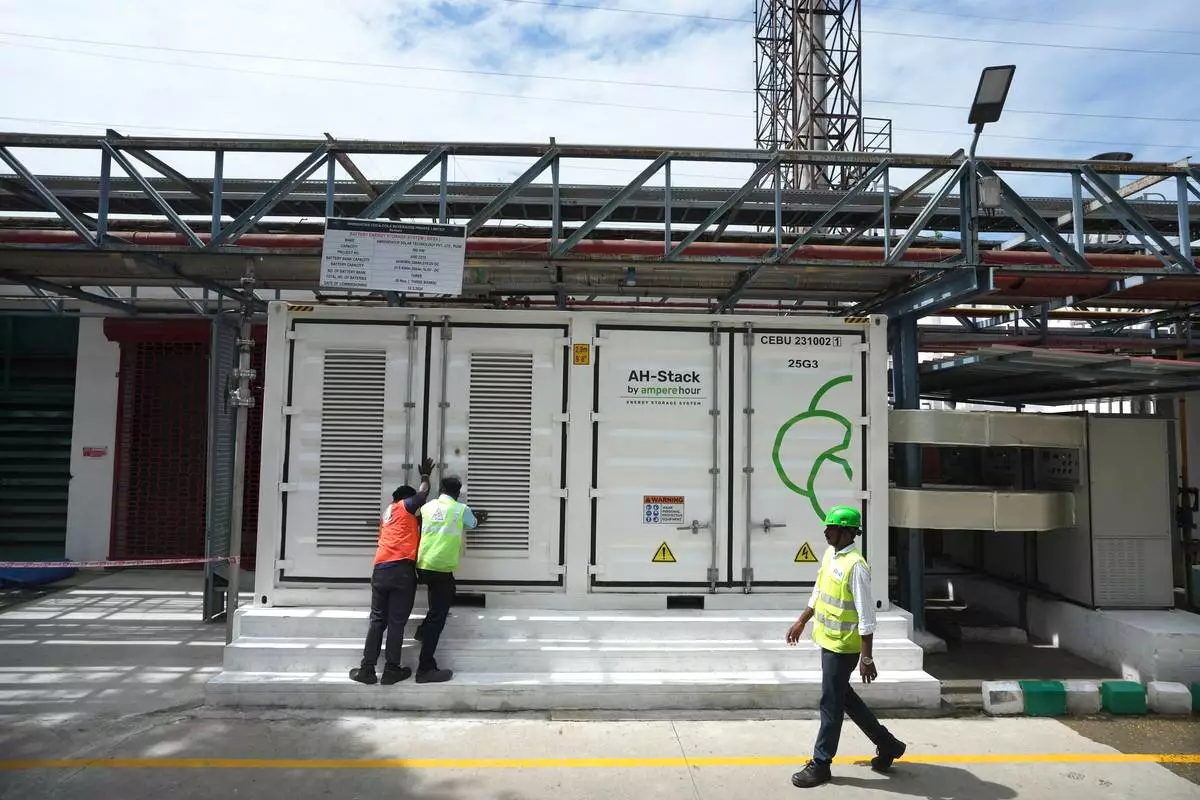
FILE - Team leader K. Sridhar, center, closes the doors after a routine check of lithium-ion batteries of 500-kilowatt battery energy storage system in Thiruvallur District, on the outskirts of Chennai, India, July16, 2024. (AP Photo/Mahesh Kumar A., File)
FILE - Team leader K. Sridhar, center, closes the doors after a routine check of lithium-ion batteries of 500-kilowatt battery energy storage system in Thiruvallur District, on the outskirts of Chennai, India, July16, 2024. (AP Photo/Mahesh Kumar A., File)

FILE - A motorcyclist ride past wind turbines, an Adani Group project, near Sadla village in Surendranagar district of Gujarat state, India, March 20, 2023. (AP Photo/Ajit Solanki, File)
FILE - A motorcyclist ride past wind turbines, an Adani Group project, near Sadla village in Surendranagar district of Gujarat state, India, March 20, 2023. (AP Photo/Ajit Solanki, File)

FILE - Workers install solar panels at the under-construction Adani Green Energy Limited's Renewable Energy Park in the salt desert of Karim Shahi village, near Khavda, Bhuj district near the India-Pakistan border in the western state of Gujarat, India, Sept. 21, 2023. (AP Photo/Rafiq Maqbool, File)
FILE - Workers install solar panels at the under-construction Adani Green Energy Limited's Renewable Energy Park in the salt desert of Karim Shahi village, near Khavda, Bhuj district near the India-Pakistan border in the western state of Gujarat, India, Sept. 21, 2023. (AP Photo/Rafiq Maqbool, File)

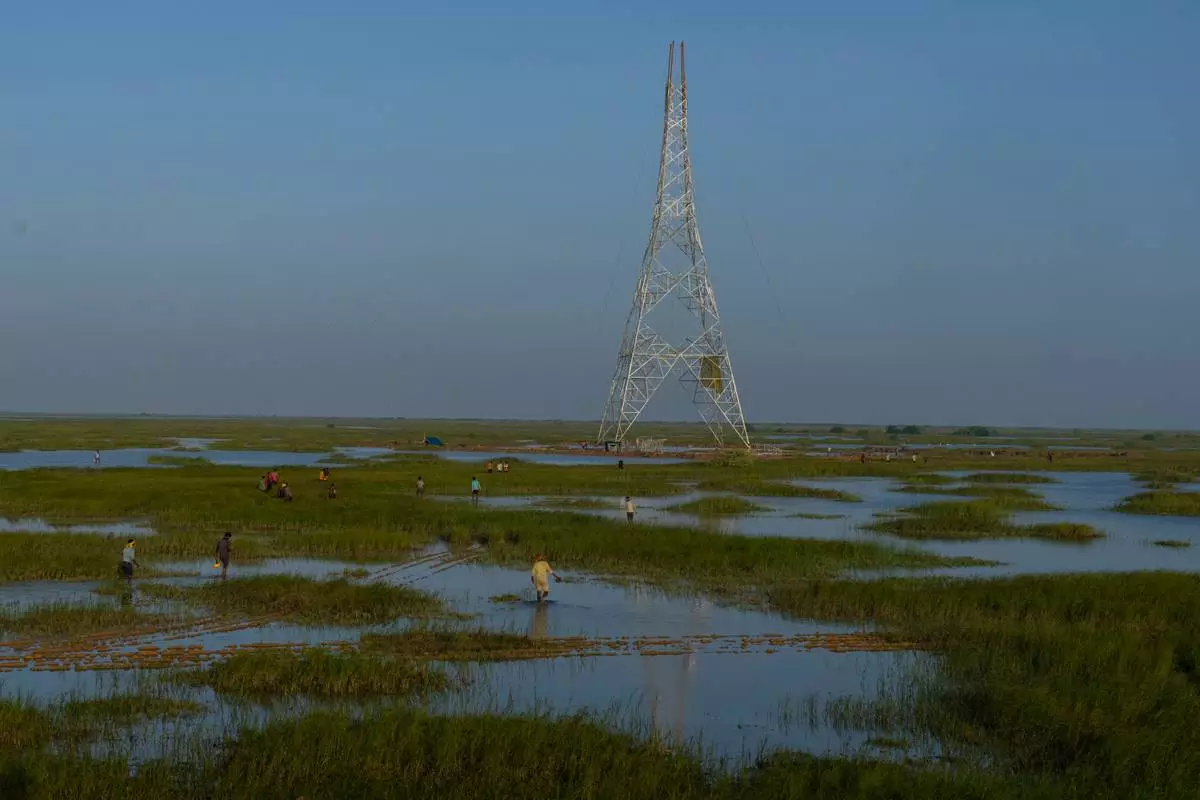
FILE - Workers walk through a swamp to install electric transmission towers for the Adani Renewable Energy Park near Khavda, Bhuj district, near the India-Pakistan border in the western state of Gujarat, India, Sept. 21, 2023. (AP Photo/Rafiq Maqbool, File)

FILE - Workers walk through a swamp to install electric transmission towers for the Adani Renewable Energy Park near Khavda, Bhuj district, near the India-Pakistan border in the western state of Gujarat, India, Sept. 21, 2023. (AP Photo/Rafiq Maqbool, File)

The U.S. Postal Service is poised to launch a hastily built, error-riddled computer system that could jeopardize the process of mail voting relied upon by one-third of all voters, according to a whistleblower statement released Tuesday by Democratic Sen. Richard Blumenthal.

The effort is part of the implementation of President Donald Trump's executive order limiting mail voting and has been temporarily halted by a federal judge. The ruling is being appealed by the administration and the directive may ultimately end up back before the U.S. Supreme Court.

The disclosure from the unidentified whistleblower contends that the Postal Service has been scrambling to try to build a complex system that would normally take a year or more in only three months, sometimes in defiance of the judge's orders halting work. The goal is to have it ready for use in the midterm elections.

The disclosure contends that, due to the new procedures, a single scanning error in a batch of tens of thousands of ballot envelopes could prevent any from reaching voters. It details a system that election officials have already warned could not be implemented before the first mail ballots begin going out Friday in North Carolina.

“The Postal Service has designed a system to disenfranchise millions of Americans,” Blumenthal told reporters in advance of releasing the whistleblower information. “This administration seems hell-bent on changing the framework on casting ballots in this country clearly for political reasons.”

Trump’s executive order, signed in March, directed U.S. Citizenship and Immigration Services and the commissioner of the Social Security Administration to develop state citizenship lists and then required the Postal Service to send mail ballots only to voters who are on such a list. Ballot envelopes would have to comply with new Postal Service rules and include barcodes.

The online portal that is the subject of the whistleblower complaint is intended for states to deliver their lists of verified voters to the Postal Service.

The Postal Service released a statement Tuesday evening in response to Blumenthal's letter, pledging to work with Congress and the courts. It noted that the judge who issued the latest restraining order explicitly allowed the service to continue to develop its online tool for states that want to use it voluntarily.

“Regardless of political party or perspective, we share a common goal: ensuring that Americans can have confidence that their election mail will be handled securely and delivered reliably,” the Postal Service said.

The White House said the software buildout process is “neither complex nor unique” for the Postal Service because it already uses bulk mailing and intelligent mail barcodes for large customers. “Under President Trump, the federal government is working to ensure safe, transparent, and honest elections," spokeswoman Lauren Bis said.

Jonathan Smith, president of the United Postal Workers Union, which has long opposed the executive order, said in a statement Tuesday: “The whistleblower report reveals what this executive order was always about — denying Americans their hard-fought right to vote. It is creating chaos in a system that is proven to be a safe, secure way for millions of Americans to vote.”

The 20 Democratic House members who sit on the Oversight Committee wrote a letter to Postmaster General David Steiner criticizing the project in light of the new revelations. "We demand that you immediately cease implementation of this irresponsible and illegal scheme to implement the Trump Administration’s plan to control our federal elections,” the Democrats wrote.

Trump has long opposed voting by mail, even though he has repeatedly used the method to cast his own ballot. He falsely blamed mail voting for his 2020 election loss and has spent years spreading conspiracy theories about it. A report by the Brookings Institution published in 2025 found that mail voting fraud occurred in only about four cases out of every 10 million mail ballots cast.

Since returning to office, Trump has said Republicans should be “taking over” vote counting in Democratic areas and launched a sweeping attempt to reinvestigate the 2020 election, despite a mountain of evidence that he lost fairly to Democrat Joe Biden.

Until Trump came out against mail voting in 2020, the system was used equally by both parties. Since then, it has become more common among Democratic voters. More than 29% of all voters in 2024 cast their ballots through the mail.

After Trump issued his executive order, Democrats and civil rights groups sued and eventually won a ruling from U.S. District Court Judge Indira Talwani in Boston barring implementation of the system before the November midterms. But without ruling on the legality of Trump's order, the Supreme Court's conservative majority last week found that was premature and overruled Talwani, momentarily clearing the way for its implementation.

On the night of Aug. 21, the Postal Service released a final rule outlining how it would implement the order.

It said it would only send mail ballots for states that got approval for the design of their envelopes and submitted a list of voters receiving them through the still-not-active online portal. That rule gave plaintiffs a chance to sue again, and Talwani on Thursday night issued a 14-day restraining order against implementation of the measure.

The letter from Blumenthal and an accompanying summary of the whistleblower's statements says the Postal Service began work on the portal on June 15 and stopped on June 25 after Talwani's initial order. Then on July 29, the Postal Service restarted the work. That was when the administration appealed the judge's order to the Supreme Court. The high court did not strike Talwani's injunction down until Aug. 24.

Talwani last week found the Postal Service violated her order by continuing to work on the final rule, but she imposed no sanctions on the government. On Monday, she issued a ruling refusing to lift the restraining order that also said the Postal Service could continue work on its portal, as long as it wasn't forcing states to use it.

In its summary of the whistleblower's statement, the group Whistleblower Aid says the hurried construction of the portal, with a goal of being active Tuesday, meant it did not undergo full testing.

“The apparently sloppy and rushed manner in which the Federal Ballot Mail Portal and supporting IT systems are being built poses significant risk,” the group wrote. “Potentially millions of American voters may not receive their mail-in ballot this election cycle in a timely manner, or at all.”

The statement also says the Postal Service is implementing a “zero percent” rule in which any errors in any mail ballots sent out by an election office could lead to all of them being discarded — even if it's simply one problem amid tens of thousands of legitimate ballots.

The rule requires ballots to be handled in a physical post office by an election official. Those will then be scanned to ensure they match the voter database. During three layers of checks, a single apparent error could cause the whole batch to be rejected, the statement says.

Blumenthal said he has “a very strong hope and some faith that our system of justice will strike down this unconstitutional and unconscionable rule.” But, he added, if it somehow goes into effect for the midterms, he would not advise voting by mail.

Associated Press writer Lindsay Whitehurst contributed to this story.

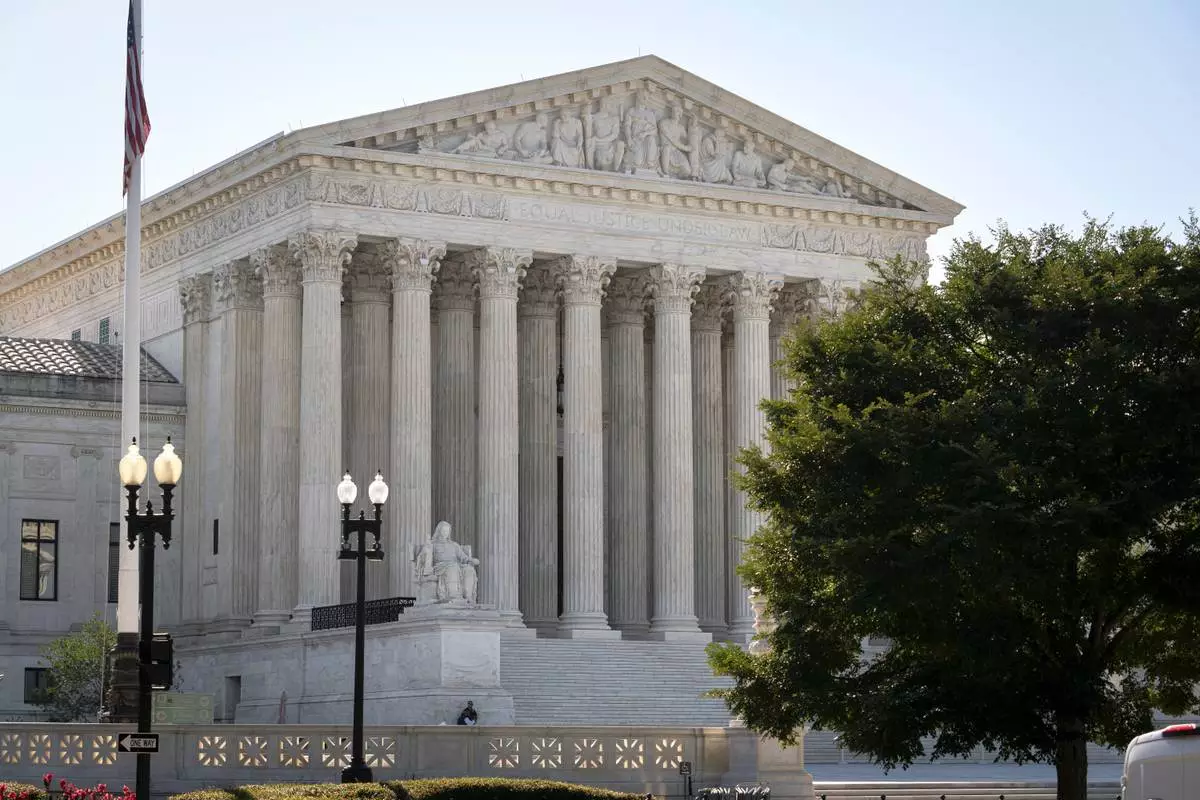
The Supreme Court is seen on the morning after the conservative majority sided with the Trump administration in a case over President Donald Trump's executive order restricting mail-in voting, on Capitol Hill in Washington, Tuesday, Aug. 25, 2026. (AP Photo/J. Scott Applewhite)

The Supreme Court is seen on the morning after the conservative majority sided with the Trump administration in a case over President Donald Trump's executive order restricting mail-in voting, on Capitol Hill in Washington, Tuesday, Aug. 25, 2026. (AP Photo/J. Scott Applewhite)

FILE - Delivery vans are parked during a protest staged as part of a countrywide National Day of Action Tuesday, July 28, 2026, outside the main United States Postal Service headquarters in northeast Denver. (AP Photo/David Zalubowski, File)

FILE - Delivery vans are parked during a protest staged as part of a countrywide National Day of Action Tuesday, July 28, 2026, outside the main United States Postal Service headquarters in northeast Denver. (AP Photo/David Zalubowski, File)

Recommended Articles