New developer platform connects AI applications to Binance trading, market data, wallets, payments and on-chain tools across crypto
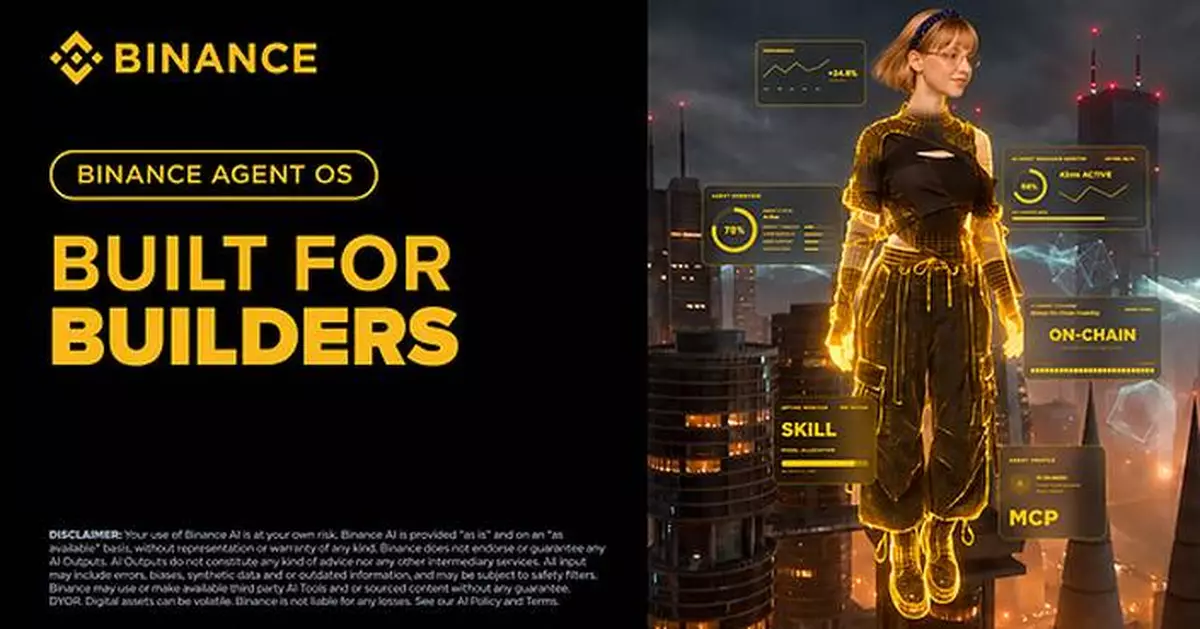
ABU DHABI, UAE, Sept. 2, 2026 /PRNewswire/ -- Binance today introduced Agent OS, a developer platform and standardized access layer connecting AI applications to Binance's trading, market data, wallet, payment and on-chain capabilities across crypto.
Built as part of Binance Intelligence, the largest cryptocurrency exchange's strategic initiative for AI-powered products and experiences, Agent OS gives AI builders, fintech developers and quantitative trading teams a controlled foundation for creating applications and agents that interact with Binance's financial infrastructure. The platform supports both ready-made integrations and users' own AI agents.
Through supported AI tools, such as ChatGPT, Claude Code, Codex and Cursor, users can authorize agents to access market data, view account information and perform supported trading activities, subject to the permissions and limits they configure. Users can also assign each agent to a dedicated subaccount to segregate funds and trading activity.
"Binance Agent OS addresses the fragmentation developers face when building agentic finance applications across crypto and traditional markets," said Jeff Li, VP of Product at Binance. "It gives everyone from developers to quantitative traders the reliable data, low–latency infrastructure, and standardized interfaces they need to deploy AI–driven strategies."
A standardized developer layer
Agent OS brings together Binance APIs, Binance Wallet Agentic Hub, Binance x402 (programmable payments), Binance Skill Hub and newly introduced support for the Model Context Protocol (MCP). Together, these capabilities give developers the components they need to build connected financial applications and AI agents.
MCP is an open standard that enables compatible AI applications to connect to and use external tools. Its integration into Agent OS gives developers and partners a standardized way to connect their applications and agents to Binance, reducing the need to create separate integrations for each product or use case.
User-controlled access
User-controlled permissions determine the Binance data and trading capabilities available to an AI agent. Binance can monitor resulting trading activity, including orders, but not the agent's broader workflow or reasoning, which runs within the user's selected AI application.
Binance's initial MCP implementation lets compatible AI applications access market data, view read-only account information and place trades. Through the MCP server, users can assign an agent to a dedicated subaccount, configure its permissions, and revoke access at any time.
Agents can view balances, portfolio information and transaction history of a designated subaccount, as well as balance and portfolio information for the user's main account. They cannot access non-trading personal account information, including email address or KYC data.
Binance monitors and applies applicable controls to trading activity initiated through the platform, including the resulting orders. The agent's external information sources, interpretation and decision-making are managed within the user's selected AI application and are not visible to Binance.
Find out more about Agent OS here: https://binance.com/agent-os
Compatible clients that support MCP over Streamable HTTP can connect using:
https://agent.binance.com/mcp/agentic
Detailed setup instructions are available in the Binance MCP Server documentation:
https://developers.binance.com/en/docs/agent-native/mcp-server
Disclaimer: Your use of Binance AI, including any Binance AI Service, is at your own risk. It is provided to you on an "as is" and "as available" basis, without representation or warranty of any kind. You are solely responsible for all of your Prompts. Prompts may be used for training purposes. AI Inputs may include various unvetted third party sourced content. Any sourced content is provided "as is" without any guarantee. Binance may restrict or alter sourced content based on various compliance safety filters, however this is not absolute. Binance does not endorse or guarantee any AI Outputs. AI Outputs may include or reflect content, positions, views and opinions of third parties unknown to Binance, which may also include errors, biases, synthetic data and or outdated information. Any AI Output should not be solely relied on for decision making. AI Outputs do not constitute any kind of advice by Binance nor any other intermediary services. Binance AI may use or make available third party AI Tools without any guarantee and subject to third party terms. Where AI Tools are configured by yourself or a third-party, you indemnify Binance against all liability. Binance does not guarantee any AI Tools. Binance AI may respond to your requests, but without any guarantee that your request will be fulfilled satisfactorily or at all. Digital asset prices can be volatile. You are solely responsible for your investment decisions and Binance is not liable for any losses. Digital asset prices can be volatile. DYOR. Use of Binance AI may be subject to additional Binance Product Terms, where applicable. For more information, see our Terms of Use, Risk Warning and AI Policy and Terms.
** This press release is distributed by PR Newswire through automated distribution system, for which the client assumes full responsibility. **
Binance Introduces Agent OS to Connect AI Applications to Financial Infrastructure