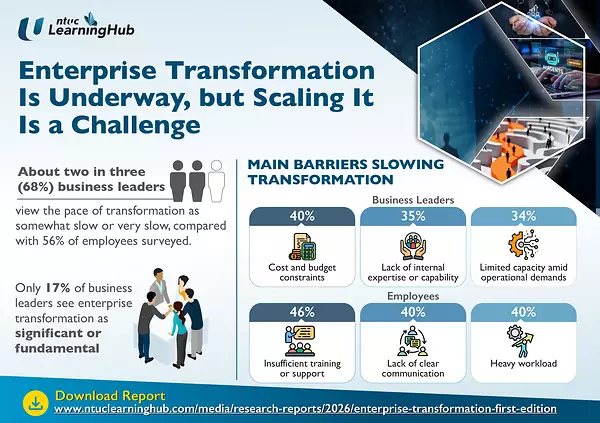
- Nearly eight in ten business leaders report enterprise transformation as moderate (42%) or limited (36%) in scale, while only 17% see it as significant or fundamental in their organisation.
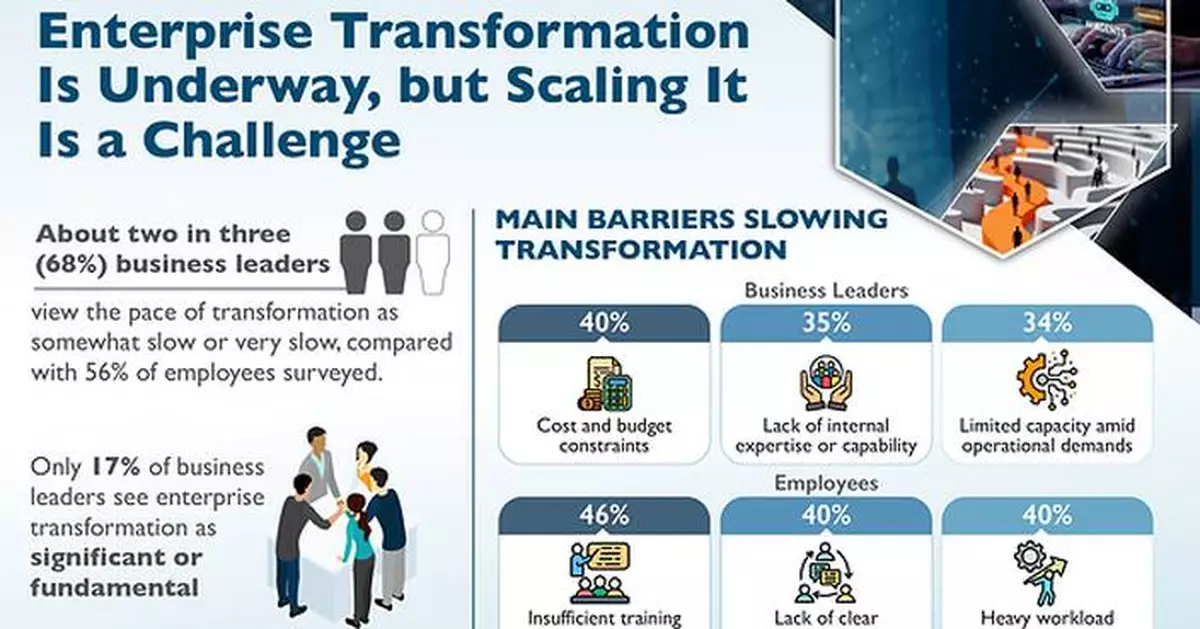
- About two in three business leaders (68%) view the pace of transformation as somewhat slow or very slow, compared with 56% of employees surveyed.
- Business leaders see the biggest implementation pressures in redesigning work (37%), building employee capability and confidence (32%) and embedding new practices (30%), while employees face these pressures through limited time to learn and practise due to workload (31%), new ways of working adding to existing demands (30%) and unclear processes or guidelines (27%).
- The main barriers slowing transformation for business leaders are budget constraints (40%), capability gaps (35%) and limited operational capacity (34%), while employees feel the most impact through insufficient training or support (46%), unclear communication (40%) and heavy workloads (40%).
SINGAPORE, Sept. 3, 2026 /PRNewswire/ -- Enterprise transformation is underway across organisations, but many businesses have yet to translate this into fundamental, organisation-wide change. Nearly eight in ten business leaders describe transformation as moderate (42%) or limited (36%) in scale, while only 17% see it as significant or fundamental.
Change is also gradual, with about two in three business leaders (68%) reporting the pace of transformation as somewhat slow or very slow, compared with 56% of employees. The findings point to transformation progressing steadily rather than rapidly, with organisations working through the practical demands of implementation and adoption.
These are among the key findings from the first edition of NTUC LearningHub's Enterprise Transformation Report series. The three-part series examines how transformation is reshaping organisations, operations and workforce outcomes. This inaugural edition focuses on the scale, pace and implementation of transformation, exploring where it is gaining traction, where implementation pressures are, and how business leaders and employees perceive the pace, impact and support surrounding change. Subsequent editions will examine other dimensions of enterprise and workforce transformation.
The report surveyed 450 working professionals, comprising 150 business leaders and 300 employees in July 2026, to examine how enterprise transformation is reshaping business models, operations and workforce needs. It explores the role of artificial intelligence (AI), the pace and impact of change, and whether transformation is translating into measurable productivity and business outcomes, as well as the workforce, leadership and cultural shifts needed to sustain transformation over time.
As organisations seek to scale transformation, the challenge lies in translating strategy into changes in how work is structured and carried out. Business leaders see the biggest implementation pressures in redesigning work (37%), building employee capability (32%), and embedding new practices (30%). This is followed by measuring business or workforce outcomes (29%) and sustaining momentum after initial launch (25%).
The implementation pressures experienced by employees further underscore this gap, with nearly one in three (31%) citing workload as a barrier to finding time to learn and practise, 30% saying new ways of working add to existing demands, and 27% pointing to unclear processes or guidelines.
Workforce support is another key factor. Business leaders and employees differ in how they assess the effectiveness of support during transformation, with three in five business leaders (60%) rating it very or moderately effective, compared with 42% of employees. Employees feel the most impact through insufficient training or support (46%), unclear communication (40%) and heavy workloads (40%). Together, these findings suggest that scaling transformation requires organisations not only to introduce change, but also to create the conditions for employees to adopt and sustain new ways of working.
This becomes even more critical as AI accelerates the transformation agenda. Its influence appears stronger at the organisational level, with more than three in four business leaders (77%) reporting that AI is shaping their organisation's transformation agenda to a moderate or large extent, compared with 63% of employees who say AI is changing the way they work to a moderate or large extent.
Technology is also emerging as the most visible area of organisational change. Half of business leaders surveyed (50%) cite the adoption of new technologies, digital tools or automation as an area of recent transformation. Among employees, 35% report changes in how AI is used in their day-to-day work, while 29% point to shifts in the skills or knowledge expected of them. Together, these findings suggest that technology-led transformation is increasingly reshaping how work is carried out and the capabilities employees need to keep pace.
Commenting on the findings, Mr Amos Tan, Assistant Chief Executive Officer and Chief Core Skills Officer, NTUC LearningHub, says, "Singapore's next phase of growth will not be decided by how fast organisations buy technology but by whether those investments change how work actually gets done. Many organisations have started transforming. The harder problem is scaling it in ways that hold - aligning strategy, technology and process, and more importantly making sure people whose roles are changing know what's expected and are supported to get there. Organisations that do that will be better positioned to innovate, adapt and compete better in an increasingly AI-driven economy."
To download Edition One of the Enterprise Transformation Report, please visit https://www.ntuclearninghub.com/media/research-reports/2026/enterprise-transformation-first-edition. To find out more about enterprise learning solutions, training, and grants, please contact NTUC LearningHub at www.ntuclearninghub.com.
### END ###
About NTUC LearningHub
NTUC LearningHub is the leading Continuing Education and Training provider in Singapore which aims to transform the lifelong employability of working people. Since our corporatisation in 2004, we have been working with employers and individual learners to provide learning solutions in areas such as Infocomm Technology, Generative AI & Cloud, Healthcare, Retail & Food Services, Employability & Literacy, Business Excellence, Workplace Safety & Health, Security, Human Resources & Coaching and Foreign Workers Training.
To date, NTUC LearningHub has helped over 34,000 organisations and achieved more than 3.2 million training places across more than 1,000 courses with a pool of about 1,000 certified trainers. As a Total Learning Solutions provider to organisations, we also forge partnerships to offer a wide range of relevant end-to-end training. Besides in-person training, we also offer instructor-led virtual live classes (VLCs) and asynchronous online learning. The NTUC LearningHub Learning eXperience Platform (LXP)—a one-stop online learning platform—offers timely, bite-sized and quality content for learners to upskill anytime and anywhere. Beyond learning, LXP also serves as a platform for jobs and skills development for both workers and companies.
For more information, visit www.ntuclearninghub.com.
** This press release is distributed by PR Newswire through automated distribution system, for which the client assumes full responsibility. **
Enterprise Transformation Is Underway, but Scaling It Is a Challenge