WASHINGTON (AP) — The Trump administration has stalled a study that would help regulators understand which industries dump harmful forever chemicals with their wastewater, according to two former agency officials who were involved in its development.
A public notice shows the first of its kind survey of wastewater treatment plants was submitted to the White House for approval nearly two years ago during the Biden administration — a far longer wait than is typical.
Many wastewater treatment plants receive PFAS-contaminated waste. A nationwide survey of hundreds of plants would help identify the source of that PFAS and could inform new regulations to limit their spread, according to Robert Wood, director of the engineering and analysis division in the EPA’s Office of Water before his retirement in 2024.
“If we can determine the top one, the top two, the top three” industries that dump PFAS, said Wood, “then we start work on the detailed studies and the regulation to get after nationwide limits on PFAS for the predominant industrial dischargers.”
Researchers have linked the family of chemicals called PFAS to increased risk of certain cancers, developmental effects in children, resistance to vaccines and other health problems. The man-made chemicals once commonly used in products like waterproof shoes and nonstick pans are also widespread in the environment and hard to remove, making them an especially challenging public health threat. Wastewater treatment plants, for example, typically aren’t equipped to separate them from waste, which means they are released back into rivers and onto soil.
The survey was submitted to the White House Office of Management and Budget, which must approve it, in October 2024.
“This is sufficiently unusual and a very long period of time that it is worth asking the question: Is OMB just sitting on it?” said Stuart Shapiro, a former OMB staffer and dean at the Edward J. Bloustein School of Planning and Public Policy at Rutgers University-New Brunswick in New Jersey. He said reviews typically take around 60 days.
The EPA and OMB did not respond to requests for comment.
The Trump administration has promised to combat PFAS. They've kept tough Biden-era limits on two common types of PFAS in drinking water and support work to find new ways to remove the chemicals from the environment.
They've also faced criticism from environmentalists and the Robert F. Kennedy Jr.-aligned “Make America Healthy Again” movement over what they see as an agency approach to chemical regulation that's too industry-friendly. Trump officials have delayed the most significant drinking water limits and scrapped a Biden-era effort to reduce PFAS in the wastewater of certain chemical manufacturers, restarting the regulatory process themselves.
The Biden-era EPA said that good data on PFAS in industrial wastewater is typically inaccessible, incomplete or inconsistent. With the new survey, officials sought to ask hundreds of wastewater treatment plants questions about their practices and to sample the industrial sources of the waste they treated.
If the work had started quickly, officials would already have some of the results, according to Betsy Southerland, a leader of the EPA’s Office of Water until 2017.
Officials also would have collected information on PFAS in biosolids, which are the treated solids water treatment plants produce in massive quantities. Those treated biosolids are often spread on farm fields as fertilizer. Officials wanted to survey biosolids to figure out the prevalence of PFAS.
Although concerns have been raised for years, officials have only recently studied the health implications of growing food on fields where PFAS-contaminated biosolids have been spread. The Biden-era EPA issued a draft report raising some concerns — a report Trump officials said had serious flaws. Agency officials, in their own draft document, said one of those flaws was that the agency had failed to conduct a national survey of PFAS in biosolids to better understand their occurrence and associated risks.
David Andrews, chief science officer at the nonprofit Environmental Working Group, said the Trump administration had created a logical paradox.
“The biosolids risk assessment was criticized by this administration for not including an EPA-run national occurrence study, and that exact survey has been sitting unapproved at OMB for nearly two years,” Andrews said.
A group representing public wastewater agencies questioned the need for the survey, saying that a lot of new data has been collected on PFAS in wastewater in recent years. That information is enough to take steps to regulate the industries that need to be addressed, and a new survey for more expensive sampling wouldn’t be useful, according to Cynthia Finley, director of regulatory affairs at the National Association of Clean Water Agencies.
“We would rather EPA look at what data is available already because there is a wealth of PFAS discharge information out there now,” said Finley.
Michigan is one of the states that has collected similar data on its own. The state had already limited the amount of certain PFAS wastewater treatment plants could dump into rivers and lakes several years ago when treatment plants started sampling the industrial waste they received.
With data in hand, “The treatment plants told their industries, 'Hey, you have to either stop discharging PFAS or reduce the amount of PFAS you are discharging to us,” to avoid violating limits on PFAS in rivers and lakes, according to Anne Tavalire, who works for the state on reducing PFAS at wastewater treatment plants.
She said the work helped achieve substantial reductions in PFAS released into the environment and in biosolids.
A “Make America Healthy Again” activist said it was good that the Trump administration had previously announced plans to tackle PFAS. But for their efforts to work, officials can't let polluters off the hook and must know where the pollution is coming from, according to Kelly Ryerson, whose social media account “Glyphosate Girl” focuses on agriculture and health.
The survey or a similar effort “is urgently needed data to help decrease toxic exposures and ultimately the chronic disease epidemic. We have no more time to waste in addressing these harmful exposures, especially on behalf of bureaucratic interests,” she said.
The Associated Press receives support from the Walton Family Foundation for coverage of water and environmental policy. The AP is solely responsible for all content. For all of AP’s environmental coverage, visit https://apnews.com/hub/climate-and-environment
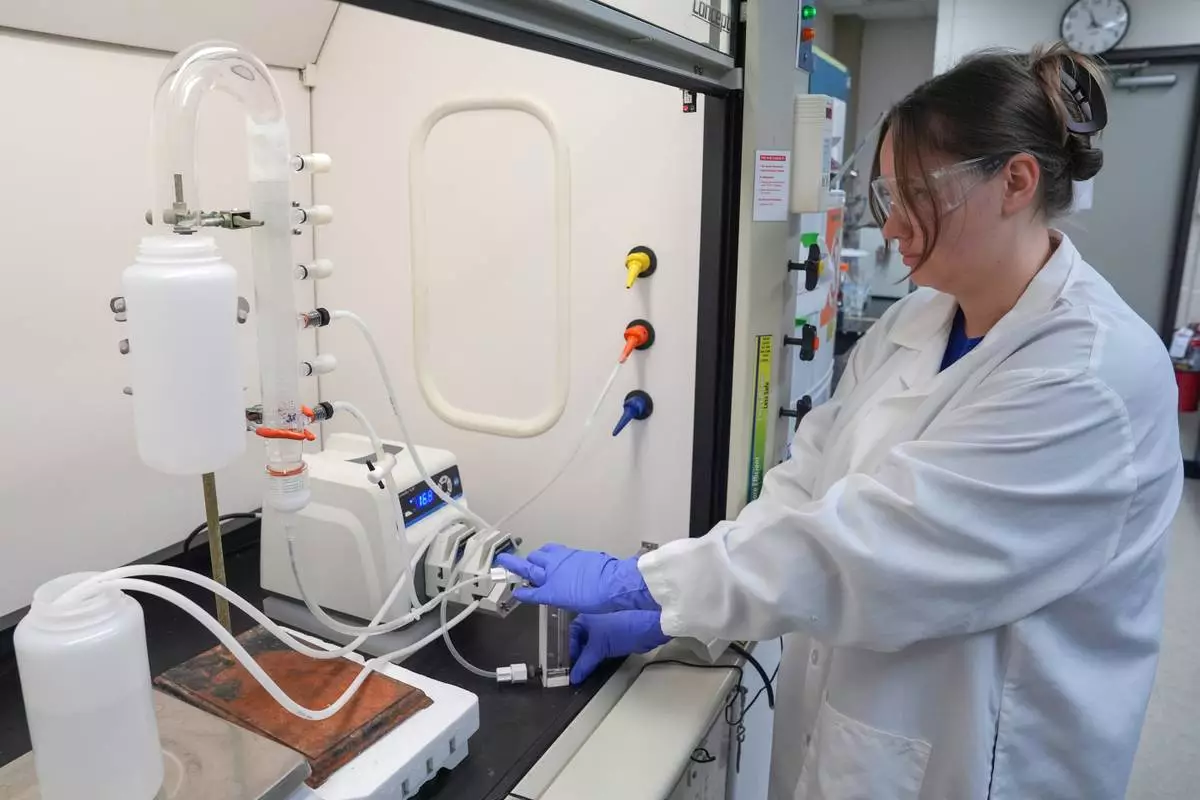
FILE - Stephanie Stoll starts a pump as part of an experiment studying the removal of PFAS from water samples, April 10, 2024, at a U.S. Environmental Protection Agency lab in Cincinnati. (AP Photo/Joshua A. Bickel, File)