A Japanese scholar who focuses on tracing Japan's wartime chemical weapons legacy on Wednesday revisited a poison gas bomb factory used by the Imperial Japanese Army in World War II, in efforts to uncover more historical truth and reflect on the cruel war of aggression.
Harada Kazuaki, the scholar, has dedicated years of his life investigating the production and usage of chemical weapons by the Imperial Japanese Army during WWII.
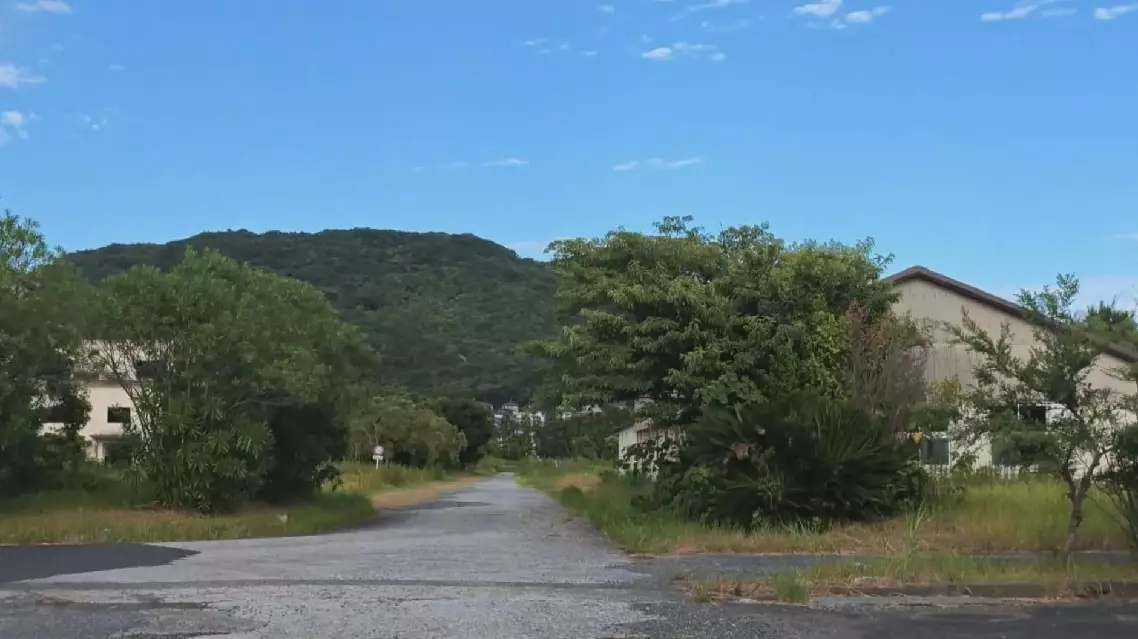
Sone Manufacturing Plant, located at Fukuoka Prefecture's Kitakyushu City, was where poison gas bombs were produced. Millions of poison gas shells transported from here were dropped on China and caused severe casualties.
"Here's the main factory for producing mustard gas and Lewisite. The building behind is where the products would undergo their final processing. A temporary warehouse can also be seen in the rear left. The building at the very back is the primary factory for producing diphenylcyanoarsine and diphenylchloroarsine," said Harada.
Sone Manufacturing Plant became an important chemical weapons production base in Japan back then, relying on the industrial and military systems of imperial Japan. By transferring the relevant technique to private enterprises, the Japanese military gradually formed a chemical weapons production system from scientific research to production.
"The military was capable of producing small batches on a laboratory scale, while private companies were responsible for scaling up production. At the time, Japan's primary targets in the war were the Korean Peninsula and China. Therefore, Kitakyushu was the most convenient location for shipping out the chemical weapons," Harada said.
Harada said he believes studying this part of history is not merely about looking back at the past, but more importantly, it is about reflecting on how people can learn from history to prevent wars.
"What I hope for is to draw lessons from history that can help us reflect on how we can prevent war," Harada said.
Japanese expert uncovers Japan's use of chemical weapons during WWII
Driven by Typhoon Saudel, seasonal monsoon airflow, and a cold front, torrential rains battered east China's Fujian Province on Thursday, triggering flooding and landslides that blocked highways and trapped residents.
Typhoon Saudel, the 18th typhoon of 2026, made its third landfall in Zhangpu County under the city of Zhangzhou in Fujian at around 06:30 on Thursday, according to the provincial meteorological observatory.
In the provincial capital of Fuzhou, heavy to torrential rain lashed many parts of the city. The intense precipitation caused severe flooding on multiple streets. Local emergency response teams were mobilized to carry out drainage and relief operations.
Between 06:00 and 09:00, four townships in Fuzhou recorded rainfall exceeding 100 millimeters, with a village in Shangjie Town receiving 156.4 millimeters.
At about 08:40, Minhou County upgraded its orange rainstorm warning to the highest red alert and activated a Level II emergency response for heavy rain.
China has a four-tier emergency response system, with Level I being the most severe response, as well as a four-tier color-coded weather warning system, with red representing the most severe level, followed by orange, yellow and blue.
The same day, over 150 millimeters of rain drenched parts of Yongchun County, Quanzhou City, in a short period of time.
In a village in Wulijie Town, houses in low-lying areas were severely flooded, stranding multiple residents. Fire and rescue personnel established an evacuation route and successfully moved the residents to safety.
Also in Yongchun County, a slope collapse occurred along a section of National Highway 356, with an estimated volume of 2,400 cubic meters of debris blocking an 80-meter stretch of road.
After the incident, local highway authorities quickly dispatched specialized rescue crews and heavy equipment to the site. Excavators were used to break up and remove large boulders, while trucks hauled away soil and rocks. Transportation departments also brought in larger crushers as repair work continued to move forward in an orderly manner.
Heavy rain batters Fujian, triggering flooding, landslides