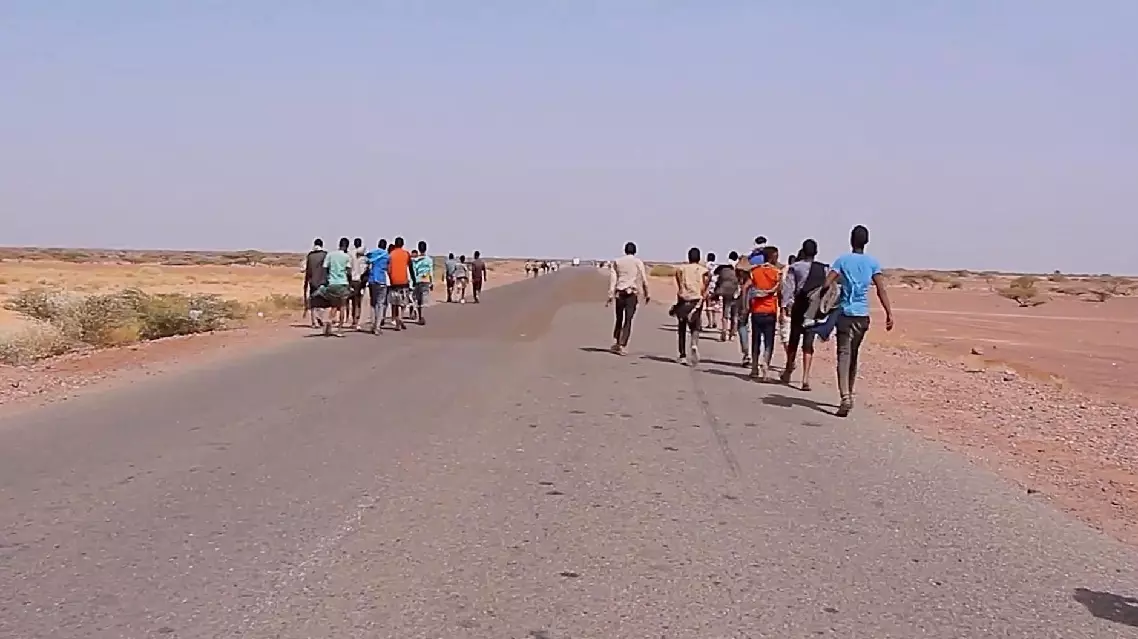
African migrants who are stranded in Yemen as the country's border with Saudi Arabia remains closed are facing an unfolding humanitarian crisis worsened by depleting aid supplies, according to the International Organization for Migration (IOM).
With humanitarian aid running low, migrants there are finding it even harder to survive.
Abdulaziz Mohammed, an Ethiopian migrant, arrived in Aden in southern Yemen about 15 days ago after a risky sea journey with smugglers. He had hoped to reach Saudi Arabia for a better life, but his journey came to a halt at the heavily guarded border.
"I was trying to cross into Saudi Arabia, but now the border is heavily guarded. The military has closed the border, and the police have tightened security there. We cannot cross, so I am here in Yemen. We have no place to stay. We look for food on the streets and sleep under the trees," he said.
Abdulaziz is one of thousands of migrants who continue to travel from the Horn of Africa to Yemen, despite the risks at sea, smuggling networks and security concerns.
The IOM says more than 110,000 migrants arrived in Yemen between January and the end of July.
"Migrants in Yemen face many risks, including human trafficking, exploitation, detention, violence and various forms of abuse. Many of them rely on smuggling networks to facilitate their movement, which exposes them to harm and risks that are not limited to crossing borders, but continue to affect them throughout the entire journey," said Mohamad Hatoum, IOM programme manager for protection.
But reaching Yemen does not mean they can continue their journey. Many find themselves stranded without shelter, income or basic services in a country already facing a deep humanitarian crisis.
"There are major economic, political, geographical and security challenges resulting from this migration. In Yemen specifically, because of the war and the difficult economic situation, there are certainly additional burdens on the host country. We all know the situation we have reached, with international organizations absent and no aid available for internally displaced people. So they undoubtedly represent an additional burden," said Mansour Al-Jaradi, a humanitarian aid activist.
African migrants stranded in Yemen face worsening humanitarian crisis
African migrants stranded in Yemen face worsening humanitarian crisis
The 19th Europe-China Business and Technology Cooperation Fair concluded on Friday in Chengdu, the capital of Sichuan Province in southwest China, attracting over 600 enterprises and institutions from more than 20 countries and generating more than 160 preliminary cooperation intentions.
Co-hosted by the China Chamber of International Commerce and the European Union Chamber of Commerce in China, the fair serves as a premier platform for targeted business matchmaking between European and Chinese businesses. It aims to foster meaningful, sustainable cooperation across sectors.
During the three-day event, enterprises from China, Spain, Portugal, and other countries held nearly 400 one-on-one business matchmaking sessions across sectors such as new energy, biomedicine, agriculture and food, and artificial intelligence.
Speaking at the fair, Liu Jiannan, vice chairman of the China Council for the Promotion of International Trade, emphasized the need to explore innovative cooperation models between the two sides.
"We are ready to help enterprises from both sides fully utilize platforms like the Europe-China Business and Technology Cooperation Fair to strengthen sci-tech exchanges, deepen innovative cooperation in areas such as AI, clean energy, and digital economy, and explore new models for cooperation in third-party markets," said Liu.
Business leaders at the event stressed the evolving and deeply integrated nature of Sino-European business ties.
Luigi Gambardella, president of the ChinaEU Digital Association, urged young entrepreneurs to become more involved to deepen mutual understanding.
"I hope that young people, young entrepreneurs, and young startups will start to consider co-creation. I think such kind of cooperation would be much more profound. That's because it will allow entrepreneurs [and] employees to enrich with a different culture, understanding each other," said Gambardella.
Adam Dunnett, secretary general of the European Union Chamber of Commerce in China, underscored the Chinese market's critical importance to Europe, calling for deeper two-way investment and trade.
"China is an important market for us. It's really, really important as a source for our supply chain. [It] really doesn't matter if [European] companies are investing in China or if Chinese companies are investing in Europe, or they're finding ways to trade with each other or to make use of each other's supply chains," said Dunnett.
Since its inception, the event has attracted over 14,000 Chinese and European enterprises. To date, it has successfully facilitated nearly 30,000 business matchmaking sessions, resulting in more than 3,000 cooperation intentions and agreements.

Europe-China fair wraps up in Chengdu with over 160 preliminary deals