China has for the first time made its national BeiDou satellite navigation and positioning reference station network service data available to the public, marking a significant step in sharing high-precision space-time information, said the Ministry of Natural Resources on Friday.
According to the ministry, the data will be opened to key industries and market players, allowing public data from the reference stations to circulate in compliance with regulations and fully unleash the economic and social value of data.
"Many industries used to build their own stations, which require substantial investment and maintenance costs. Through this data sharing, we have effectively expanded the application scenarios of BeiDou high-precision data services in areas such as autonomous driving, the low-altitude economy, urban renewal and precise governance," said Chen Ming, director of the Basic Surveying and Mapping Division of the Department of Land Surveying and Mapping under the Ministry of Natural Resources.
Satellite navigation and positioning reference stations are the ground-based infrastructure that enables the BeiDou to deliver high-precision navigation and positioning services.
The number of China's BeiDou reference stations has now expanded to 7,569, covering the entire country. These stations provide stable and accurate data support for land planning, disaster warning, engineering construction, urban governance and many other fields.

China offers public access to BeiDou reference station data
The Wan'an Reservoir, a major reservoir on the Ganjiang River in east China's Jiangxi Province, opened its floodgates to discharge excess water, as the first flood of the year on the river officially formed on Friday, marking the largest flood to hit the facility in nearly seven years.
Footage from the facility -- operated by China Energy Investment Corporation's Jiangxi branch -- showed torrents of water surging through the dam's open gates in thick sprays of mist. The maximum flood peak safely cleared the dam at 7:30 on Saturday, registering a flow rate of 8,890 cubic meters per second.
Jiangxi has seen days of torrential rains brought by Typhoon Saudel, the 18th typhoon of 2026 that made its third landfall in Zhangpu County under the city of Zhangzhou in Fujian on Thursday.
The typhoon brought heavy rain to central and southern parts of Jiangxi, leading the Ganjiang River to swell rapidly.
The Wan'an basin of the river recorded a cumulative rainfall of 193.9 millimeters, driving a sudden surge in inbound water flow that caused water levels to rise rapidly.
Operating under a provincial flood control directive, the Wan'an Hydropower Plant started to discharge the excess water in it at a rate of 7,000 cubic meters per second.
Reservoir staff remained stationed on the front lines to conduct rigorous equipment inspections and monitor real-time water conditions. By balancing flood regulation with power generation, the facility aims to safeguard communities along the river.
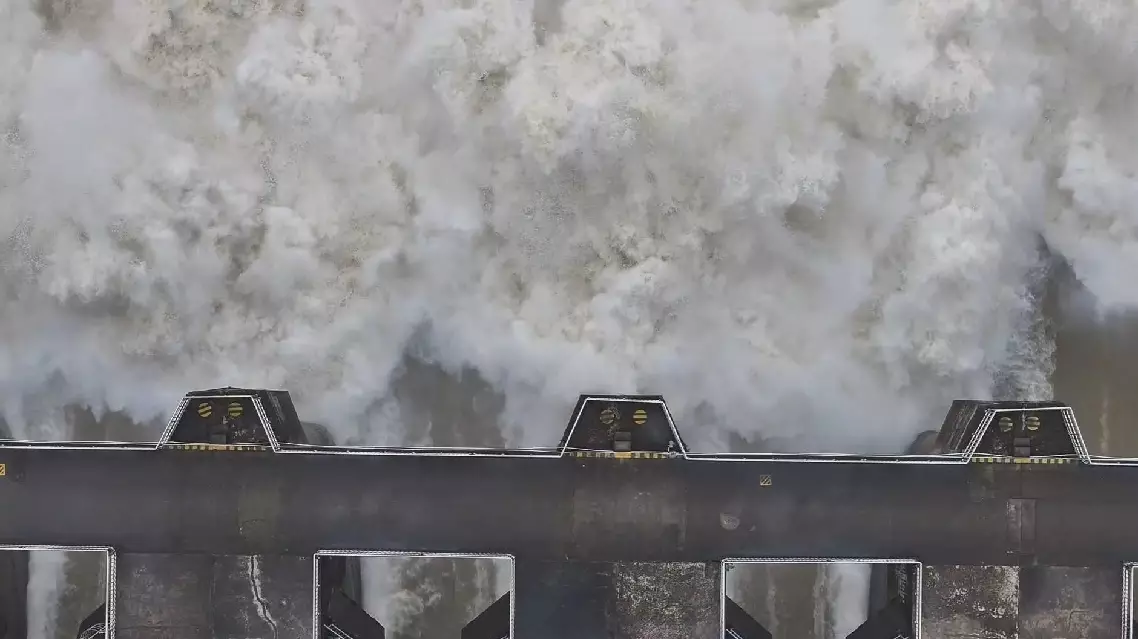
East China reservoir opens floodgates as major river sees largest flood in seven years