Villagers in Nepal's Trishuli Valley are struggling to rebuild shattered lives and restore basic services following the deadly flash floods and mudslide last month, when a collapsing glacier swept away homes, bridges and entire communities along the border with China.
In Trishuli Valley, some 300 homes were torn apart by a torrent of water, rock and debris, leaving families grieving for loved ones while many residents remain missing. Survivors were stripped of belongings, money and clothing, and shopkeepers saw their entire stock washed away in minutes.
The disaster has prevented schoolchildren from returning home, left families without access to medicines and food, and blocked fuel deliveries.
With bridges across the Trishuli River destroyed, whole communities have been split in two. Zip lines are now being strung along the valley, slowly reconnecting villages divided by the floods.
"We all hope that this will make things better," said Maising Tamang, a villager.
"We have to wait a long time, but it helps a lot," said Suryekumari Tamang, another villager.
Suman Singh, another villager, hopes for vehicles to help them go in and out.
"It helps, but it would be better if we can take vehicles across," he said.
Farther up the valley, the Nepalese army is racing to construct a temporary bridge to restore access, while engineers work to reconnect power after days of blackout and bring telephone lines back online. Yet with so much destroyed, full reconstruction remains a daunting task far beyond what villagers can contemplate for now.
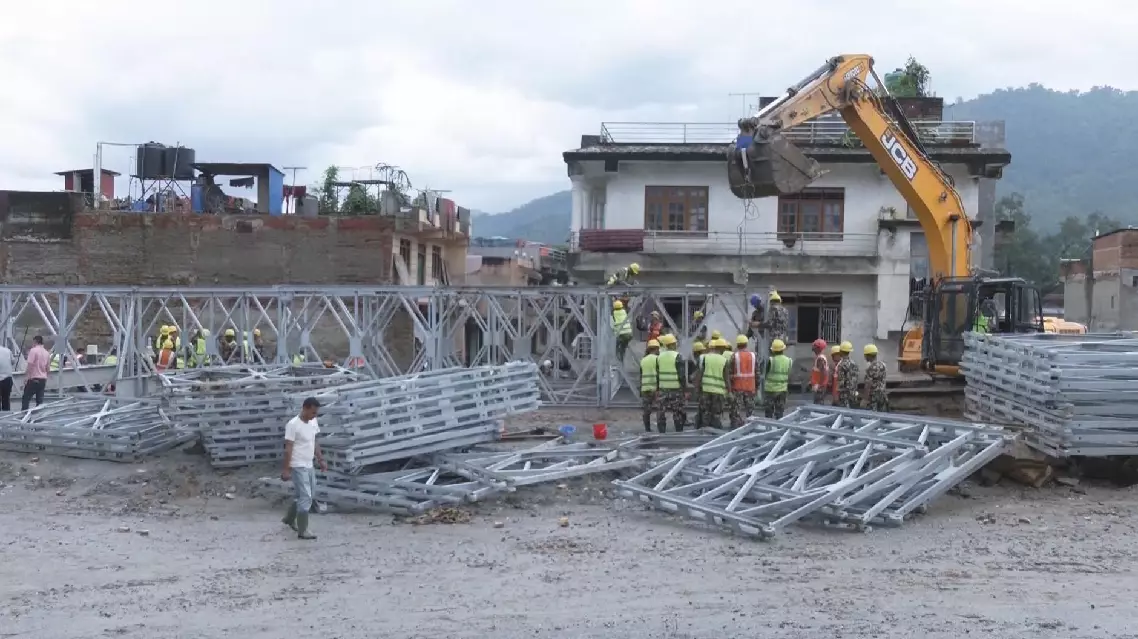
Nepal's Trishuli Valley struggles to rebuild after deadly glacier‑triggered floods
The International Deep Space Exploration (Tiandu) Conference run from Thurday from Friday in Hefei, capital of east China's Anhui Province, where Chinese commercial space companies laid out their plans for expanding lunar activity.
At the event, firms presented lunar ambitions ranging from rovers and robotics to rockets and visions for long-term human stays, marking what Wu Weiren, director of the Deep Space Exploration Laboratory and a Chinese academician, called "the age of commercial lunar exploration" in his opening keynote speech.
Among the active players, Galactic Energy celebrated the successful maiden flight of its medium-lift liquid rocket PALLAS-1 on Tuesday and is now preparing the larger PALLAS-2 for potential lunar and deep-space missions. Xia Dongkun, the company's executive president, said the goal is to access rare earth elements and other resources on the Moon and asteroids, which are far more abundant than on Earth.
Guangzhou-based CAS Space also shared footage of its Kinastra-1 upper stage, which is set to carry out the company's first lunar mission. The stage is expected to place a satellite into a trans-lunar transfer trajectory in the first quarter of 2027.
"Building on the successful maiden-flight verification, we will focus on advancing a three-step plan for deep-space applications -- helping unlock the trillion-yuan value of the space economy," said Zhu Qinglin, deputy chief designer of the Kinastra-1 upper stage.
Beyond technology demonstrations, the conference was aimed to lay the groundwork for sustainable and inclusive deep space exploration. Organizers announced that the China-led Cislunar CubeSat Constellation (C3) Program will be open to scientists and institutions worldwide, giving developing countries opportunities to participate in deep-space missions.
"It gets busier. We have more actors. It's more accessible in that sense, which is a good thing. But it's maybe for the first time in human history that we are trying to get to the moon with some mechanism already in place -- these principles for everyone's benefit and go there. With those principles very well understood, so that it can be, in a way or another, sustainable for the future," said Ulpia-Elena Botezatu, co-chair of UN-COPUOS Action Team on Lunar Activities Consultation.

Chinese commercial space companies aim high for expanding lunar activity at Hefei conference