Chinese AI-generated short drama producers are aiming to win overseas audience with compelling storytelling, localized characters and high-quality production.
Domestically, the sector is booming as rapid advancements in AI technology significantly accelerate production cycles and slash costs.
To stand out in an increasingly crowded field, many companies are pivoting to international markets to pursue sustained growth.
Industry insiders emphasize that establishing a strong foothold abroad requires meticulous localized character design and effective cultural translation.
"Science fiction naturally provides an international narrative context, so we chose a female lead with a globally appealing look. This is a promotional still of her from the drama. Currently, we are involved in three areas: AI-generated short dramas featuring digital humans, interactive cinematic games with digital humans, and IP-customized short dramas. Our revenue target for this quarter is around 300,000 yuan (about 44,700 U.S. dollars)," said Xie Minghong, founder of Shanghai Zhenlv Technology, a company focused on AI content creation.
Overseas audiences have developed a growing appetite for premium AI dramas from China.
"In terms of commercial revenue, Western markets, led by the United States, account for more than half of the total market share, likely close to 60 percent. Other regions, including Southeast Asia, Japan, the Republic of Korea, and the Middle East, make up the remaining 30 percent to 40 percent. Regarding industry budgets, a traditional live-action short drama typically costs anywhere from tens of thousands to hundreds of thousands of U.S. dollars. However, for AI short dramas, the production costs are reduced by 70 percent to 80 percent," said Wu Gaoming, co-founder of Shanghai-based CreativeFitting.
Industry data projects China's AI short drama market to surpass 40 billion yuan (about 5.96 billion U.S. dollars) this year, marking a 138-percent increase year on year.
The overseas market has an equally outstanding performance with its scale expected to exceed 4 billion dollars.
Despite this rapid expansion, experts warn against falling into price wars in overseas expansion.
"We must avoid falling into a low-quality, low-price mindset when expanding overseas, assuming that simply relying on cheap pricing will allow us to outperform other teams. The same principle applies to cultural export. It is not merely about exporting industrial technology or production capacity; more importantly, it requires the export of aesthetics, storytelling, and, ultimately, governance capabilities," said Lyu Shengpu, an associate professor of the School of Media and Communication at Shanghai Jiao Tong University.
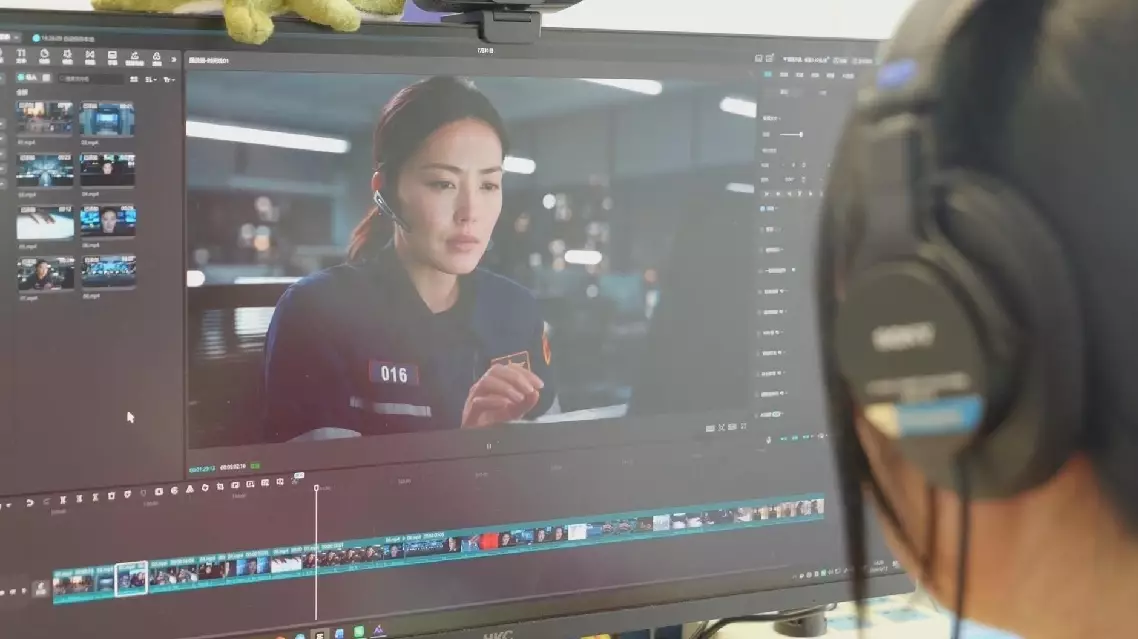
Chinese AI drama creators aim to win overseas audience with compelling storytelling, high quality production