MONZA, Italy (AP) — Ferrari brought confidence and upgrades into its home grand prix weekend. The race ended in tears and despair.
Lewis Hamilton finished the Italian Grand Prix a distant sixth, more than 20 seconds behind Formula 1 leader Kimi Antonelli — who had a sensational race from the back — to leave his title hopes in tatters.
Click to Gallery
Ferrari driver Charles Leclerc of Monaco steers his car during the Italian Formula One Grand Prix race, in Monza, Italy, Sunday, Sept. 6, 2026. (AP Photo/Antonio Calanni)
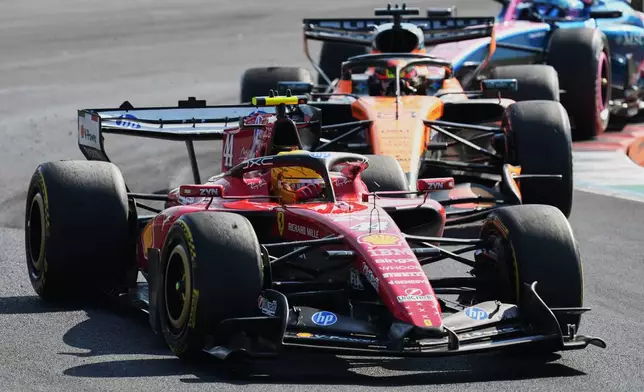
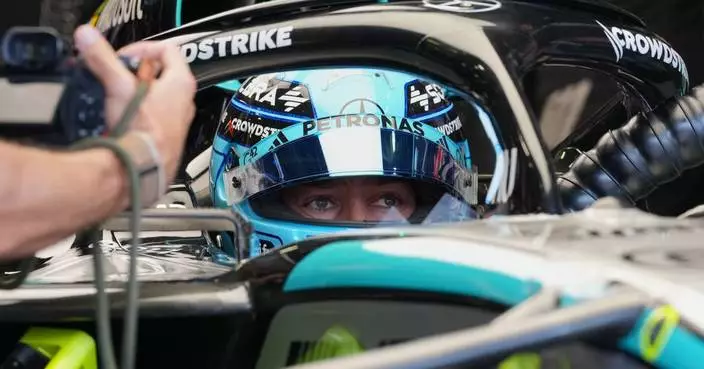
Ferrari driver Lewis Hamilton of Britain steers his car during the Italian Formula One Grand Prix race, in Monza, Italy, Sunday, Sept. 6, 2026. (AP Photo/Antonio Calanni)
Ferrari driver Lewis Hamilton of Britain steers his car during the Italian Formula One Grand Prix race, in Monza, Italy, Sunday, Sept. 6, 2026. (AP Photo/Antonio Calanni)
Ferrari driver Charles Leclerc of Monaco reacts after the qualifying session ahead of the Italian Formula One Grand Prix, in Monza, Italy, Saturday, Sept. 5, 2026. (AP Photo/Luca Bruno)
It was even worse for Charles Leclerc, whose race lasted less than five minutes before he crashed hard.
Leclerc lost control coming out of Parabolica at the end of Lap 2 and swerved off into the barriers at high speed. He got out of his car and sat down near the track, looking heartbroken.
The hordes of passionate, red-clad tifosi around the track looked similarly despondent, with many in tears.
“It’s very frustrating, but it’s the way it is now. I cannot change the result,” said Leclerc, who admitted the car felt “a little bit weird.”
“I think from Lap 1 to Lap 2, I had a bit of a difference in power delivery. We’ll look into it, but I don’t want to comment too much before checking the data and confirming it 100%," he added.
Leclerc said he had a bit of a problem with the vision in his right eye immediately after the crash but that he now felt fine, apart from “a bit of pain here and there.”
He did add, however, that he would have further checks over the next 24 hours to make sure that he is fit to compete in next weekend’s Spanish GP.
“It should be the case but better be safe than sorry,” Leclerc said.
Questions were also raised about the relationship between Leclerc and Hamilton after a tense tussle between the two Ferrari drivers at the second corner that saw Hamilton go into the gravel and tumble from fourth to 10th.
“I don’t really know who is forcing that narrative that we are one against the other,” Leclerc said. “Here it’s true though that we went too far. I think Lewis in turn one, then turn two I tried to do the tightest corner possible, but that was just not enough and doing it here is not good.
“It is never what you want between two cars of the same team.”
Hamilton arrived at Monza on the back of eight consecutive top-five finishes and having finally got his first win for Ferrari in June. That had thrust him right into the title race.
The seven-time champion started Sunday 59 points behind Antonelli, with upgrades to his Ferrari and 15 grid places ahead of the young Italian.
He ended the weekend 76 points behind Antonelli.
“A bit devastating, tough one to swallow, lost a lot of points and ultimately couldn’t keep a Mercedes engine behind,” Hamilton said.
See AP’s full auto racing coverage here

Ferrari driver Charles Leclerc of Monaco steers his car during the Italian Formula One Grand Prix race, in Monza, Italy, Sunday, Sept. 6, 2026. (AP Photo/Antonio Calanni)

Ferrari driver Lewis Hamilton of Britain steers his car during the Italian Formula One Grand Prix race, in Monza, Italy, Sunday, Sept. 6, 2026. (AP Photo/Antonio Calanni)
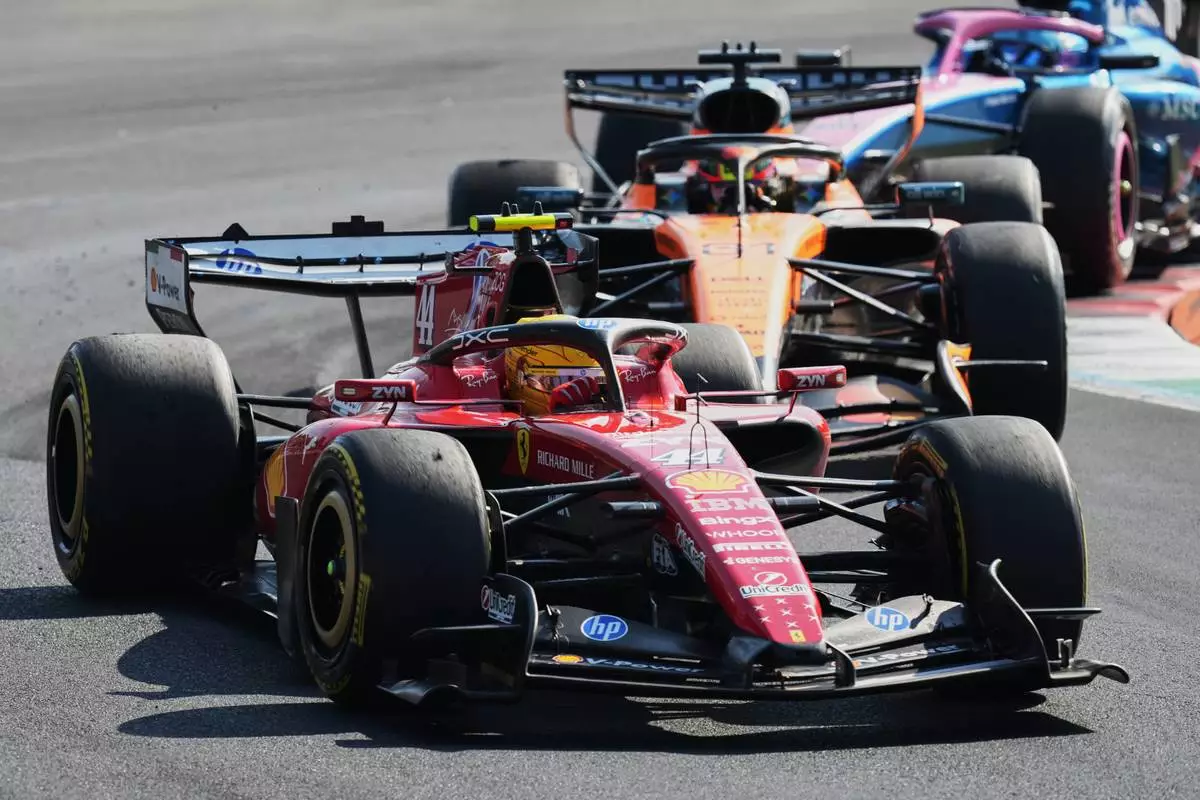
Ferrari driver Lewis Hamilton of Britain steers his car during the Italian Formula One Grand Prix race, in Monza, Italy, Sunday, Sept. 6, 2026. (AP Photo/Antonio Calanni)
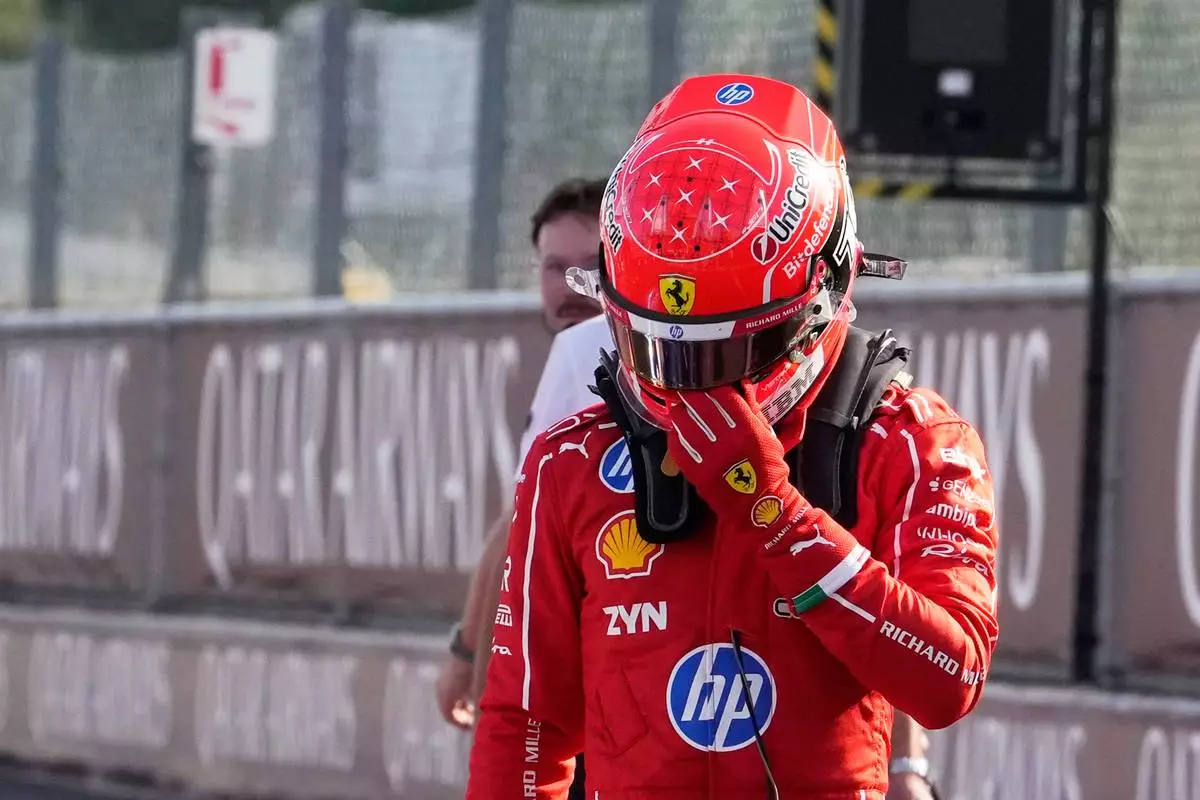
Ferrari driver Charles Leclerc of Monaco reacts after the qualifying session ahead of the Italian Formula One Grand Prix, in Monza, Italy, Saturday, Sept. 5, 2026. (AP Photo/Luca Bruno)
MAGDEBURG, Germany (AP) — The far-right Alternative for Germany was projected to win a strong victory in a regional election Sunday, but it wasn’t immediately clear whether it would be able to fulfill its ambition of forming the country’s first far-right state government since World War II.
The party of German's unpopular leader, Chancellor Friedrich Merz, was set for a disastrous result in the the eastern state of Saxony-Anhalt. The anti-migration and Russia-friendly Alternative for Germany's candidate for governor said that “we have written history.”
Ulrich Siegmund, 35, told public broadcaster ARD that voters had sent a signal that “things cannot carry on like this” and that it was “also a signal toward Berlin.” Of Germany’s unpopular leader, he said: “A very good campaigner for us in this election campaign was Friedrich Merz. Every day this man is in the chancellery is one too many.”
Alternative for Germany, or AfD, went into the vote seeking an absolute majority in the state legislature to govern on its own. That would overcome the so-called firewall of mainstream parties’ refusal to work with AfD, but it was unclear after polls closed whether it would happen.
A first state government would be the biggest prize in the anti-migration party’s 13-year history, at a time of widespread discontent with a national government that has yet to persuade voters that it can get the country’s sluggish economy moving.
Whether or not AfD can form a government, the projected result is a blow to Merz, whose center-right party has led Saxony-Anhalt for 24 years. Unlike other countries in Europe, modern Germany hasn't yet had a far-right or right-wing populist party leading a national, state or major-city government.
AfD is the biggest opposition party in Germany’s national parliament and is strongest in the formerly communist and less prosperous east, where Saxony-Anhalt is located. Its regional branch in Saxony-Anhalt is one of several classified by the domestic intelligence agency as a proven right-wing extremist group. AfD vehemently rejects accusations of extremism.
Projections for ARD and ZDF public television, based on exit polls and early counting, put AfD at a bit over 44% of the vote, more than double its showing five years ago in the region of 2.1 million people west of Berlin.
That was far ahead of Merz's Christian Democratic Union which was seen polling 18.5% and losing about half its support. The Left Party and the center-left Social Democrats and Greens were seen taking around 9% each.
It was unclear whether the BSW party would get the 5% of the vote needed to win seats. The projections put AfD at least marginally short of an absolute majority, though that could change.
AfD's national co-leader, Alice Weidel, described the projected result as “sensational” and said that “we have received a very clear mandate to govern here.” The party's “hand is outstretched to all who want to make Saxony-Anhalt better and move Germany forward,” she said.
A visibly disappointed incumbent governor, Sven Schulze, congratulated AfD on becoming the state's strongest political force and said that “we as the CDU will also have to deal with this result,” without specifying how.
Franziska Hoppermann, the national general-secretary of Merz's party, rejected the idea of backing off its refusal to deal with AfD.
“AfD is a right-wing extremist party. It wants to leave the euro; that would be economic downfall ... it works closely together with Russia, it wants a completely different social model," she said. “We will not work with them.”
There already has been one case in which AfD won a state election but didn’t end up governing. That was two years ago in neighboring Thuringia, where a CDU governor took power with a minority government, but against a regional AfD that was well short of a majority.
If the result allows Schulze to try to put together some kind of alliance with smaller parties, that would be delicate, because it would require at least some tacit support from the Left Party, a hard-left party with which the CDU refuses to form coalitions.
Germany’s 16 states have extensive powers, for example in overseeing security matters and running the education system.
Siegmund has listed among his top priorities “a deportation offensive and above all dropping the incentives for why people come here and exploit our social system.” He wants to initiate a long process to withdraw Saxony-Anhalt from the regional public broadcaster, citing concerns about “disinformation.”
AfD in Saxony-Anhalt wants to allow home schooling, which so far isn’t permitted in Germany. It pledges to ban schools from officially raising the rainbow flag and ensure they fly the national flag. It opposes taxpayers’ money being “given away” to Ukraine and says it would push to lift sanctions against Russia, but that isn’t a matter state governments can decide.
State governments also sit in Germany's upper house of parliament, which has to approve some government legislation. The influence there of Saxony-Anhalt, one of the smaller states in a nation of 83.5 people, is limited — it controls four of the 69 votes.
Geir Moulson reported from Berlin.
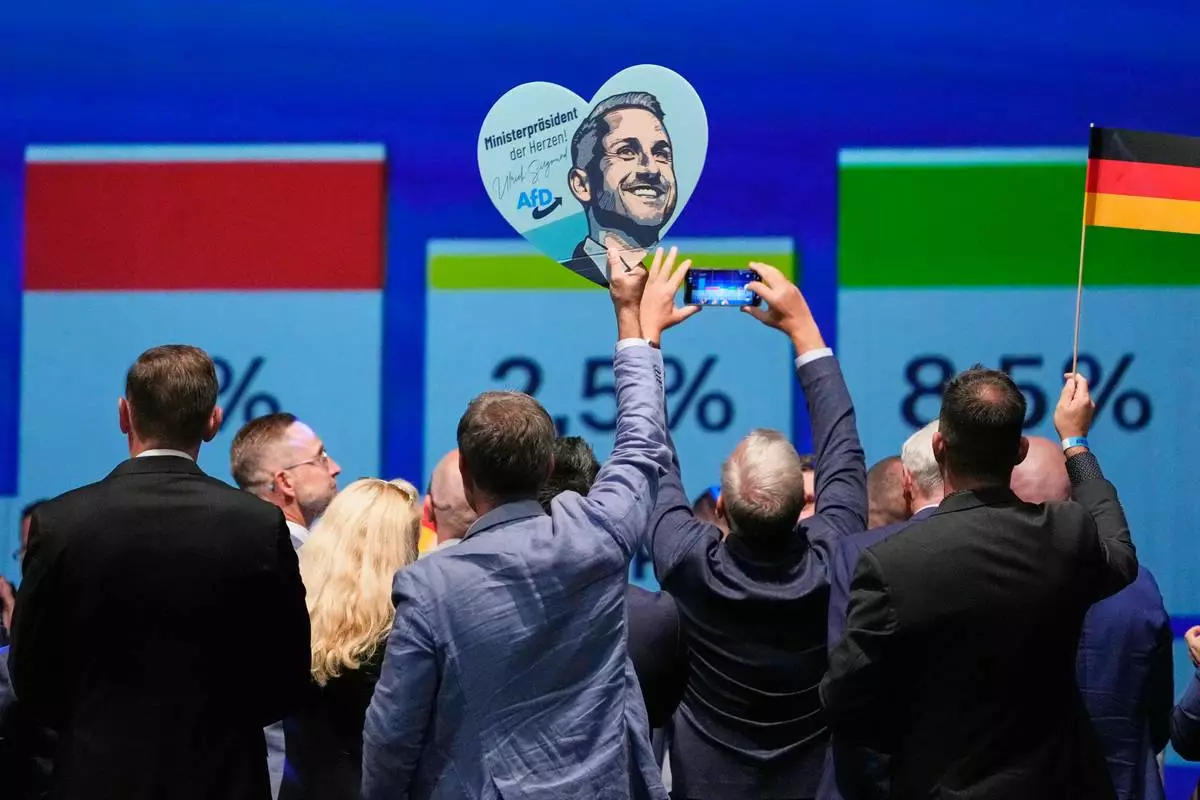
Party members celebrate with a sign of AfD top candidate Ulrich Siegmund after the first results at an election party of the "Alternative for Germany" (AfD) after the Saxony-Anhalt state elections in Magdeburg, eastern Germany, Sunday, Sept. 6, 2026. (AP Photo/Matthias Schrader)
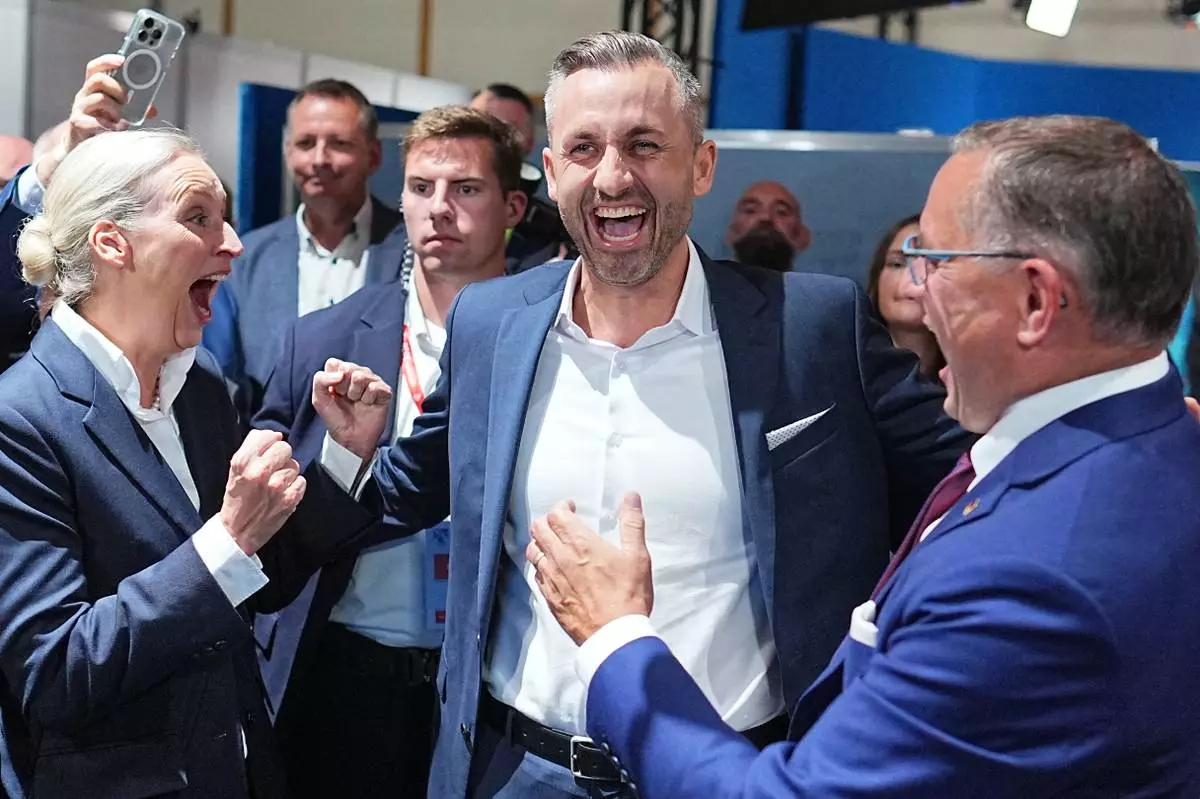
Ulrich Siegmund, center, lead candidate and co-chair of the AfD state parliamentary group in Saxony-Anhalt, celebrates with Alice Weidel, federal chairwoman and co-chair of the AfD parliamentary group in the Bundestag, and Tino Chrupalla, federal chairman and co-chair of the AfD parliamentary group in the Bundestag, after the first results at an election party of the "Alternative for Germany" (AfD) after the Saxony-Anhalt state elections in Magdeburg, eastern Germany, Sunday, Sept. 6, 2026. (Michael Kappeler/dpa via AP)
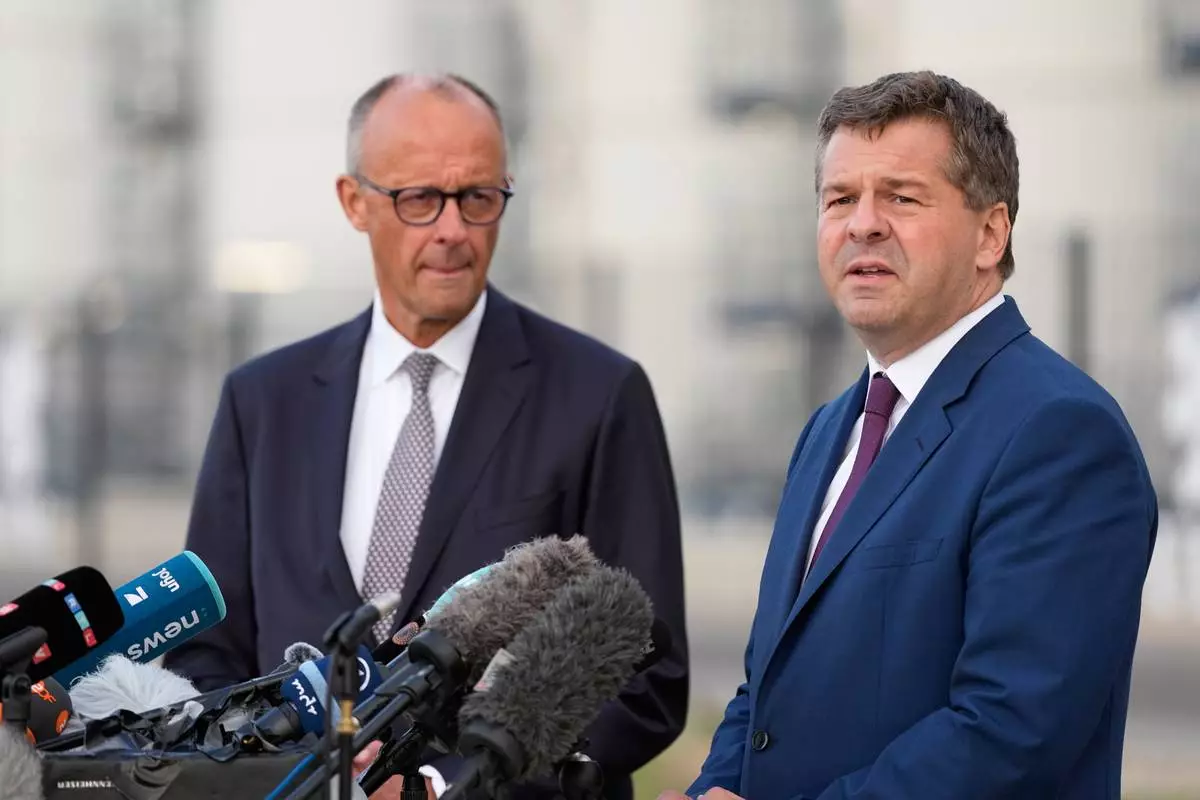
German Chancellor and Christian Democratic Union (CDU) party leader Friedrich Merz, left, and Saxony-Anhalt State Governor and top candidate Sven Schulze give a press statement after visiting UPM Biochemicals in Leuna, Germany, Thursday, Sept. 3, 2026. (AP Photo/Matthias Schrader)
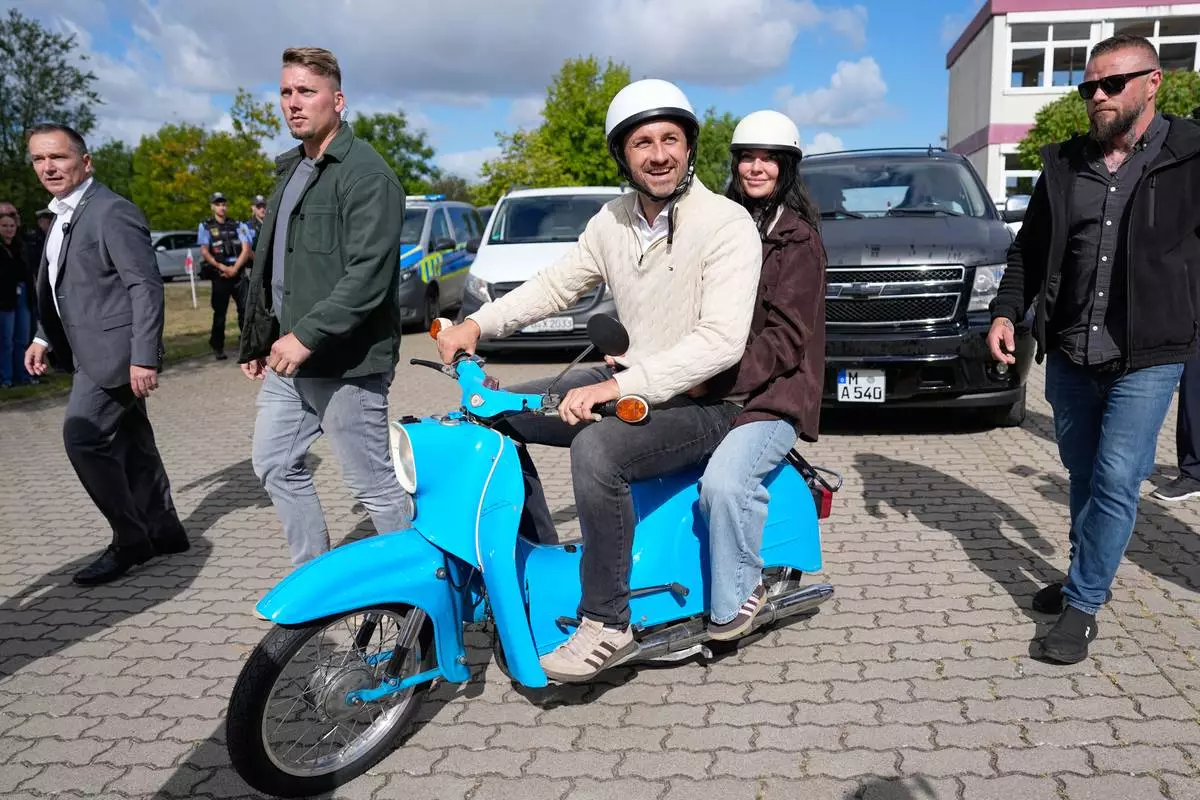
Ulrich Siegmund, top candidate for the "Alternative for Germany" (AfD) party and his wife Julia leaving a polling station on a small Schwalbe motorcycle after voting during the Saxony-Anhalt state elections in Tangermuende, eastern Germany, Sunday, Sept. 6, 2026. (AP Photo/Matthias Schrader)
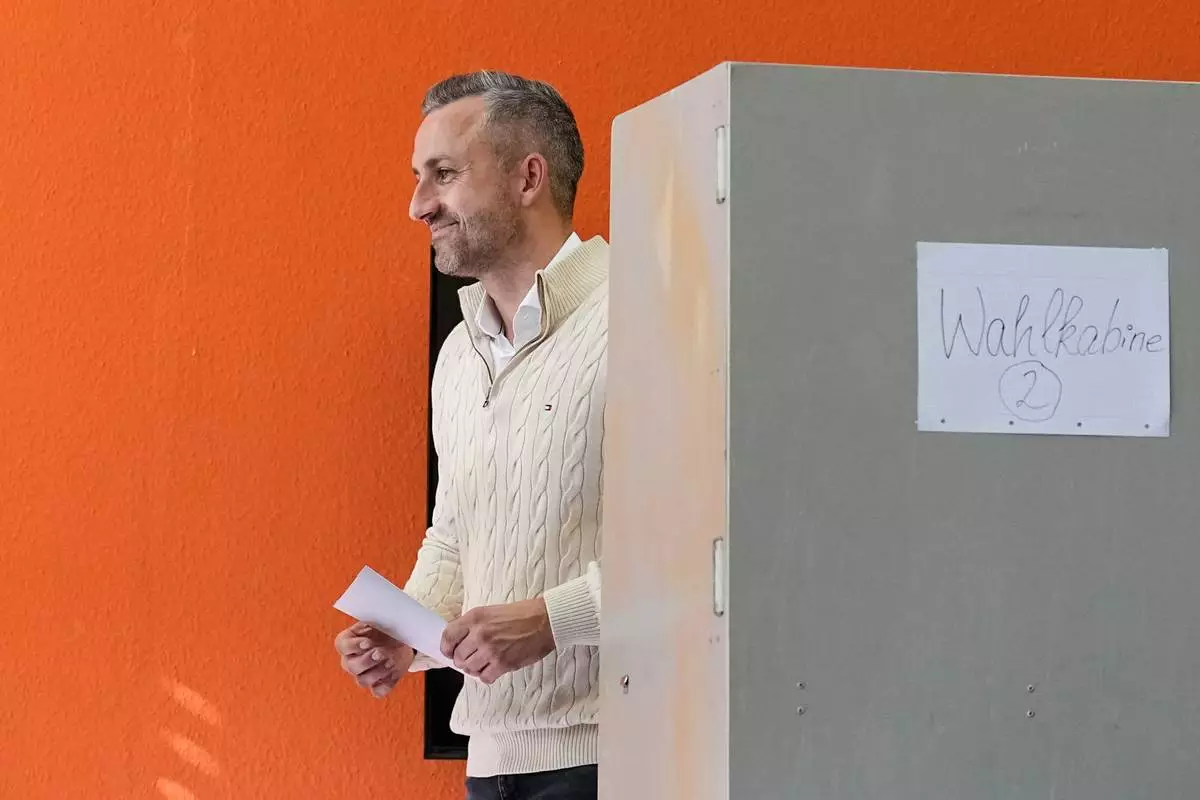
Ulrich Siegmund, top candidate for the "Alternative for Germany" (AfD) party votes at a polling station during the Saxony-Anhalt state elections in Tangermuende, eastern Germany, Sunday, Sept. 6, 2026. (AP Photo/Matthias Schrader)
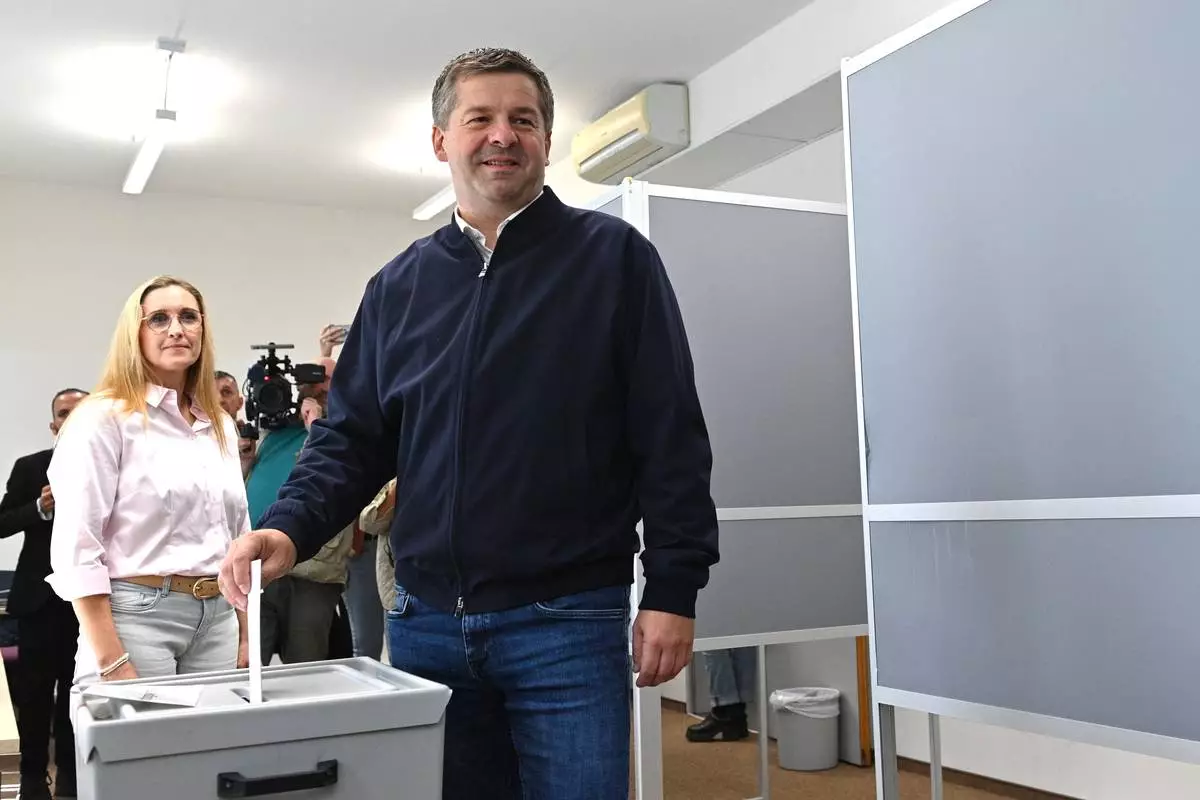
Sven Schulze, Minister-President of Saxony-Anhalt and state chairman of the CDU in Saxony-Anhalt, drops his ballot into the ballot box during the Saxony-Anhalt state election, in Magdeburg, Germany, Sunday Sept. 6, 2026. At left is his wife Kati Schulze. (Klaus-Dietmar Gabbert/dpa via AP)

Ulrich Siegmund, top candidate for the "Alternative for Germany" (AfD) party how's his motorcycle keys in party coolers after voting at a polling station during the Saxony-Anhalt state elections in Tangermuende, eastern Germany, Sunday, Sept. 6, 2026. (AP Photo/Matthias Schrader)