Two incoming passengers convicted and jailed for importing of duty-not-paid cigarettes
Two incoming male passengers were each sentenced to six months' imprisonment with a fine of $2,000 by the West Kowloon Magistrates' Courts today (September 7) for importing duty-not-paid cigarettes and failing to declare them to Customs officers, in contravention of the Dutiable Commodities Ordinance (DCO).
Customs officers intercepted two incoming Mainland male passengers, aged 32 and 42, at Hong Kong International Airport on September 5 and 6 respectively, seized a total of 61,816 duty-not-paid cigarettes, with an estimated market value of about $280,000 and a duty potential of about $205,000 from their personal baggage. The two passengers were subsequently arrested.
Customs welcomes the sentences. The custodial sentences have imposed a considerable deterrent effect and reflect the seriousness of the offences.
Customs reminds members of the public that under the DCO, cigarettes are dutiable goods to which the DCO applies. Any person who imports, deals with, possesses, sells or buys illicit cigarettes commits an offence. The maximum penalty upon conviction is a fine of $2 million and imprisonment for seven years.
Members of the public may report any suspected illicit cigarette activities to Customs' 24-hour hotline 182 8080 or its dedicated crime-reporting email account (crimereport@customs.gov.hk) or online form (eform.cefs.gov.hk/form/ced002).
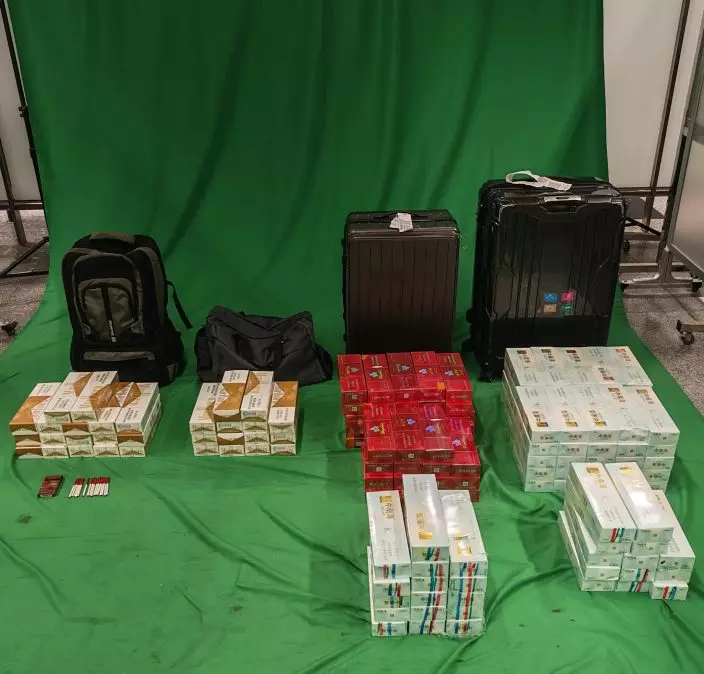
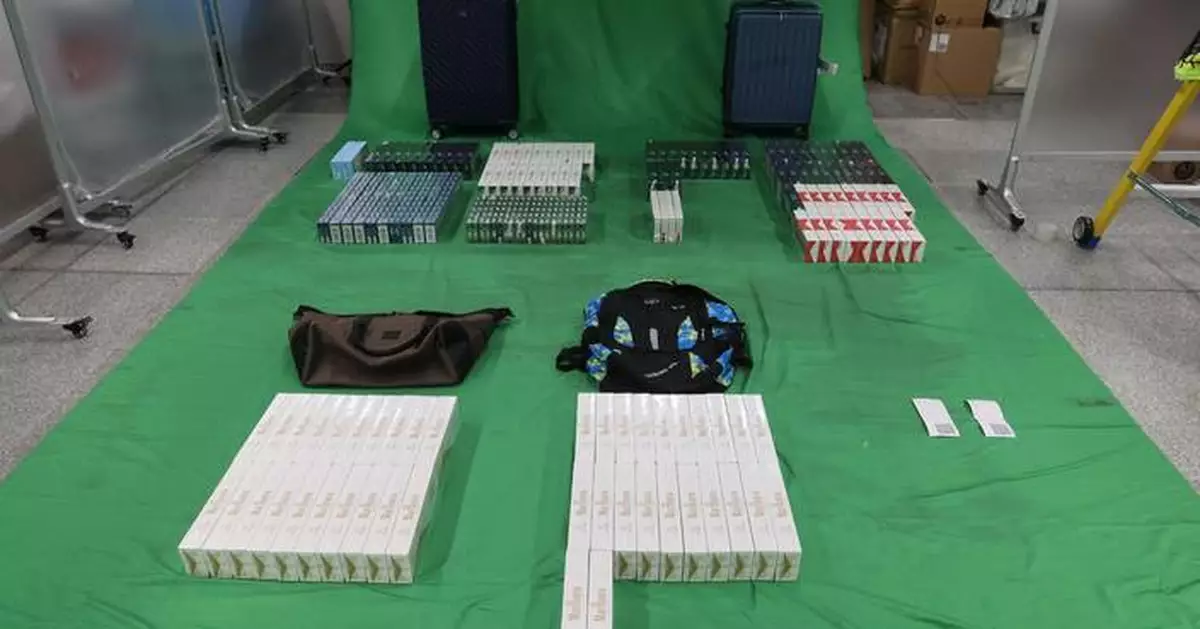
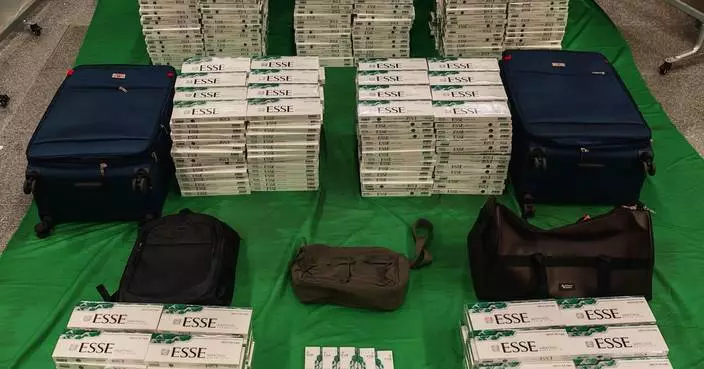
Two incoming male passengers were each sentenced to six months' imprisonment with a fine of $2,000 by the West Kowloon Magistrates' Courts today (September 7) for importing duty-not-paid cigarettes and failing to declare them to Customs officers, in contravention of the Dutiable Commodities Ordinance. Photo shows the duty-not-paid cigarettes seized from the personal baggage of the 42-year-old incoming Mainland male passenger. Source: HKSAR Government Press Releases
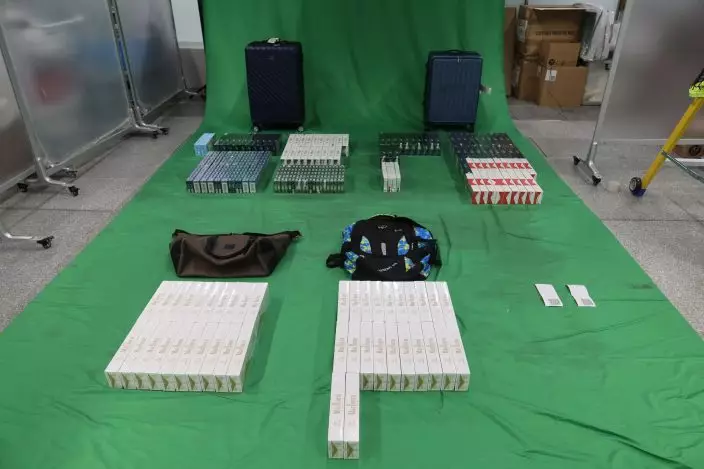
Two incoming male passengers were each sentenced to six months' imprisonment with a fine of $2,000 by the West Kowloon Magistrates' Courts today (September 7) for importing duty-not-paid cigarettes and failing to declare them to Customs officers, in contravention of the Dutiable Commodities Ordinance. Photo shows the duty-not-paid cigarettes seized from the personal baggage of the 32-year-old incoming Mainland male passenger. Source: HKSAR Government Press Releases
FEHD reviews this year's efforts to tackle dripping air conditioners
A spokesman for the Food and Environmental Hygiene Department (FEHD) said today (November 10) that the department has continued to adopt a multipronged approach to tackle the problem of dripping air conditioners, combining enhanced inspections and enforcement with publicity and education, innovative technology and adjustments to operational strategies. This year, the FEHD has fully deployed the third-generation Air-conditioning Water Dripping Inspection System, featuring infrared night-vision technology and artificial intelligence (AI) image recognition, across all districts to detect dripping locations quickly and accurately, significantly enhancing enforcement effectiveness.
The spokesman said, "As of September 30, the FEHD had issued about 8 100 nuisance notices concerning dripping air conditioners this year, representing an increase of about 16 per cent and 54 per cent over the corresponding periods last year and in 2024 respectively. The figure was about four times that for the same period in 2023. Over 99 per cent of the households that received the notices have addressed the dripping problem as required. Significant improvements have also been recorded at the locations of concern identified by the department."
In recent years, the FEHD has adopted a new operational strategy. In addition to handling public complaints, officers proactively conduct door-to-door inspections and take enforcement action, focusing on around 300 locations of concern with more serious dripping problems across districts, including bus stops, minibus stops and pedestrian passages. Each location is inspected at least once a week. By August, dripping problems at about half of these locations had been resolved or had shown significant improvement. As conditions improved at some locations, the FEHD extended its operations to more than 110 additional locations with less serious problems. As of September 30, the number of locations being followed up by the FEHD had increased from around 300 to more than 400.
The FEHD has also actively applied innovative technology, collaborating with a local innovation and technology institution to develop the Air-conditioning Water Dripping Inspection System. Using infrared night-vision technology, the system enables officers to detect dripping locations quickly in low-light conditions without entering residents' premises. The enhanced second-generation system features a remote-controlled pan-tilt head and autofocus functions. Its detection range has been extended to 120 metres, enabling it to cover buildings around 40 storeys high. In April this year, the system won a bronze award in thecategory of Engineering and Robotics – Optical Sensing and Spatial Intelligence at the Edison Awards 2026, gaining international recognition for its innovative technology. This year, the department has fully deployed the third-generation system, featuring AI image recognition, across all districts. The system uses high-precision image recognition to detect dripping locations automatically and pinpoint their sources quickly and accurately, further reducing the time required for observation and evidence collection.
In addition to strengthening enforcement, the FEHD actively collaborates with the property management sector to tackle dripping air conditioners. The department continues to promote the Scheme of Participation by Property Management Agents in Tackling Dripping Air-conditioners, inviting staff of property management companies serving private housing estates to help identify dripping sources and advise residents to rectify the problem. More than 300 private housing estates across the territory currently participate in the scheme, helping to complete follow-up and handling of an average of over 4 000 dripping complaints each year. The department also works closely with the Property Management Services Authority to provide relevant guidelines for licensed property management companies and property management personnel, and encourages more licensed companies to join the scheme.
The FEHD calls on all sectors to work together to tackle dripping air conditioners. Property management companies should regularly repair and maintain building drainage systems and remind residents to inspect and repair their air conditioners. Members of the public should also inspect and maintain their air conditioners regularly and address any dripping problems promptly to avoid causing a nuisance. For more information, please refer to the leaflet on the FEHD website (www.fehd.gov.hk/english/pleasant_environment/library/aircon/Pamphlet_water_dripping_from_air_conditioner.pdf).

Source: AI-found images