China has launched its first international standard on automotive AI safety, officially approved for project initiation by the Standardization Administration of China (SAC).
The landmark project marks the first time China has spearheaded an international standard in the field of automotive AI safety.
The standard is co-led by experts from China and the United States, who serve as joint project leaders, with specialists from Germany, France, Japan and other nations contributing to the development.
AI functions as the "digital brain" of intelligent connected vehicles (ICVs), directly shaping their operational safety. Current global standards on automotive AI safety offer only broad principles and guidelines. They lack detailed implementation rules tailored to ICVs, especially autonomous driving scenarios, and therefore fall short of addressing the industry's specific safety challenges.
Li Bo, a senior researcher at the China Auto Standardization Research Institute, said the new standard is designed to translate broad safety principles into measurable benchmarks and practical safeguards for autonomous driving. "The primary objective of this standard is to establish quantitative AI safety indicators, as well as comprehensive risk control measures covering the entire process — from safety analysis and testing validation to operational monitoring. As we know, one of the most critical metrics for autonomous driving is the failure rate: no more than one incident per 10,000 hours of operation. Based on this quantitative indicator, it must be further broken down and allocated to AI subsystems across various scenarios," said Li.
The standard systematically addresses industry-wide safety challenges posed by AI large models, such as their lack of interpretability and inherent uncertainty. It analyzes full-chain failure modes and hazard mechanisms across the entire lifecycle, and translates these insights into concrete requirements for AI system architecture, model design, hardware security, and dataset development.
Additionally, it introduces layered AI diagnostics and multi-dimensional redundancy design schemes to establish robust safety defense lines.
"The development of this standard is aimed at providing risk management guidelines for the entire lifecycle of AI safety in intelligent connected vehicles — from design, testing, and development all the way to operational monitoring. It seeks to systematically address safety hazards caused by systemic failures and insufficient AI capability output, which may arise from AI system models, data, computing power, algorithms, as well as model iteration processes," Li said.
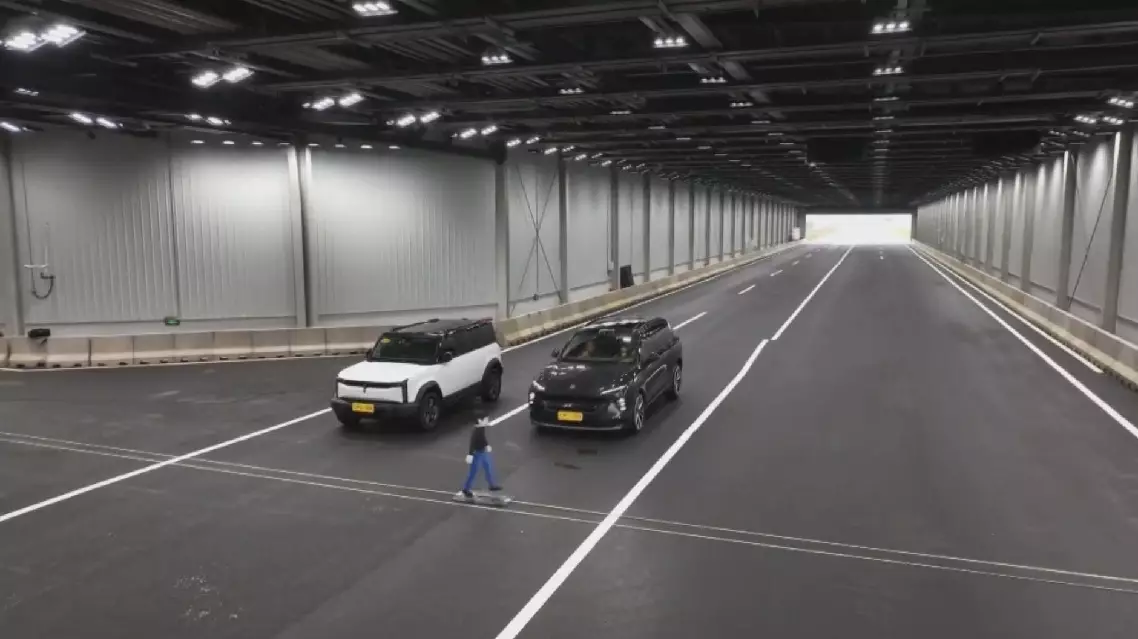
China launches first global standard for automotive AI safety