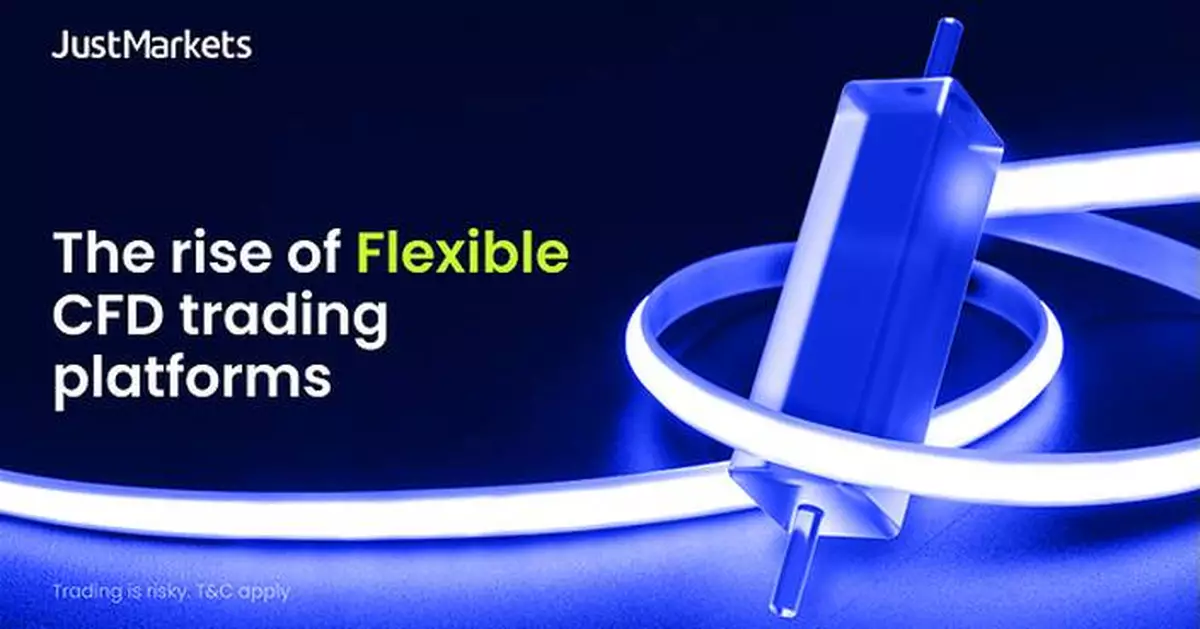
HO CHI MINH CITY, Vietnam, Sept. 7, 2026 /PRNewswire/ -- JustMarkets, a multi-asset CFD broker, has published an analysis of how platform flexibility has moved from a point of differentiation to a baseline expectation in retail CFD trading, and where browser-based terminals sit alongside desktop and mobile access.
Ten years ago, retail trading was largely centered around installed desktop terminals. That model has been losing ground. Finance Magnates Intelligence estimated mobile as responsible for 64.6% of retail trading transactions in 2025. According to FCA's Financial Lives 2024 survey, there were 1.6 million UK adults who used a trading app, 47% of whom fell in the age group 18–34.
What Flexibility Means Now
Flexibility refers to how far the trading environment adapts to the user. This may include position flexibility, API integration, copy trading services, automated trading solutions, or the capacity to switch between desktop, mobile, and web platforms. While the feature list may vary by platform, the technology tends to adapt to the CFD trader's style of trading.
The broader online trading platform market has grown alongside this shift: Mordor Intelligence estimates its value at $12.57 billion in 2026, increasing to $18.18 billion in 2031, with cloud deployment being 63.42% of the market in 2025.
Where Browser Terminals Belong
Browser terminals sit between the installed desktop version and the mobile version. They skip the installation step and work on different operating systems, which may become significant when a work laptop and a home machine have different settings.
JustMarkets entered this niche with WebTerminal, which allows trading in MT5 accounts directly from the Personal Area without downloading anything. The terminal features charts with indicators and drawing tools, volume in lots and CFD asset units, instrument description, market sentiment, trading schedule changes, margin level, multiple positions, and pending orders management.
Convenience and Risk Are Two Distinct Features
Easier access does not reduce the risks involved. According to ASIC, 133,674 Australian retail clients incurred losses from CFD trading in FY2023/24, with total net losses exceeding A$458 million. By the end of the period, 68.42% of retail clients had lost money. Kalda et al., writing for NBER, also found that trading via smartphones was associated with greater risk-taking and stronger return-chasing behavior.
Regulators have responded with structural measures. The FCA restricts retail leverage between 30:1 and 2:1 depending on the underlying instrument; ESMA implements margin close-out and negative balance protection. These restrictions vary between jurisdictions and providers. Leverage increases market exposure, capital volatility, and the potential for losses, and CFDs remain leveraged instruments whose value may change in response to relatively small moves in the underlying market.
What It All Sums Up To
Flexibility has settled down to become one of the basic requirements. It has served as a differentiation factor for a couple of years, but now, for many traders, it sounds like a minimum expectation.
The new question to consider is this: less about where you can open a position, and more about what the platform still does well once the novelty wears off. In this context, the JustMarkets WebTerminal is one of the examples of how brokers respond to these shifting demands by making web browser accessibility a part of the trading process.
Risk Warning: Trading financial instruments involves significant risk and may not be suitable for all investors. Market conditions can change rapidly, and losses may exceed deposits. Ensure you understand the risks involved and trade responsibly.
** This press release is distributed by PR Newswire through automated distribution system, for which the client assumes full responsibility. **
JustMarkets Examines the Rise of Flexible CFD Trading Platforms

From United Nations related camps to 8,000 person workforce facilities and 30,000 square meter commercial projects, Lida Group is expanding modular construction solutions for complex international developments.
QINGDAO, China, Sept. 7, 2026 /PRNewswire/ -- Lida Group, a modular building manufacturer and prefabricated construction company, is expanding its integrated modular construction services to support large scale projects across international markets, combining design, factory production, logistics and site installation under one project delivery model. With project experience spanning United Nations related facilities, large labor camps, energy projects and commercial buildings, the company is broadening its role in international modular construction.
The expansion reflects a practical shift in how modular buildings are being used across global projects. Large workforce camps, remote energy facilities and infrastructure developments often require multiple building types within the same site. Accommodation may need to be delivered alongside offices, dining facilities, clinics, warehouses and other operational spaces. Lida Group addresses these requirements through an integrated building portfolio and coordinated project services.
From Modular Units to Integrated Project Delivery
Established in 1993, Lida Group designs, manufactures and installs modular and prefabricated building systems. Its portfolio includes labor camps, container houses, prefabricated houses, steel structure buildings and other integrated buildings.
The company has also established a one stop service platform covering integrated camp construction, industrial construction, civil construction, infrastructure construction, logistics services, property management, human resource services, building materials and construction equipment supply, and programming and design.
This model gives international contractors and project owners access to multiple construction services through a single supplier. For projects operating across remote or demanding locations, coordination between design, production, transportation and installation can directly affect project schedules and site operations.
"Large international projects require more than individual building units. They require a coordinated process that connects design, manufacturing, logistics and installation," said George Wang, Vice President of Lida Group. "Our focus is to make modular construction easier to deploy at scale, especially for projects where site conditions, workforce requirements and delivery schedules vary from one market to another."
Project Scale Across International Markets
Lida Group's project record provides evidence of its experience across different project sizes and operating environments.
In 2013, Lida Group supplied 600 container houses for a United Nations peacekeeping camp in Bor, South Sudan. Lida Group also participated in a United Nations aided library and printing building project in Senegal.
The company's workforce accommodation projects extend to the Middle East. Its project portfolio includes a 5,000 person container camp and an 8,000 person prefabricated labor camp in Saudi Arabia. Lida Group has also completed a prefabricated house labor camp project for Saudi Bin Laden Group.
The company's modular systems have been used in energy and industrial settings as well. Its project portfolio includes a welded container camp for an oil and gas company in Eastern Europe and a hydropower station camp project in Malaysia.
At a larger commercial scale, Lida Group completed a farmers market project covering approximately 30,000 square meters in West Africa. The project expands the application of its construction capabilities beyond workforce accommodation into large commercial facilities.
Building for Cross Border Projects
Lida Group has established seven subsidiaries and overseas branch offices in Saudi Arabia, Qatar, the United Arab Emirates, Kuwait, Malaysia, Sri Lanka, Maldives, Angola and Chile. The company states that its products have been exported to more than 155 countries and regions.
Its quality and management credentials include ISO 9001, ISO 14001 and ISO 45001 certifications, EU CE certification under EN1090, and inspections by SGS, TUV and BV. Lida Group also holds Chinese qualifications related to steel structure professional construction contracting and general construction contracting.
The company has established cooperation with major engineering and construction organizations including China State Construction Engineering Corporation, China Railway Engineering Group, China Railway Construction Group, China Communications Construction Company, China Power Construction Corporation, Sinopec, CNOOC, MCC Group and Saudi Bin Laden Group.
For Lida Group, the next stage of modular construction is centered on project delivery. Its expanding service model brings factory built structures, engineering services and international project execution into one framework, giving contractors and project owners a broader way to deploy modular buildings across large and complex developments.
About Lida Group
Established in 1993, Lida Group specializes in the design, production and installation of modular and prefabricated buildings. Its main products include labor camps, container houses, prefabricated houses and steel structure buildings. The company provides integrated building solutions for projects across more than 155 countries and regions, supported by subsidiaries, overseas offices and manufacturing operations. For more information, please visit https://www.lidamodularhouse.com/
Media Contact:
Lida Group
Tel: +86-532-88966982 88965892
Whatapp/Wechat: +86-13793209022
Email: Marketing@lidajituan.com
Website: www.lidamodularhouse.com
** This press release is distributed by PR Newswire through automated distribution system, for which the client assumes full responsibility. **
Lida Group Expands Integrated Modular Construction Services for Large Scale Global Projects