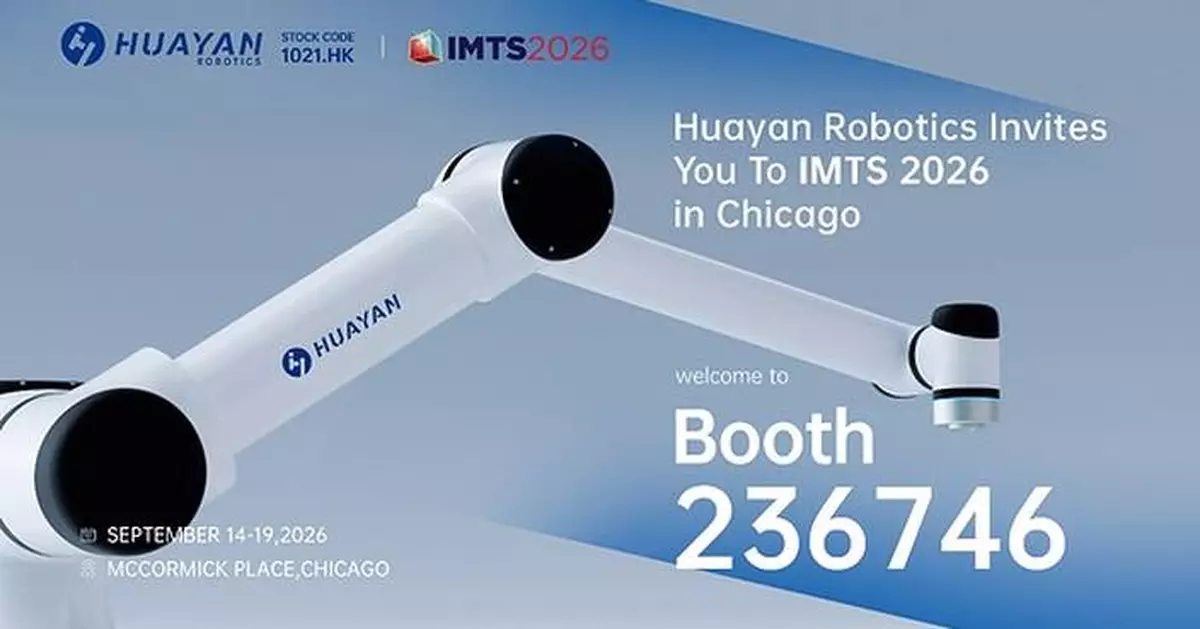
CHICAGO, Sept. 7, 2026 /PRNewswire/ -- From September 14 to 19, Huayan Robotics will participate in IMTS 2026 at McCormick Place in Chicago, the United States (Booth No.: 236746). Started in 1927 and held biennially, this 99-year-old manufacturing technology show is expected to attract more than 2,000 exhibitors and 90,000 professional visitors from around the world. The 2026 edition will provide a platform for companies to gain insights about the latest trends in global manufacturing technologies.
At IMTS 2026, Huayan Robotics will highlight its flexible and intelligent manufacturing capabilities across welding, palletizing, CNC machine tending, vision inspection, force-controlled grinding, and more.
Featured solutions will include:
- The E12-Pro collaborative robot for welding. With a 1.8-meter reach, the E12-Pro is designed to handle large or irregular welding workpieces. It can be configured with integrated force control and AI vision for applications such as visual positioning, inspection, polishing, and grinding.
- A palletizing robot for high-throughput material handling. With a payload of up to 60 kg and a palletizing speed of 8–13 cycles per minute, the solution is designed for demanding operations in food and beverage, daily chemicals, logistics, and other high-volume industries.
- A collaborative robot solution for CNC machine tending. Optimized motor control and algorithms can increase loading and unloading speed by up to 50%, while internal or external deployment options and high-speed or collaborative operating modes support flexible integration with different CNC machines.
- The HY 7 and Echo 5 7-axis humanoid robotic arms for embodied robotic platforms. Their seven-axis configurations provide human-like flexibility and obstacle avoidance in confined spaces, while native ROS 2 support and open communication protocols help simplify integration with humanoid, quadruped, and other embodied robotic systems.
About Huayan Robotics
Backed by over 20 years of expertise in technical innovation, Huayan Robotics develops an ecosystem of core motion components, including motors and joint modules, robotic platforms, and the full chain of embodied intelligence. As one of China's largest collaborative robot exporters by export volume, Huayan Robotics' solutions support more than 60 process scenarios across over 40 industries, serving customers in more than 50 countries and regions.
Visitors are invited to explore Huayan Robotics' latest collaborative robots and automation solutions at Booth 236746 and discuss their manufacturing needs with the company's team.
Media Contact
Website: https://www.huayan-robotics.net/
LinkedIn: https://www.linkedin.com/company/huayanrobotics
YouTube: https://www.youtube.com/@Huayanrobotics
Email: marketing.oversea@huayan-robotics.com
** This press release is distributed by PR Newswire through automated distribution system, for which the client assumes full responsibility. **
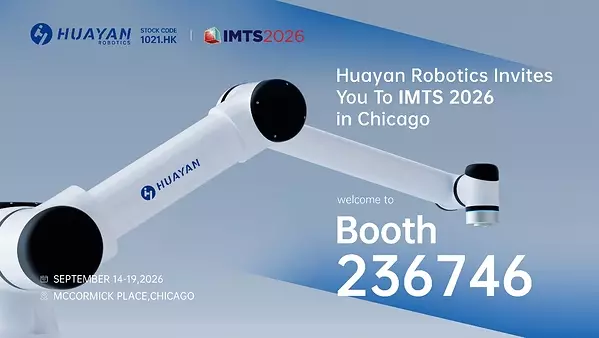
Huayan Robotics to Present Chinese Intelligent Manufacturing Solution at IMTS 2026
- Advancing Precision Diagnosis and Treatment
- Photodynamic Therapy Introduced for the First Time into Colposcopy Faculty Training in China
WUHAN, China, Oct. 23, 2026 /PRNewswire/ -- The 2026 CSCCP-ASCCP Colposcopy Training Course, held in Wuhan from October 21 to 23, concluded successfully. Jointly organized by the Chinese Society for Colposcopy and Cervical Pathology (CSCCP) and the American Society for Colposcopy and Cervical Pathology (ASCCP), and co-hosted by Tongji Hospital and Union Hospital, both affiliated with Tongji Medical College of Huazhong University of Science and Technology, the program featured live demonstrations and teaching sessions on representative clinical cases, lectures on foundational principles and the latest advances, interdisciplinary clinical-pathological discussions, and multidisciplinary team (MDT) consultations on challenging cases. Emphasizing precision diagnosis, treatment, and risk-stratified management, the program also marked the first time photodynamic therapy (PDT) had been incorporated into colposcopy faculty training in China, with the PDT training sessions supported by Asieris Pharmaceuticals. This initiative represents a practical contribution to China's efforts to foster a fertility-friendly society and advance the management of cervical lesions toward greater precision and non-invasive treatment.
During the three-day program, more than 60 clinicians specializing in colposcopy and the diagnosis and treatment of cervical lesions from across China completed systematic training and the final examination. The program was conducted under the honorary chairmanship of Professor Ding Ma, Member of the Chinese Academy of Engineering and Chair of the Department of Obstetrics and Gynecology at Tongji Hospital. Professor Peng Wu, Director of the Department of Obstetrics and Gynecology at Union Hospital, served as program lead. Professor Nan Yu, Head of the Cervical Disease Specialty at Tongji Hospital, and Professor Rui Gao of Union Hospital served as course coordinators.
The faculty also included Professor Christine Conageski of the University of Colorado; Professor Chenquan Zhao, University of Pittsburgh Medical Center and Chief Overseas Medical Advisor to CSCCP; Professor Yuxin Liu of the Department of Pathology at the Icahn School of Medicine at Mount Sinai; and Professor Francisco García, Member of the U.S. National Academy of Medicine and former President of ASCCP, among other experts.
Precision Diagnosis and Risk-Stratified Management Throughout the Training Program
The principles of precision diagnosis, treatment, and risk-stratified management were integrated into every component of the program, from procedural demonstrations and theoretical lectures to case-based discussions. During live demonstrations of colposcopy, loop electrosurgical excision procedure (LEEP), laser ablation, and PDT, experts presented cases representing different risk levels, incorporating risk-based decision-making throughout colposcopic assessment, biopsy sampling, and individualized treatment planning.
The didactic sessions covered a comprehensive range of clinical topics. Chinese and U.S. experts discussed triage and management of individuals who test positive for HPV during primary screening; HPV integration empowers precision diagnosis and treatment of cervical lesions; advances in the pathological diagnosis of cervical cancer and precancerous lesions; colposcopy techniques and quality control; standardized colposcopy terminology and reporting; treatment strategies for cervical intraepithelial neoplasia grade 2 (CIN2) based on the latest 2026 U.S. National Cancer Institute data; the development and clinical translation of the world's first trivalent HPV therapeutic vaccine; risk-based colposcopy management; management of positive surgical margins following cervical conization; diagnostic pitfalls in cervical biopsy pathology; colposcopy and fertility preservation in lower genital tract and cervical diseases; the colposcopic identification of cervical glandular lesions; and the diagnosis and treatment of vaginal intraepithelial neoplasia with case sharing; interpretation of the 2026 ISSVD terminology standards for vulvar intraepithelial neoplasia and squamous intraepithelial lesions; and the diagnosis and management of vulvar lichenoid diseases.
From triage following a positive primary HPV screening result to quality assurance in colposcopy, standardized reporting, and the management of positive surgical margins, the program promoted an integrated approach spanning the entire care pathway: screening, triage, diagnosis, treatment, and follow-up.
During the interdisciplinary clinical-pathological and MDT case discussions, Chinese and international experts guided participants through case reviews incorporating pathological findings. In-depth discussions addressed key diagnostic challenges, including concordance between colposcopic impressions and pathological diagnoses, as well as potential pitfalls in cervical biopsy interpretation. These sessions helped participants strengthen their ability to integrate clinical, pathological, and molecular information to support more precise clinical decision-making.
Several participating clinicians noted that this risk-stratified approach to faculty training offered practical guidance for standardizing colposcopy practice, particularly in primary and community-level healthcare settings.
PDT Incorporated into Colposcopy Faculty Training in China for the First Time, Supporting Standardized Non-Invasive Treatment
Another highlight of the program was the first-ever inclusion of PDT in a colposcopy faculty training program in China, with a dedicated curriculum combining theoretical instruction and simulated hands-on practice.
As cervical precancerous lesions are increasingly being diagnosed in younger women, an important clinical challenge is how to effectively treat these lesions while preserving reproductive function in women of childbearing age. Traditional excisional treatments can effectively remove lesions but may increase the risks of adverse pregnancy outcomes, including miscarriage and preterm birth, as well as cervical stenosis.
PDT is a non-excisional, non-invasive treatment approach that uses light-activated photosensitizers to selectively target abnormal cells. It can also help eliminate high-risk human papillomavirus (HPV), offering a treatment option that aims to control lesions while preserving normal cervical anatomy and function. This approach may be particularly relevant for women who wish to preserve their fertility.
PDT has been recommended in relevant expert consensus documents, and a portable cervical PDT technology has been approved in China for the treatment of CIN2. It may be particularly suitable for women who plan to conceive in the near future or who wish to preserve their future reproductive options, subject to individualized clinical assessment.
During the training, experts provided live demonstrations of LEEP, laser ablation, and PDT, enabling participants to observe procedural workflows and the considerations involved in selecting appropriate patients. The curriculum also included sessions on procedural principles and simulated practice in colposcopy, LEEP, laser ablation, and PDT. Under expert supervision, participants practiced the relevant procedures and learned the standardized operating protocols, principles of efficacy assessment, and key considerations for post-treatment follow-up associated with PDT.
A dedicated lecture on colposcopy for lower genital tract and cervical diseases, with a focus on fertility preservation, further reinforced the importance of fertility-conscious clinical decision-making.
The inclusion of PDT in colposcopy faculty training represents a step toward equipping clinicians not only with standardized diagnostic skills but also with training in non-invasive treatment options. By strengthening clinical capabilities across both diagnosis and treatment, the program supports more comprehensive management of cervical lesions while contributing to China's broader efforts to build a fertility-friendly society.
From advancing risk-stratified precision management to pioneering the inclusion of PDT in colposcopy faculty training in China, 2026 CSCCP-ASCCP Colposcopy Training Course—Wuhan Station represented more than a systematic effort to strengthen clinical teaching capabilities. It also marked an important practical step toward more precise, individualized, and non-invasive management of cervical lesions.
** This press release is distributed by PR Newswire through automated distribution system, for which the client assumes full responsibility. **
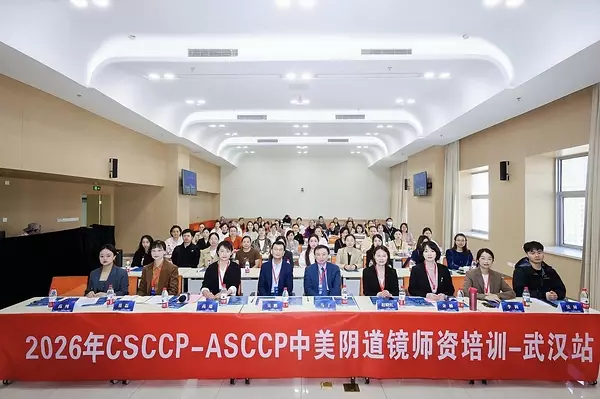
2026 CSCCP-ASCCP Colposcopy Training Course--Wuhan Station Concludes, Promoting More Precise and Non-Invasive Management of Cervical Lesions