Skip to Content Facebook Feature Image

Stoke Raises Series E to Accelerate Fully Reusable Launch

Business

Stoke Raises Series E to Accelerate Fully Reusable Launch
Business

Business

Stoke Raises Series E to Accelerate Fully Reusable Launch

2026-09-08 17:03 Last Updated At:17:10

KENT, Wash.--(BUSINESS WIRE)--Sep 8, 2026--

Stoke Space Technologies, Inc. the rocket company developing fully and rapidly reusable launch vehicles, announced today that it has completed an initial closing of its billion-dollar Series E financing round. This funding brings Stoke’s total capital raised to $2.3 billion and will support the company as it prepares for its first orbital launch, expands production and launch capacity, and accelerates development of its larger Nova Block 2 launch vehicle.

This press release features multimedia. View the full release here: https://www.businesswire.com/news/home/20260903687535/en/

The round was co-led by Point72 Ventures and Spark Capital, with participation from General Innovation, Glade Brook Capital, US Innovation Technology, Washington Harbour Partners, Woven Capital, Y Combinator, and other new and existing investors.

“Stoke is pursuing what we see as one of the most important opportunities in space transportation: making launch fully reusable, reliable, and scalable,” said Chris Morales, Partner at Point72 Ventures. “Having supported Stoke through multiple stages of its growth, we believe this company has demonstrated both the exceptional technical progress and the ambition to build a launch system capable of serving the market at industrial scale. That progress has strengthened our conviction in the team. We are proud to support Stoke as it moves toward flight and high-cadence operations.”

“Every mature transportation system is built around fully reusable vehicles. It’s the only way to reach the cost floor while scaling availability. Space transportation will be no different,” said Andy Lapsa, co-founder and CEO of Stoke. “We are humbled by the trust our investors and customers have placed in us in pursuit of this critical generational challenge. This investment enables us to scale toward delivering the capability and cadence our customers require.”

The financing advances the development of Stoke’s core reuse technologies, alongside manufacturing, test, launch, and recovery infrastructure to support high-cadence operations. Stoke’s Nova Pathfinder vehicle is approaching its first flight. Pathfinder will carry payloads to orbit while proving Nova’s core architecture, full reuse technologies, and operational capabilities. Stoke is targeting early 2027 for the first orbital launch of Pathfinder.

Over the last several years, the launch market has been sending a clear and consistent signal demanding more capacity, greater availability, and flexibility to fly larger missions. Accordingly, the Series E funding also supports an expanded product roadmap. Stoke’s higher capacity Nova Block 2 vehicle is already under development and carries forward the architecture and technologies being proven on Pathfinder. Nova Block 2 delivers 15 metric tons to low Earth orbit (LEO) in a 5-meter payload fairing. Its first launch is targeted for 2029, with production and flight cadence ramping quickly from there.

“ Full reusability is the inevitable end state of the market, providing an order-of-magnitude cost and service advantage over partially reusable rockets,” said Clay Fisher, General Partner at Spark Capital. “Stoke had the right thesis seven years ago and has paired that prescient vision with a blistering pace of execution. As a result, they stand uniquely positioned to give customers more choice and capacity when they need it, and to unlock an enormous new economy in space.”

For a deeper look at the vehicle architecture and development strategy, see Stoke’s roadmap from Nova Pathfinder to Nova.

“Nova Pathfinder is how we turn the promise of Nova into flight-proven capability,” Lapsa said. “Pathfinder allows us to learn quickly, reduce risk, and prove the hardest parts of a fully reusable architecture in flight. Nova Block 2 scales those lessons into the capacity and cadence our customers are asking for. This investment allows us to move with urgency on both and brings us closer to delivering payloads to any orbit at any time.”

About Stoke

Stoke is building fully and rapidly reusable launch vehicles designed to provide reliable, on-demand transportation to, through, and from space. Its vehicles are designed for rapid turnaround and high-frequency operation, dramatically lowering the cost of access while expanding the range of missions that launch systems can serve. Stoke’s technology development has been supported by NASA, the U.S. Space Force, the Defense Innovation Unit, the National Science Foundation, and other commercial and government partners.

The upper stage flight article for Flight 1 of Stoke Space’s Nova Pathfinder launch vehicle at the company’s headquarters in Kent, Wash.

The upper stage flight article for Flight 1 of Stoke Space’s Nova Pathfinder launch vehicle at the company’s headquarters in Kent, Wash.

NORMAN, Okla. (AP) — The Sooner Schooner was parked on the sideline on a rainy Sunday and there were quite a few empty seats at home for Oklahoma's 24-17 win over No. 19 Mississippi, after the Rebels didn't arrive in time to play the game as scheduled the previous day.

Oklahoma fans who did brave rain and chilly temperatures booed loudly when the Rebels ran out on the field before the start of the game.

They also had plenty to cheer about as the Sooners (6-4, 4-3 SEC) overcame the unusual situation to get consecutive wins for the first time this year. And that pretty much ended any chance for the Rebels (6-4, 4-4) to get back into the 12-team College Football Playoff for the second season in a row.

Ole Miss arrived in Oklahoma City on Saturday night. The FAA’s decision to ground all flights on Friday sent sports teams nationwide scrambling for new travel accommodations.

While some other games adjusted kickoff times, Mississippi-Oklahoma was the only FBS game pushed back a day until Sunday.

Oklahoma athletic director Roger Denny was upset with the decision, saying the Southeastern Conference threatened the Sooners with a forfeit if they didn't agree to play Sunday.

“I understand that difficult decisions sometimes must be made under extraordinary circumstances,” Denny said in a statement on Saturday. “Put simply, this decision isn’t fair to our athletes, our institution or to Sooner nation.”

Clint and Kelsey Epperson, with their son and a buddy, stood in a steady rain outside Gaylord Family-Oklahoma Memorial Stadium before kickoff. They drove three hours from Commerce in northeast Oklahoma — where baseball Hall of Famer Mickey Mantle grew up — to celebrate their son's 10th birthday.

They had bought game tickets in advance and paid $140 to stay in Norman an extra night.

“We were coming, no matter what,” said Clint Epperson, who agreed with Denny that SEC Commissioner Greg Sankey didn’t have enough consideration for the fans in changing the game. “We were an afterthought.”

On a normal game day, the streets outside the stadium are lined with tailgating fans. The pregame mood was subdued Sunday, with a sprinkling of fans wandering around and tents and outerwear dominating the scene.

Oklahoma cut the prices of beer and other concessions to draw fans, and moved basketball and wrestling events to later in the day. Football tickets were available online for as low as $20, fees included, in the hours leading up to kickoff.

The temperature when the game started just after noon local time was 44 degrees with 19 mph wind gusts making it feel closer to freezing. Those conditions were pretty steady throughout, as was the rain. The game had originally been scheduled for 3:15 p.m. Saturday, when it was about 10 degrees warmer and much drier.

Ole Miss officials insisted they did everything possible to avoid postponing the game, and had every intention to fly to Oklahoma on Friday night and play Saturday. They also reiterated Sankey’s remarks that the school's charter company could not accommodate a late Friday night departure after the stoppage was lifted.

“At that hour, due to the time required to rescreen the party and travel to the Tupelo airport, the crew’s duty time would have expired prior to departure,” Ole Miss said in its statement Saturday. “There were no other flight options at that point, and we determined it was too late to put our student-athletes on a bus trip of eight or more hours. In addition, the flight crew’s duty time restrictions prevented us from being able to fly out until Saturday afternoon at the earliest.”

Ken Gallon, a 20-year Sooners season ticket holder, drove three hours as usual for the game and, like most fans wandering around the stadium before kickoff, was draped in a jacket and a rain poncho.

“I have to agree with the (Oklahoma) AD,” Gallon said. “I think that the commissioner took into account Ole Miss’s whatever and did whatever they wanted and they certainly didn’t do what we wanted, which was play on Saturday.”

Sign up for Top 25 poll alerts here, visit the Top 25 here and see AP’s full college football coverage here

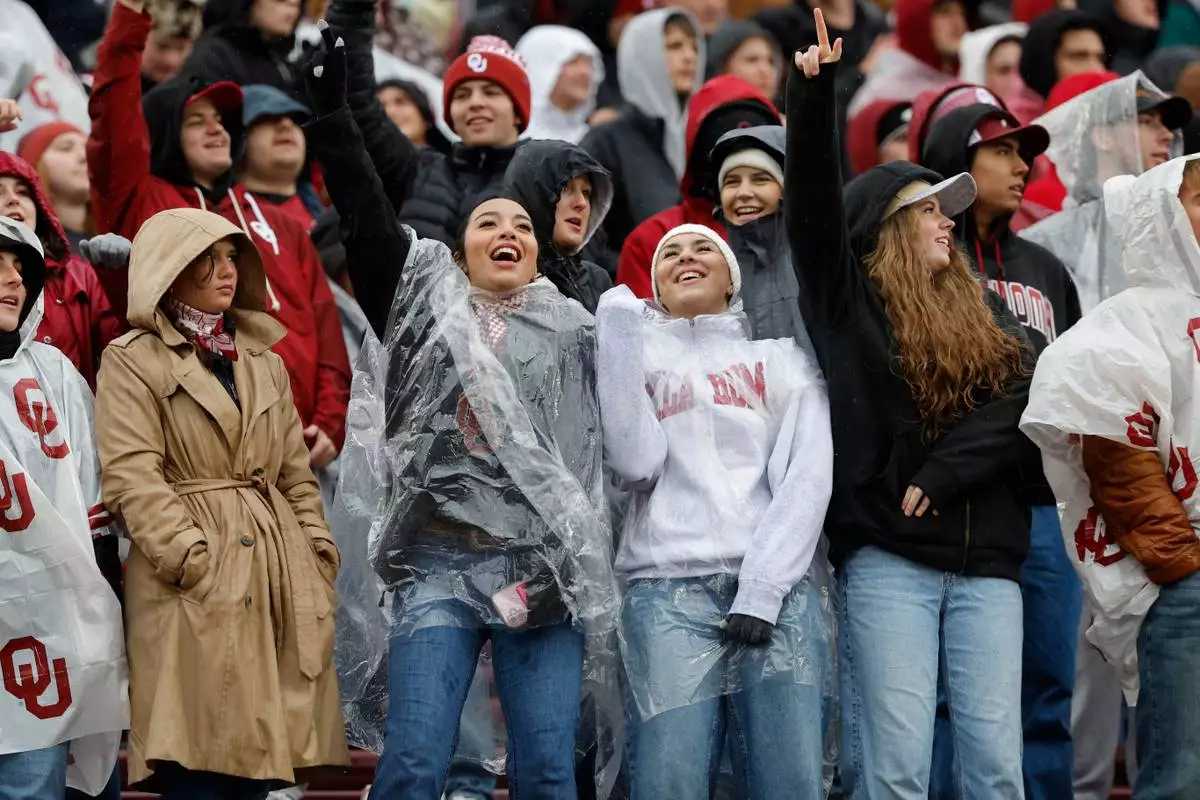
Oklahoma student section cheer in the rain before an NCAA college football game against Mississippi in Norman, Okla., Sunday, Nov. 15, 2026. (AP Photo/Alonzo Adams)

Oklahoma student section cheer in the rain before an NCAA college football game against Mississippi in Norman, Okla., Sunday, Nov. 15, 2026. (AP Photo/Alonzo Adams)

Recommended Articles