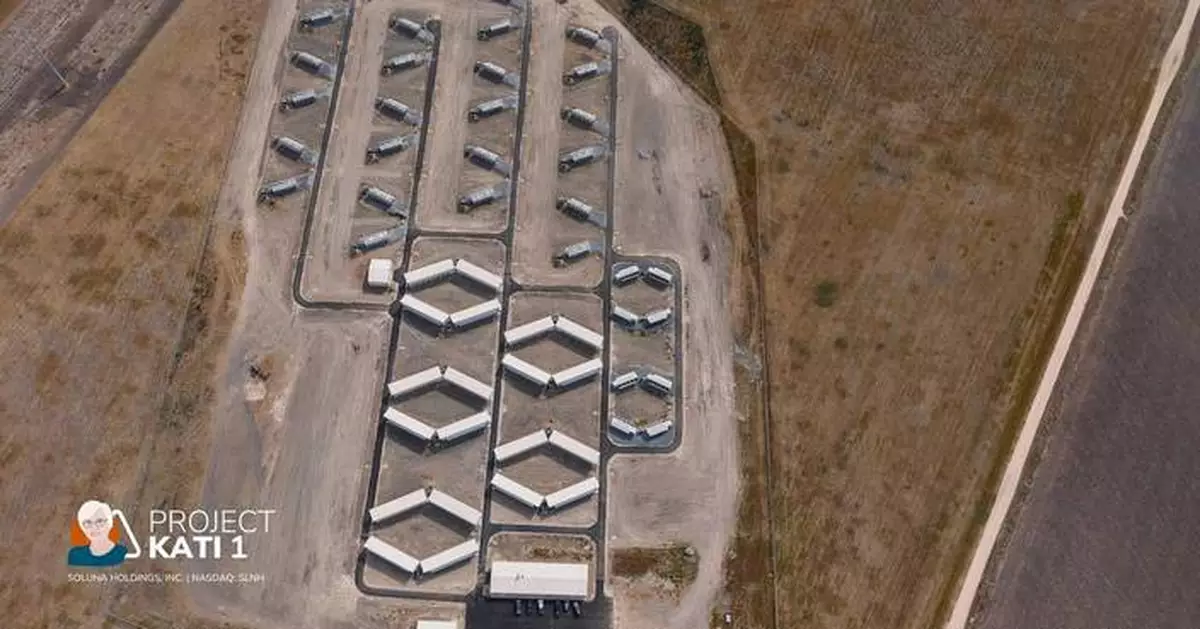
Skip to Content Facebook Feature Image

Soluna Finishes Kati 1 and Secures Conditional Base Load Position for All 166 MW in ERCOT

Business

Soluna Finishes Kati 1 and Secures Conditional Base Load Position for All 166 MW in ERCOT
Business

Business

Soluna Finishes Kati 1 and Secures Conditional Base Load Position for All 166 MW in ERCOT

2026-09-08 19:30 Last Updated At:19:40

ALBANY, N.Y.--(BUSINESS WIRE)--Sep 8, 2026--

Soluna Holdings, Inc. ("Soluna" or the "Company") (NASDAQ: SLNH), a developer of green data centers for intensive computing applications, including AI and Bitcoin mining, today announced two milestones at its Project Kati campus in Willacy County, Texas. The Company has energized the final 14 MW at Project Kati 1, completing the 83 MW site, and has been notified that ERCOT has conditionally classified the full 166 MW Kati campus, including the planned Kati 2 AI expansion, as Base Load in its Batch Zero interconnection process.

This press release features multimedia. View the full release here: https://www.businesswire.com/news/home/20260908967115/en/

With Project Kati 1 complete, Soluna's total operating capacity increases to approximately 206 MW, delivering on the timeline the Company outlined on its second-quarter earnings call. Every phase of Project Kati 1 was delivered on time with infrastructure costs on budget.

Batch Zero is ERCOT's transitional process for evaluating large load interconnection requests on a system-wide basis, replacing the prior project-by-project approach. A Base Load classification means a project's interconnection capacity is preserved on the basis of prior study work, and that the project is not subject to further reliability evaluation or megawatt allocation within the Batch Zero study. According to ERCOT, more than 438,000 MW of large load interconnection requests had entered the queue as of mid-2026, with nearly 90 percent coming from data centers.

The classification is conditional pending completion of ERCOT's ongoing verification process, under which ERCOT may remove a project from Batch Zero if the applicant does not respond to its information requests. Soluna is participating in the verification process and expects the full 166 MW to be confirmed as Base Load.

"This is proof that the Soluna model works," said John Belizaire, CEO of Soluna. "We build where the power already is and we bring generation with us, and ERCOT's framework recognizes exactly that. Kati 1 is finished and energized today, and our full 166 megawatts is positioned as Base Load while much of the market is still waiting to learn what it will be allocated."

Project Kati is a 166 MW wind-powered campus in Willacy County, Texas, powered by the Las Majadas wind energy project and built in two phases. Kati 1, the 83 MW first phase, is dedicated to Bitcoin hosting. Kati 2 will add 83 MW for AI and high-performance computing. Built behind the meter, the campus converts stranded renewable energy into productive computing capacity while bypassing the transmission upgrades and interconnection queues that constrain grid-connected development.

Energization of Kati 1 began in February 2026 following ERCOT approval and proceeded in phases. Kati 1A completed its 48 MW on April 1, filled by Galaxy Digital, with the remaining 35 MW energized in phases through the summer. The co-mining agreement with Bitdeer (NASDAQ: BTDR) announced in August is now underway, with equipment being delivered and deployed.

Soluna continues to advance a development pipeline of approximately 6.3 GW, including more than 650 MW of AI and high-performance computing capacity in development at Kati 2 and Project Dorothy 3.

For more information, visit www.solunacomputing.com.

Safe Harbor Statement

This announcement contains forward-looking statements. These statements are made under the "safe harbor" provisions of the U.S. Private Securities Litigation Reform Act of 1995. These forward-looking statements include all statements, other than statements of historical fact, regarding our current views and assumptions with respect to future events regarding our business, including the anticipated timing and completion of the deployment described in this release, the expected hash rate and capacity contribution of that deployment, the final classification of the Project Kati campus in ERCOT's Batch Zero process, the development of Project Kati 2, and the Company's development pipeline. These forward-looking statements can be identified by terminology such as "will," "expects," "anticipates," "future," "intends," "plans," "believes," "estimates," "confident," and similar statements. Soluna may also make written or oral forward-looking statements in its periodic reports to the U.S. Securities and Exchange Commission ("SEC"), in its annual report to shareholders, in press releases and other written materials, and in oral statements made by its officers, directors, or employees to third parties. Statements that are not historical facts, including but not limited to statements about Soluna's beliefs and expectations, are forward-looking statements. Forward-looking statements involve inherent risks and uncertainties, further information regarding which is included in the Company's filings with the SEC. All information provided in this press release is as of the date of the press release, and Soluna undertakes no duty to update such information, except as required under applicable law.

About Soluna Holdings, Inc. (Nasdaq: SLNH)

Soluna is on a mission to make renewable energy a global superpower, using computing as a catalyst. The Company designs, develops, and operates digital infrastructure that transforms surplus renewable energy into global computing resources. Soluna’s pioneering data centers are strategically co-located with wind, solar, or hydroelectric power plants to support high-performance computing applications, including Bitcoin Mining, Generative AI, and other compute-intensive applications. Soluna’s proprietary software MaestroOS™ helps energize a greener grid while delivering cost-effective and sustainable computing solutions and superior returns. To learn more, visit solunacomputing.com and follow us on:

LinkedIn: linkedin.com/company/solunaholdings

X (formerly Twitter): x.com/solunaholdings

YouTube: youtube.com/c/solunacomputing

Newsletter: bit.ly/solunasubscribe

Resource Center: solunacomputing.com/resources

Soluna regularly posts important information on its website and encourages investors and potential investors to consult the Soluna investor relations and investor resources sections of its website regularly.
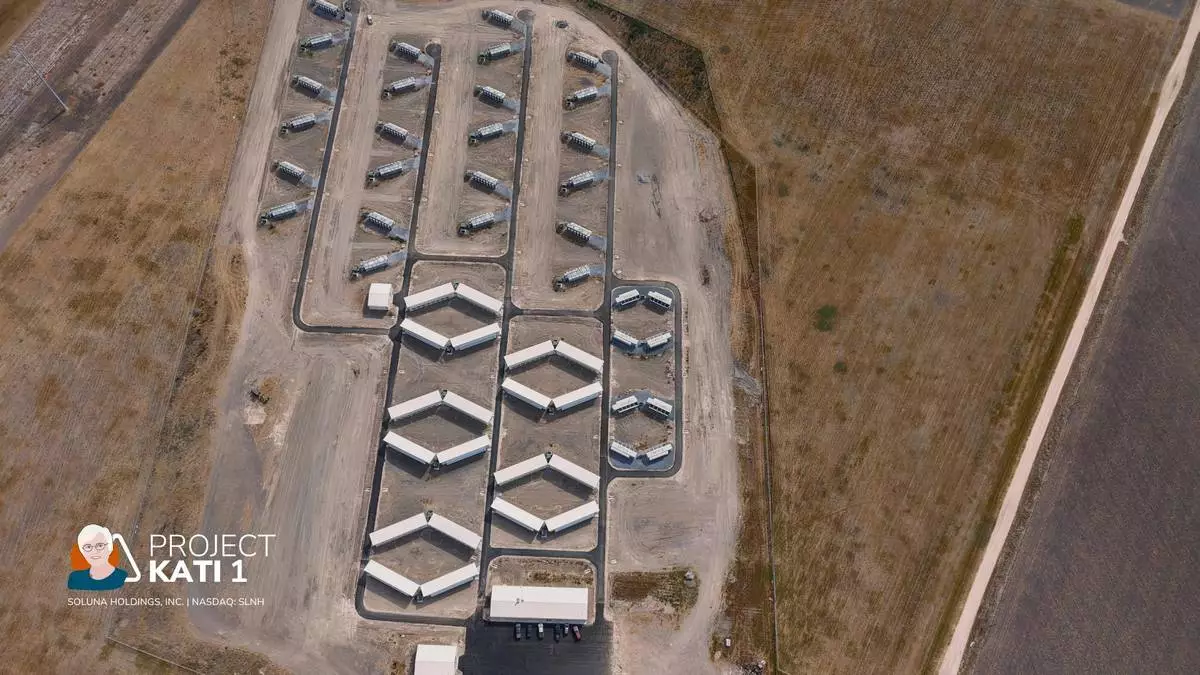
Soluna Finishes Project Kati 1 and Secures Conditional Base Load Position for All 166 MW in ERCOT

Soluna Finishes Project Kati 1 and Secures Conditional Base Load Position for All 166 MW in ERCOT
BRUSSELS (AP) — Top European Union officials on Tuesday expressed shock after Serbia gave a hero’s funeral to Ratko Mladic, a Bosnian Serb general who died while serving a life sentence for war crimes, and questioned Serbia’s fitness to join their bloc.

Mladic was buried in Belgrade on Monday with military honors. The head of the Serbian Orthodox Church, Patriarch Porfirije, led the funeral service and Serbian army soldiers carried Mladic’s flag-draped coffin at the cemetery.

Several Serbian government ministers attended the service for the man known as the “Butcher of Bosnia” and found guilty of committing the continent’s first genocide since World War II. Mladic is still considered a hero by many Serbs.

“The images from Ratko Mladic’s funeral yesterday in Belgrade were shocking,” European Commission President Ursula von der Leyen and European Council President Antonio Costa said in posts on social media.

“The elements of official support and the presence of some senior Serbian officials at the funeral are deeply regrettable,” von der Leyen and Costa said. “They demonstrate a failure to confront a dark chapter in Europe’s recent history and contradict the values underpinning Serbia’s path towards the European Union.”

Populist President Aleksandar Vucic did not go to the funeral but his son, Danilo, did. Bosnian Serb nationalist leader Milorad Dodik and the Russian ambassador in Serbia, Alexander Botsan-Kharchenko, were among those present.

Vucic, a former extreme nationalist who supported Serbia’s expansionist policies during the wars that tore Yugoslavia apart in the 1990s, described the funeral as an “emotional outpouring.”

Serbia’s Justice Minister Nenad Vujic attended and stood with Mladic’s family. He said the authorities helped keep order at the funeral to make sure it passed in a “dignified” manner but that the family was in charge.

Vucic has been walking a political tightrope. He’s trying to rally supporters — many of them Mladic admirers — ahead of an early parliamentary election that could be held in late October without alienating the EU, which Serbia says it wants to join.

Last week, EU Enlargement Commissioner Marta Kos warned that the funeral would be “a test” for Belgrade. She canceled an upcoming visit to Serbia, arguing that “the glorification” of Mladic’s death would be incompatible with EU values.

The EU traditionally hands down its annual enlargement report in late October or early November, laying out the progress that each of the candidate countries, including Serbia, is making toward membership and highlighting deficiencies.

Von der Leyen is scheduled to tour the Western Balkans region just before the report is published. She usually visits each country, but no dates have been set for the visit, nor has any agenda been made public.

Asked what the consequences might be for Serbia’s EU membership, von der Leyen’s spokesperson said only: “we are looking into it.”

Mladic’s funeral is unlikely to help Serbia’s cause. Its membership prospects were already damaged over democratic backsliding. In April, Kos warned Belgrade that it could lose access to around 1.5 billion euros ($1.8 billion) in EU funds as concern mounted about municipal election irregularities.

In Serbia’s favor, Vucic’s nationalist-populist SNS party has close ties to the EU’s biggest political grouping, the European People’s Party, which unites center-right political parties from across Europe. The EPP has been accused of protecting Vucic.

“It is high time for the EPP to stop acting as a safe haven for the SNS party, which openly celebrates convicted war criminals and rolls out the red carpet for the ‘Butcher of Bosnia’,” Slovenian Green member of the European Parliament Vladimir Prebilic said last week.

Von der Leyen is a senior member of the EPP, as are half of her team of policy commissioners and European Parliament President Roberta Metsola. Von der Leyen in particular has refrained from criticizing Vucic publicly.

For many years, the EPP staunchly supported former Hungarian Prime Minister Viktor Orbán’s stridently nationalist Fidesz party, hoping to keep him within Europe’s political mainstream. But the EPP eventually suspended Fidesz in 2019 over concerns about democracy and the rule of law in Hungary. Fidesz quit the group in 2021.

AP writer Jovana Gec in Belgrade, Serbia, contributed to this report.

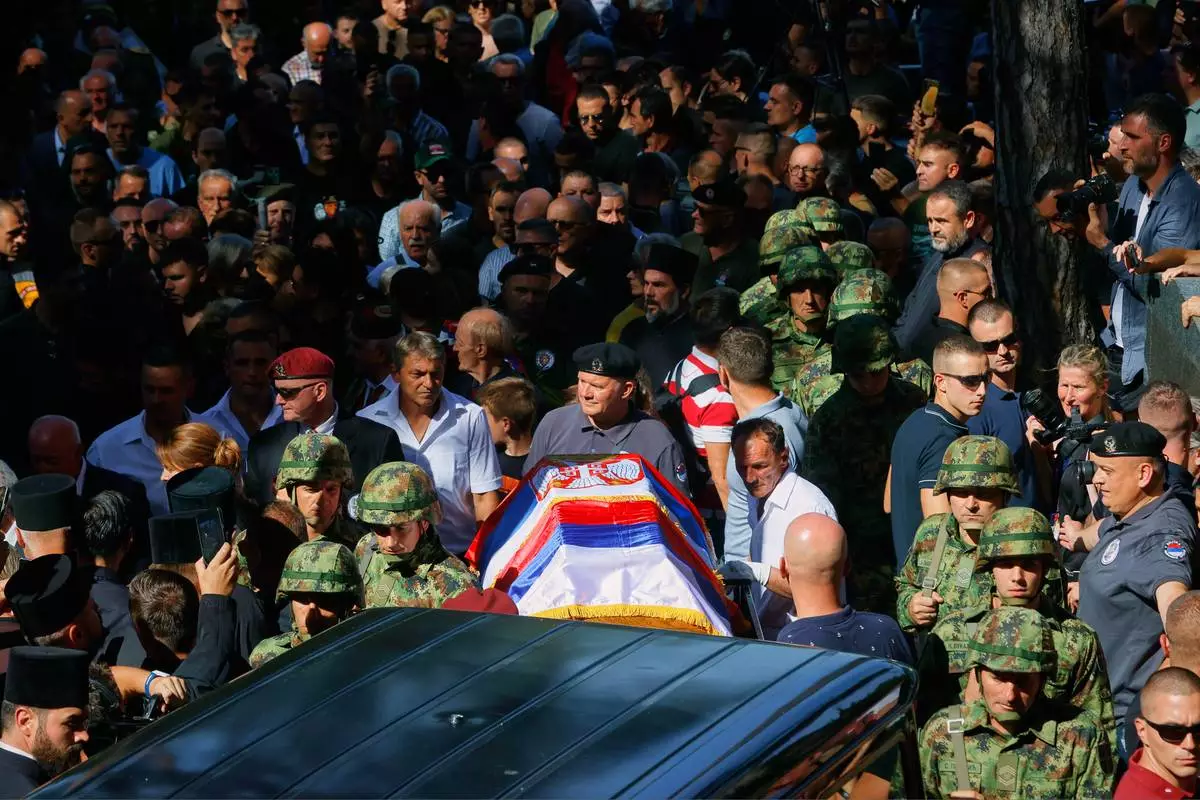
Serbian national military servicemen walk by the coffin of the former Bosnian Serb army commander Ratko Mladic, who died last week while serving a life sentence for genocide and other atrocities during the war in Bosnia, at the Topcider Cemetery, in Belgrade, Serbia, Monday, Sept. 7, 2026. (AP Photo/Marko Drobnjakovic)

Serbian national military servicemen walk by the coffin of the former Bosnian Serb army commander Ratko Mladic, who died last week while serving a life sentence for genocide and other atrocities during the war in Bosnia, at the Topcider Cemetery, in Belgrade, Serbia, Monday, Sept. 7, 2026. (AP Photo/Marko Drobnjakovic)

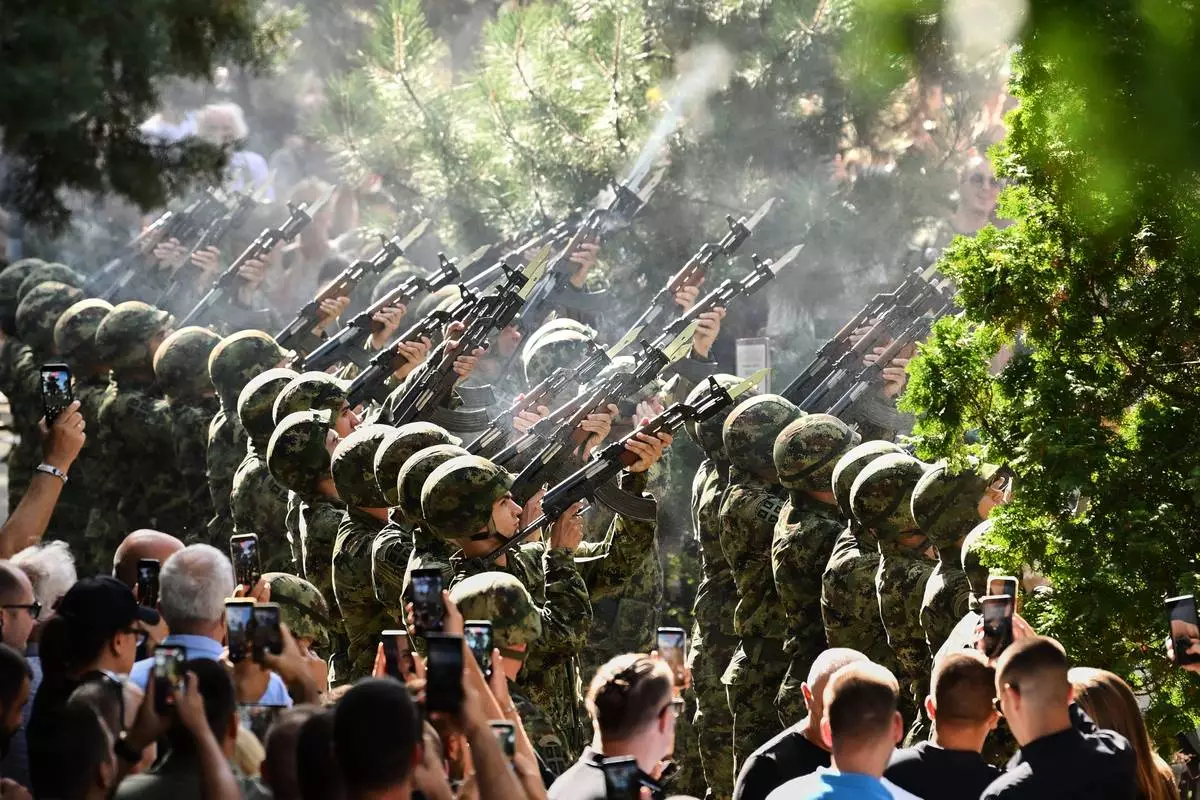
Serbian national military servicemen fire a three-volley salute during the funeral of former Bosnian Serb army commander Ratko Mladic, who died last week while serving a life sentence for genocide and other atrocities during the war in Bosnia, at the Topcider Cemetery, in Belgrade, Serbia, Monday, Sept. 7, 2026. (AP Photo)

Serbian national military servicemen fire a three-volley salute during the funeral of former Bosnian Serb army commander Ratko Mladic, who died last week while serving a life sentence for genocide and other atrocities during the war in Bosnia, at the Topcider Cemetery, in Belgrade, Serbia, Monday, Sept. 7, 2026. (AP Photo)

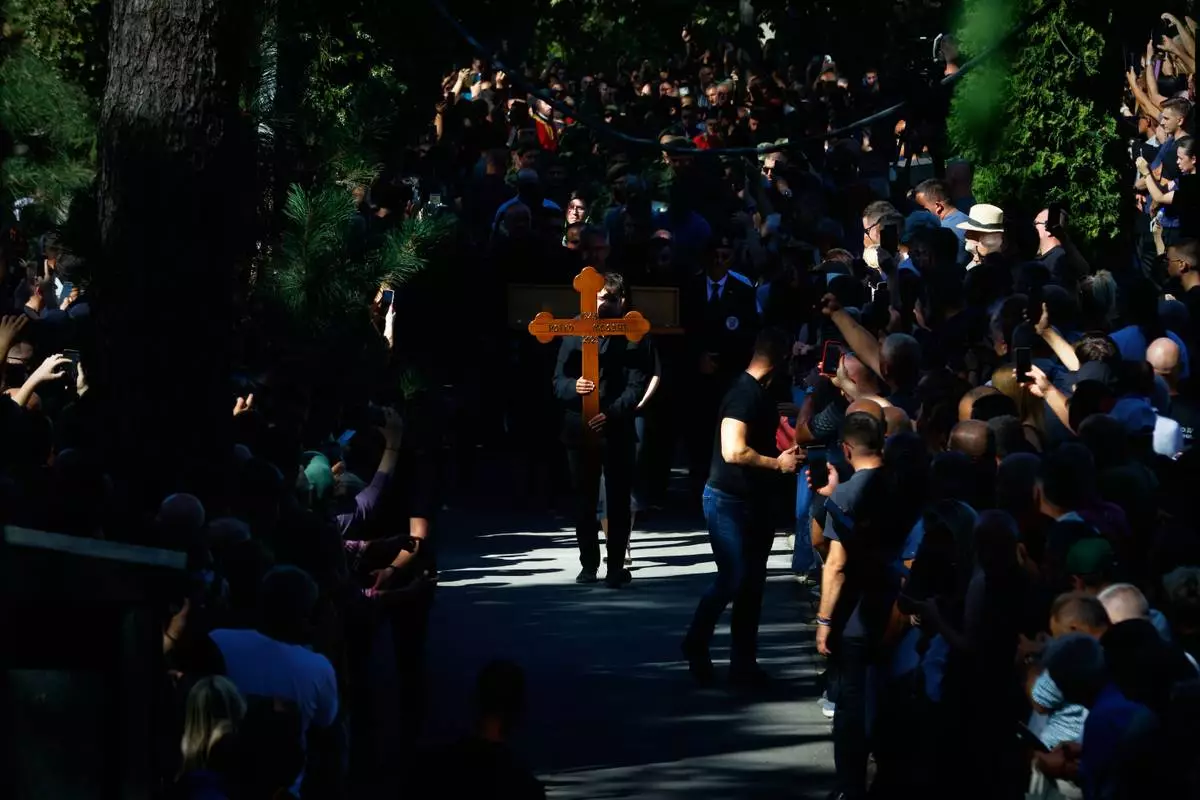
A young man carries the cross of the former Bosnian Serb army commander Ratko Mladic, who died last week while serving a life sentence for genocide and other atrocities during the war in Bosnia, at the Topcider Cemetery, in Belgrade, Serbia, Monday, Sept. 7, 2026. (AP Photo/Marko Drobnjakovic)

A young man carries the cross of the former Bosnian Serb army commander Ratko Mladic, who died last week while serving a life sentence for genocide and other atrocities during the war in Bosnia, at the Topcider Cemetery, in Belgrade, Serbia, Monday, Sept. 7, 2026. (AP Photo/Marko Drobnjakovic)

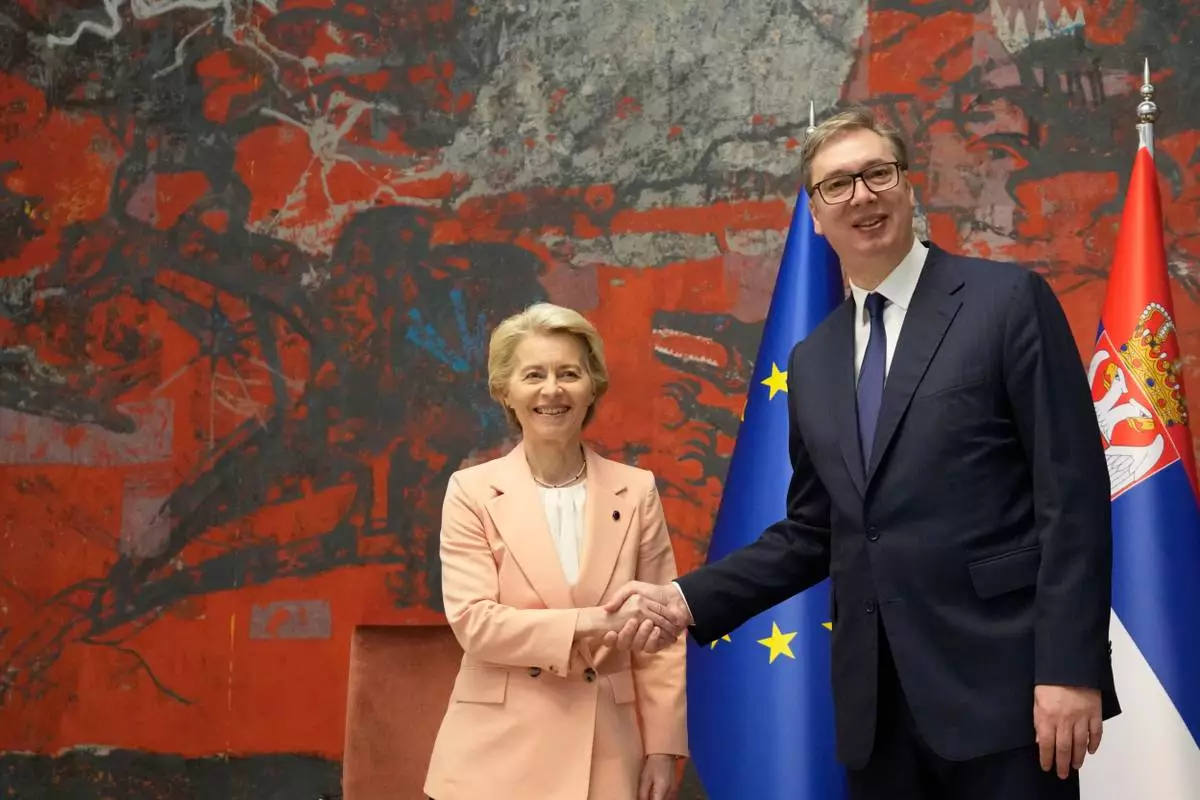
FILE - European Commission President Ursula von der Leyen, center, shakes hands with Serbian President Aleksandar Vucic in Belgrade, Serbia, on Oct. 25, 2024. (AP Photo/Darko Vojinovic, File)

FILE - European Commission President Ursula von der Leyen, center, shakes hands with Serbian President Aleksandar Vucic in Belgrade, Serbia, on Oct. 25, 2024. (AP Photo/Darko Vojinovic, File)

Recommended Articles