NEW YORK (AP) — Linda Noskova was forced to serve while sun was giving way to shadows in a key moment of her U.S. Open loss to Aryna Sabalenka on Tuesday after a delay caused the roof above Arthur Ashe Stadium to not finish adjusting in time.
The court was almost entirely covered by sun when Noskova began to serve with Sabalenka holding a 5-4 lead in the third set of their quarterfinal match. By the time she hit her first ball, the shadow line had nearly reached the middle of the court. After Noskova won that point, the court was nearly completely shaded by the time the next one began.
“I did notice the roof closing right after the point, although it started closing even before the point, so it was weird,” Noskova said. "No one even told us about it, I guess. We didn’t expect it at all.
“At the same time, I knew that the tournament wanted to keep us in the shade, and not have us play on the light throughout the whole match. But at the same time, it was, like, a crucial point of the match, so I don’t know why they started moving it so late.”
According to the U.S. Open's roof policy “the roof may partially close on Arthur Ashe Stadium to move the shade line fully across the court to optimize visibility for players and broadcast.”
Because the roof was not being fully closed, only enough to shade the court, it should have been completed during the changeover before Noskova began serving. It did not because of a delayed start.
A full roof closure takes about six minutes, so play would be halted.
Noskova said following Sabalenka's 7-6 (1), 3-6, 7-6 (10-7) victory that she hadn't been bothered by the shadows.
“Well, it was fine the way it was,” the Wimbledon champion said. “I feel like maybe in the very beginning it was more tough than as the match went on, but I don’t know. Didn’t really make a big difference for me if we were playing in shade or not.”
See AP’s full tennis coverage here

Aryna Sabalenka, of Belarus, returns the ball to Linda Noskova, of the Czech Republic, during the quarterfinal round of the U.S. Open tennis championships, Tuesday, Sept. 8, 2026, in New York. (AP Photo/Seth Wenig)

Linda Noskova, of the Czech Republic, serves to Aryna Sabalenka, of Belarus, during the quarterfinal round of the U.S. Open tennis championships, Tuesday, Sept. 8, 2026, in New York. (AP Photo/Yuki Iwamura)

Aryna Sabalenka, of Belarus, returns the ball to Linda Noskova, of the Czech Republic, during the quarterfinal round of the U.S. Open tennis championships, Tuesday, Sept. 8, 2026, in New York. (AP Photo/Yuki Iwamura)
TORONTO (AP) — U.S. President Donald Trump moved Tuesday to shut Canadian products out of large, long-term U.S. government contracts as Canada’s retaliatory tariffs took effect and Prime Minister Mark Carney vowed to speed efforts to reduce the country’s dependence on the United States.
Trump directed the U.S. General Services Administration to declare Canadian products ineligible for those contracts until Canada allows “full and fair reciprocity″ for American products.
Earlier on Tuesday, Carney said Canada’s strategy was about becoming more independent. “It’s about ensuring that no country can hold us hostage. And that we can live how we want to live.”
Canada is exploring ties with the European Union that could stop just short of membership, a Canadian official familiar with the discussions said.
Options could include expanding existing agreements, negotiating a new treaty or creating other forms of cooperation. The official said Canada is already consulting provinces, territories and labor groups about what a deeper relationship with the EU could look like, but no model has been chosen.
The official spoke on condition of anonymity because they were not authorized to discuss the talks publicly.
Carney is due in Strasbourg, France, next week, where he will attend European Commission President Ursula von der Leyen’s State of the European Union address Sept. 16 and address the European Parliament the following day.
The rupture has upended one of the world’s closest relationships. The countries have deeply integrated economies and close defense and security ties, but Trump has imposed a series of tariffs on Canadian goods despite negotiating and repeatedly praising the North American trade agreement during his first term. Many of those tariffs violate the pact.
Carney acknowledged the trade actions would cause short-term pain but said they would push Canada to move faster on investment, infrastructure and trade diversification.
“It was easy business, but it meant we relied too much on one economic partner,” he said. “That time is over.”
More than 70% of Canadian exports still go to the United States, underscoring the scale of Carney's push to diversify trade. He said Canada’s exports to other countries are rising sharply and are on track to double over the next decade.
Carney defended the retaliation, saying Canada could not let American goods enter tariff-free while Canadian companies face U.S. tariffs
Canada was not seeking to escalate the confrontation, he said, but the tariffs were necessary to protect Canadian workers.
Carney said the larger problem was what Washington had sought in the failed negotiations.
“The most fundamental issue is that the cumulative U.S. demands revealed that they wanted us to become even more reliant on them, not less,” he said. “In too many areas, they wanted dependency, not a true economic partnership.”
The prime minister said Washington sought limits on French-language and cultural protections, influence over future trade deals and terms that would weaken the auto, steel and forestry sectors.
How the trade war ends could carry consequences far beyond Canada, testing whether a smaller U.S. ally can resist Trump’s economic pressure without being forced to yield.
Earlier on Tuesday, a Canadian official said Ottawa did not intend to change course regardless of whether Trump responded with nothing or what the official called a “nuclear response.” The government’s strategy will remain focused on building more at home and diversifying trade abroad, the official said.
The tariffs hit hundreds of American products, including steel, aluminum, cheese, appliances, clothing, cosmetics and farm equipment, at rates of 15%, 25% or 50%. They cover about $20 billion in American goods, roughly 6% of the $333.6 billion the United States exported to Canada last year.
Since Canada-U.S. trade talks collapsed Aug. 21, Trump and his administration have imposed additional tariffs and issued a series of threats and attacks portraying Canada as weak and dependent.
Trump’s trade war and repeated talk of making Canada the 51st state have fueled anger across the country. Canadians have sharply cut travel to the United States and boycotted U.S. goods, moves Carney praised as signs of national resolve.
British Columbia Premier David Eby said the province will install new signs at U.S. border crossings reading: “Welcome to British Columbia, Canada. Strong, proud and will NEVER be the 51st state. Sorry!”
“While our kindness is one of our greatest strengths, you should never, ever mistake that kindness for weakness,” Eby said.
Gabriel Brunet, a spokesman for Canada-U.S. Trade Minister Dominic LeBlanc, said officials from both countries remain in contact even though formal talks have not resumed.
Former U.S. trade official Wendy Cutler said Carney’s public approval rating, now topping 70%, gives him little reason to restart talks.
“Clearly, at this point each side does not want to look too anxious to reengage in fear of looking weak,” she said.
Wiseman in Washington contributed to this report.
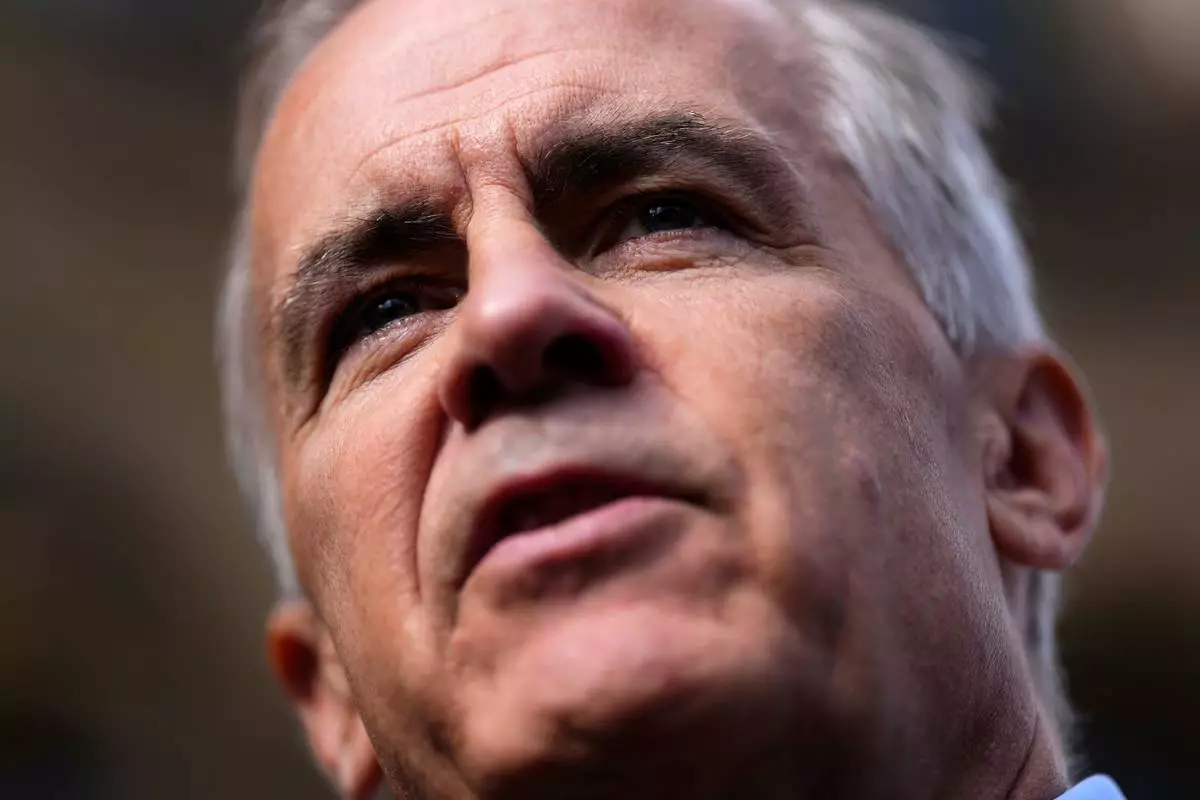
Prime Minister Mark Carney speaks to journalists as he arrives at the Office of the Prime Minister and Privy Council in Ottawa, Canada, Tuesday, Sept. 1, 2026. (Justin Tang/The Canadian Press via AP)