SYDNEY--(BUSINESS WIRE)--Sep 8, 2026--
Smartsheet today announced new leadership appointments and regional expansion across Asia-Pacific and Japan. The moves underscore the company's commitment to helping customers across the region progress from individual AI productivity gains to organization-wide AI transformation.
This press release features multimedia. View the full release here: https://www.businesswire.com/news/home/20260908165343/en/
Smartsheet has promoted Jarrod Kinchington to Vice President and General Manager of APAC (Australia, New Zealand, Southeast Asia and India), and appointed Takeshi Osawa as President of Japan.
This comes as Smartsheet experiences accelerating customer adoption across key growth sectors in APAC and Japan—including Technology, Manufacturing and Professional Services—and surging adoption of its Model Context Protocol (MCP) Server AI capabilities throughout the region.
Leadership for the Next Era of Regional Growth
Kinchington is stepping up to lead APAC as the company deepens its regional footprint. The appointment comes amid continued growth across the region, with Smartsheet opening offices in Sydney in 2020, Tokyo in 2023, and most recently Singapore and India earlier this year to support its expanding customer base.
“Customer demand continues to accelerate across APAC, fueling strong growth and reinforcing the region’s importance to our global strategy,” said Kinchington. “Organizations here are looking to transform with AI, but many are starting from a fragmented foundation. Before they can scale AI, they need a platform that shows them how work flows across the business and provides the governance to manage AI responsibly. That's especially important in APAC, where compliance requirements are stringent. Smartsheet connects work across the enterprise and gives organizations the visibility and control to safely scale AI.”
Takeshi Osawa brings more than 25 years of enterprise technology experience from Autodesk, SAP Fieldglass, and Cloudera. He takes the helm of a rapidly growing market: since establishing its Tokyo office in 2023, Smartsheet has grown to serve more than 400 customers in Japan, and its business has grown by approximately 400%.
“I'm honored to join Smartsheet at this pivotal moment for the Japan business,” said Takeshi Osawa, Smartsheet President & General Manager, Japan. “What resonates deeply with me is Smartsheet's approach: rather than replacing the systems and processes Japanese enterprises have invested in, we connect them securely to deliver visibility, governance and real-time insights across the organization. As AI adoption accelerates, I believe what companies need is not simply adopting AI itself, but translating AI into 'execution' that leads to concrete business outcomes. That's the kind of long-term business partnership Japanese customers are looking for. Together with our customers and partners, we aim to make Smartsheet an indispensable platform that supports the transformation and growth of Japanese businesses.”
Customer Growth and AI Adoption Accelerate Across Key Industries
As organizations across APAC and Japan pursue AI transformation, they are turning to Smartsheet to connect data, systems and teams on a single platform. This demand fueled double-digit growth across the company’s fastest-growing sectors in APAC and Japan over the past year, including:
Organizations across APAC and Japan are embracing AI. Since the launch of its MCP Server in March 2026, adoption across the region has grown by more than 500%. By connecting AI tools such as Claude, Microsoft Copilot, ChatGPT, and Google Cloud Gemini Enterprise directly to live Smartsheet data, customers have executed over 600,000 AI actions —an average of 4,000 per day—with the vast majority creating, updating, or modifying live work.
“Smartsheet is the backbone of how we run our consulting business,” said Mike Ellis, Global Head of Zalaris Consulting at Zalaris. “We’ve unified seven business units across 34 countries on Smartsheet to create a single source of operational truth. Now with Smartsheet's MCP Server and AI capabilities, we're transforming our data into real-time intelligence. We can pull insights from across our entire tech stack, including Smartsheet, our BI and CRM platforms, and more, enabling greater automation and efficiency. As a result, we're seeing approximately 67% productivity gains, allowing our project managers to take on more projects simultaneously.”
Looking Ahead
As organizations across APAC and Japan rethink how work gets done in the age of AI, Smartsheet is positioned to help them work more effectively, adapt faster and drive stronger business outcomes.
“The opportunity ahead is significant,” said Scott Torrey, Chief Revenue Officer at Smartsheet. “APAC organizations are making strategic investments in work management and AI capabilities. Smartsheet is the platform that brings these together—giving teams the visibility, speed and governance they need to execute complex work with confidence. Our leadership team is fully committed to supporting that growth.”
About Smartsheet
Smartsheet unites people, data and AI to turn strategy into measurable enterprise impact. Smartsheet gives enterprises the speed, governance and trust to execute complex work across portfolios, operations and IT on a single, secure system. Smartsheet empowers millions of users to move faster, reduce risk and realize ROI with confidence. Visit www.smartsheet.com to learn more.

Smartsheet names new leaders across APAC and Japan for its next era of regional growth
TORONTO (AP) — The United States is banning dairy products, most alcoholic beverages and motorcycles from Canada, the White House said Tuesday, as the trade war between the two nations escalates.
The ban will take effect in three weeks and comes after Canada imposed retaliatory tariffs on $20 billion in U.S. imports earlier Tuesday.
THIS IS A BREAKING NEWS UPDATE. AP’s earlier story follows below.
TORONTO (AP) — U.S. President Donald Trump moved Tuesday to shut Canadian products out of large, long-term U.S. government contracts as Canada’s retaliatory tariffs took effect and Prime Minister Mark Carney vowed to speed efforts to reduce the country’s dependence on the United States.
Trump directed the U.S. General Services Administration to declare Canadian products ineligible for those contracts until Canada allows “full and fair reciprocity″ for American products.
Earlier on Tuesday, Carney said Canada’s strategy was about becoming more independent. “It’s about ensuring that no country can hold us hostage. And that we can live how we want to live.”
Canada is exploring ties with the European Union that could stop just short of membership, a Canadian official familiar with the discussions said.
Options could include expanding existing agreements, negotiating a new treaty or creating other forms of cooperation. The official said Canada is already consulting provinces, territories and labor groups about what a deeper relationship with the EU could look like, but no model has been chosen.
The official spoke on condition of anonymity because they were not authorized to discuss the talks publicly.
Carney is due in Strasbourg, France, next week, where he will attend European Commission President Ursula von der Leyen’s State of the European Union address Sept. 16 and address the European Parliament the following day.
The rupture has upended one of the world’s closest relationships. The countries have deeply integrated economies and close defense and security ties, but Trump has imposed a series of tariffs on Canadian goods despite negotiating and repeatedly praising the North American trade agreement during his first term. Many of those tariffs violate the pact.
Carney acknowledged the trade actions would cause short-term pain but said they would push Canada to move faster on investment, infrastructure and trade diversification.
“It was easy business, but it meant we relied too much on one economic partner,” he said. “That time is over.”
More than 70% of Canadian exports still go to the United States, underscoring the scale of Carney's push to diversify trade. He said Canada’s exports to other countries are rising sharply and are on track to double over the next decade.
Carney defended the retaliation, saying Canada could not let American goods enter tariff-free while Canadian companies face U.S. tariffs
Canada was not seeking to escalate the confrontation, he said, but the tariffs were necessary to protect Canadian workers.
Carney said the larger problem was what Washington had sought in the failed negotiations.
“The most fundamental issue is that the cumulative U.S. demands revealed that they wanted us to become even more reliant on them, not less,” he said. “In too many areas, they wanted dependency, not a true economic partnership.”
The prime minister said Washington sought limits on French-language and cultural protections, influence over future trade deals and terms that would weaken the auto, steel and forestry sectors.
How the trade war ends could carry consequences far beyond Canada, testing whether a smaller U.S. ally can resist Trump’s economic pressure without being forced to yield.
Earlier on Tuesday, a Canadian official said Ottawa did not intend to change course regardless of whether Trump responded with nothing or what the official called a “nuclear response.” The government’s strategy will remain focused on building more at home and diversifying trade abroad, the official said.
The tariffs hit hundreds of American products, including steel, aluminum, cheese, appliances, clothing, cosmetics and farm equipment, at rates of 15%, 25% or 50%. They cover about $20 billion in American goods, roughly 6% of the $333.6 billion the United States exported to Canada last year.
Since Canada-U.S. trade talks collapsed Aug. 21, Trump and his administration have imposed additional tariffs and issued a series of threats and attacks portraying Canada as weak and dependent.
Trump’s trade war and repeated talk of making Canada the 51st state have fueled anger across the country. Canadians have sharply cut travel to the United States and boycotted U.S. goods, moves Carney praised as signs of national resolve.
British Columbia Premier David Eby said the province will install new signs at U.S. border crossings reading: “Welcome to British Columbia, Canada. Strong, proud and will NEVER be the 51st state. Sorry!”
“While our kindness is one of our greatest strengths, you should never, ever mistake that kindness for weakness,” Eby said.
Gabriel Brunet, a spokesman for Canada-U.S. Trade Minister Dominic LeBlanc, said officials from both countries remain in contact even though formal talks have not resumed.
Former U.S. trade official Wendy Cutler said Carney’s public approval rating, now topping 70%, gives him little reason to restart talks.
“Clearly, at this point each side does not want to look too anxious to reengage in fear of looking weak,” she said.
Wiseman in Washington contributed to this report.
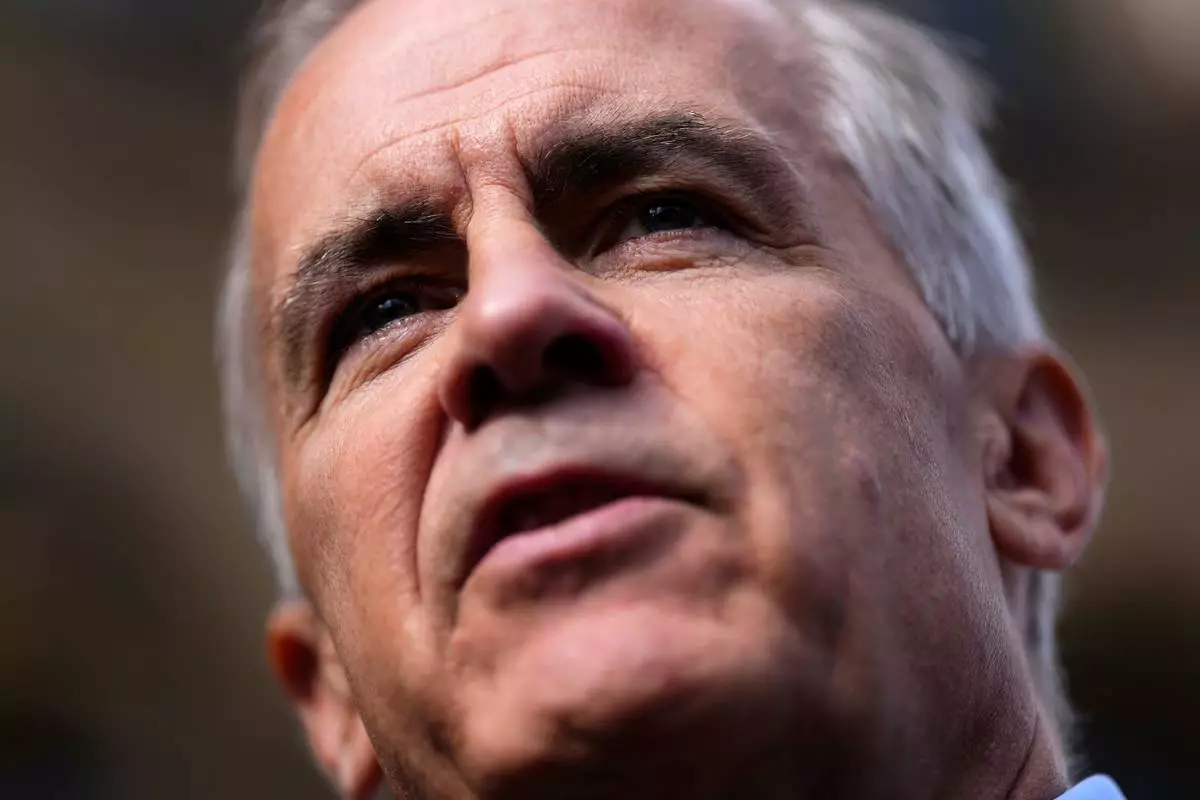
Prime Minister Mark Carney speaks to journalists as he arrives at the Office of the Prime Minister and Privy Council in Ottawa, Canada, Tuesday, Sept. 1, 2026. (Justin Tang/The Canadian Press via AP)