GREEN BAY, Wis. (AP) — Green Bay’s Jordan Love already has established himself as one of the game’s elite quarterbacks as far as Packers coach Matt LaFleur is concerned.
Love will certainly get a chance to prove that this season.
The unsettled nature of Green Bay’s rushing attack without three-time Pro Bowl running back Josh Jacobs means the Packers may have to depend on their passing game more than usual. The Packers open the season Sunday at Minnesota.
“No matter who’s out there, I want to be the best,” Love said. “I want to go out there and execute my job at a high level on every play. So, I think for everybody — the receivers, you don’t have to go out there and do anything fancy or try and do anything more. It’s just go out there and do your job and make plays.”
Love hasn’t yet received a Pro Bowl invitation despite leading the Packers to playoff berths in each of his three seasons as a starting quarterback. When he was asked about the next step Love must take to be considered among the league’s best quarterbacks, LaFleur contended that the 27-year-old already has entered that class.
“I get so confused by that question every time, because I think he’s an elite player,” LaFleur said Wednesday. “So I don’t know. I’ll let you guys figure that out, what the next step is.”
LaFleur believes Love might get more recognition if the Packers made a longer postseason run.
Green Bay hasn’t advanced beyond the divisional round of the playoffs in Love’s three seasons as a starter and has lost in the wild-card round each of the past two years.
“I think a lot of times it’s due to team success,” LaFleur said. “And the more success we have, the more people will view him in that light.”
Love wasn’t to blame for the Packers’ five-game skid that ended their 2025 season.
A helmet-to-helmet hit from Chicago’s Austin Booker knocked Love out of an overtime loss to the Bears on Dec. 20 and prevented him from playing in a loss to the Baltimore Ravens the next week. Green Bay rested Love and its other starters for its regular-season finale at Minnesota.
Love returned for the playoffs and threw for 323 yards and four touchdowns without an interception, but the Packers fell 31-27 at Chicago after allowing 25 points in the fourth quarter.
Another issue that could impact the perception of Love is that the Packers generally don’t pass the ball as often as many other teams. According to Sportradar, only four teams ran the ball a higher percentage of time than the Packers did last season. The Packers had the third-highest rushing percentage in 2024.
Love tied for 14th in the league in touchdown passes (23) and ranked 13th in passing yards (3,381) and 19th in pass attempts (439) last season. He was intercepted only six times.
The Packers may need to lean on Love more this season, particularly as long as Jacobs is unable to play or practice because of his placement on the commissioner’s exempt list. Jacobs has a court appearance scheduled for Thursday as he faces misdemeanor charges of battery and criminal damage to property stemming from a May altercation with his girlfriend.
Love’s teammates believe he can handle that extra responsibility.
“Since I’ve been playing with him, he’s never flinched,” wide receiver Jayden Reed said. “That’s the biggest thing for him that I see. He’s the same guy out there every play, through adversity, through great plays. He just does a great job leading the offense, and he’s going to continue to do that.”
Love should benefit from the fact that three of his top playmakers finally are all healthy at the same time.
The Packers didn’t have the entire trio of Reed, Christian Watson and tight end Tucker Kraft all available for a single game last season. Watson made his season debut Oct. 26 as he recovered from a torn anterior cruciate ligament until Oct. 26. Kraft’s season ended when he tore his ACL on Nov. 2. Reed went on injured reserve Sept. 20 with shoulder and foot injuries, and he didn’t come back until Dec. 7.
They’re all good to go for the start of this season.
“I think you guys see what we can do all together,” Reed said. “That’s huge, to have all of us together, plus MG (Matthew Golden) plus all the other playmakers we have. I think we can be the best in the league, me personally. We’ve just got to put that all on display on Sunday.”
NOTES: DT Warren Brinson (calf) and LB Ty’Ron Hopper (Achilles) didn’t practice Tuesday. … RB Damon Bankston and S Kahlef Hailassie joined the practice squad. S Murvin Kenion III was released from the practice squad.
See AP’s full NFL coverage here

Green Bay Packers' Jordan Love talks to Arizona Cardinals' Gardner Minshew II after a preseason NFL football game Friday, Aug. 28, 2026, in Green Bay, Wis. (AP Photo/Matt Ludtke)
WASHINGTON (AP) — Earth cooked to its hottest month on record in August, blowing far past a key climate threshold, due to the dangerous double whammy of human-caused climate change and a supersized El Nino, according to the European climate service Copernicus.
August's sizzle also helped push the globe and the United States to swelter through the hottest Northern Hemisphere summer scientists have measured.
Last month the world averaged 62.53 degrees Fahrenheit (16.96 degrees Celsius), which technically was one-hundredth of a degree Celsius more than the all-time global mark set in July 2023, but because that's also the uncertainty level, it's considered a tie, said Samantha Burgess, strategic climate lead for Copernicus.
“It is now time to stop acting surprised that our warming planet keeps getting warmer. This is occurring exactly as forecast by scientists literally decades ago,” Texas A&M University climate scientist Andrew Dessler said in an email. “The interesting question is not whether we will keep breaking heat records (we will), but whether we’re going to do anything about it or just stand there while the climate train runs us over.”
Globally, August was 1.65 degrees Celsius (nearly 3 degrees Fahrenheit) above pre-industrial levels, far exceeding the longer term 1.5 degrees Celsius (2.7 degrees Fahrenheit) threshold set by the 2015 Paris climate agreement. The eight hottest months on record have all been from July 2023 on, according to Copernicus data.
“Our climate system is really operating well outside the range we would have expected just a decade ago,” Burgess said Wednesday from a United Kingdom that has been beset with heat waves. “We've transitioned from climate being very abstract and perhaps impacting the global South or far away places to climate impacting and disrupting our daily lives with schools closing, hospitals being overwhelmed, roads melting, train lines buckling. And the reality is we will get more of these conditions that we've seen this summer.”
Global monthly ocean temperatures in August tied a March 2024 all-time record for warmest month recorded, while Aug. 22 set a record for hottest day recorded in the world's seas, according to Copernicus.
“This summer has really been exceptional. We’ve seen records that existed for close to 100 years be broken, in the U.S. in particular," Burgess said.
The U.S. National Oceanic and Atmospheric Administration on Wednesday announced that for the first time, summer in the Lower 48 states was hotter than during the peak of the devastating Dust Bowl in 1936. June through August of 2026 in the contiguous United States averaged 74.37 degrees (23.54 degrees Celsius), nearly four tenths of a degree warmer than the mark set 90 years earlier. Globally, this past summer also tied, with 2024, for the hottest on record, according to Copernicus.
In the U.S., August smashed heat records by more than half a degree Fahrenheit, averaging 75.58 degrees (24.21 degrees Celsius) and the average daytime high was a blistering 88.56 degrees (31.42 degrees Celsius), also a record. July was similarly record hot in the U.S., erasing another long-standing Dust Bowl mark.
That records are regularly getting broken, and that August and not July which is traditionally warmer set an all-time record, are signs that human-caused climate change is accelerating, Berkeley Earth climate scientist Zeke Hausfather said.
Copernicus data goes back to 1940. NOAA data for the United States goes back to 1895 and global data, which generally matches Copernicus data but takes longer to calculate, dates back to 1880.
Several scientists said while El Nino is a factor, this natural and temporary warming of parts of the Pacific that warps and warms weather globally is nowhere as big a cause as the heat-trapping gases emitted as humans burn coal, oil and natural gas.
“While El Nino is starting to ramp up the heat, the underlying driver remains our relentless burning of fossil fuels. Climate change makes every El Nino hotter, and until we stop burning coal, oil, and gas these record-shattering months will simply keep on coming," said Friederike Otto, a climate scientist at Imperial College London.
Burgess said El Nino generally adds only one or two tenths of a degree Celsius (two to four tenths Fahrenheit) to the global temperature with the overwhelming rest of the heat coming from the burning of fossil fuels.
This El Nino is forecast, however, to break records for strength in the coming months. And as temperatures continue to rise, heat waves, storms, floods and wildfires will get more frequent and more dangerous, said Texas Tech climate scientist Katharine Hayhoe.
According to Hausfather, “it is increasingly likely that 2026 ends up beating 2024 as the warmest year on record, and almost certain that 2027 beats both, potentially reaching as high as 1.8 degrees Celsius (3.2 degrees Fahrenheit) above preindustrial levels on the back of an unprecedentedly-strong El Nino event.”
Some days may hit an even higher climate threshold, 2 degrees Celsius (3.6 degrees Fahrenheit) above mid 1800s, Burgess said.
“Until humanity stops burning colossal amount of coal, oil and gas, the pollution this causes will keep baking our planet, and extreme heat will keep smashing all-time records, killing millions and costing trillions, hitting transport and health systems, and pushing up prices for household basics like food," United Nations climate chief Simon Stiell said. “This is the spiraling price of humanity’s fossil fuel addiction, and the global climate crisis it is fueling.”
The Associated Press’ climate and environmental coverage receives financial support from multiple private foundations. AP is solely responsible for all content. Find AP’s standards for working with philanthropies, a list of supporters and funded coverage areas at AP.org.
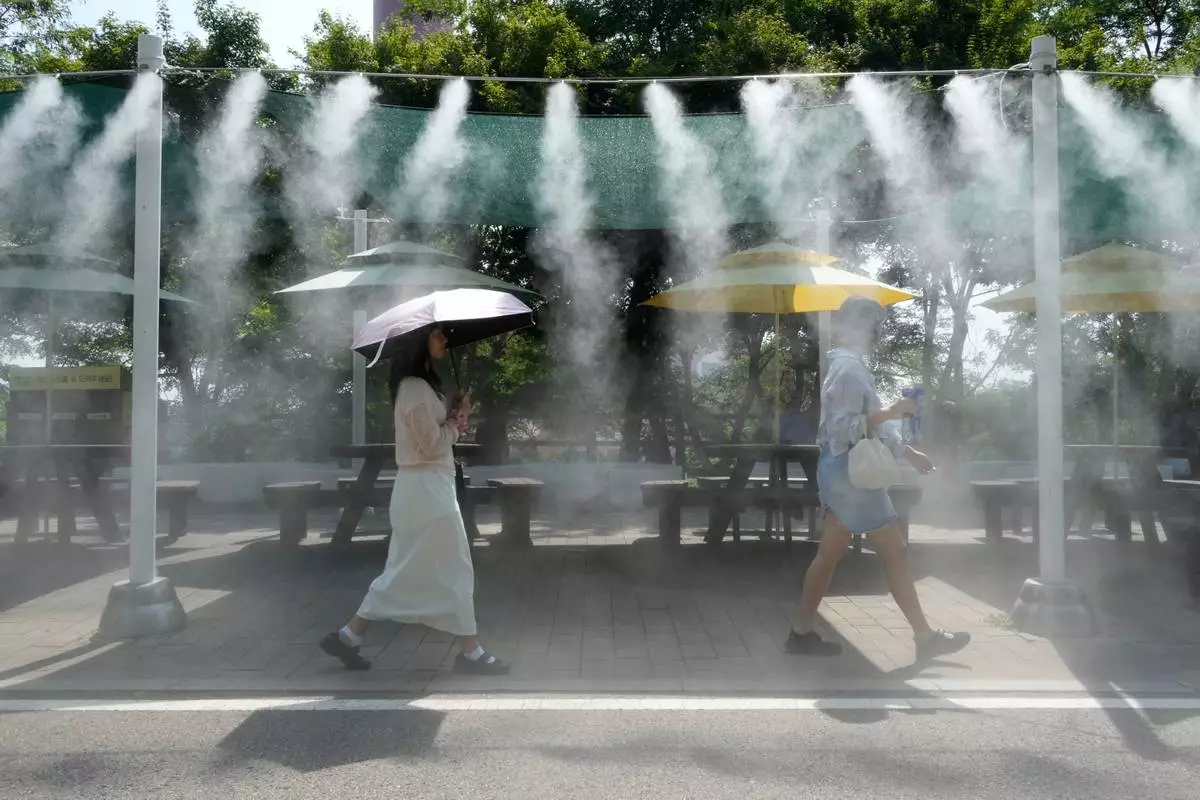
FILE - Visitors pass by the cooling fog device at Gwangmyeong Cave tourist site in Gwangmyeong, South Korea, Aug. 6, 2026. (AP Photo/Ahn Young-joon, File)

FILE - Rickie Fowler wipes his face in the heat off the fifth tee box during the first round of the St. Jude Championship golf tournament Aug. 13, 2026, in Memphis, Tenn. (AP Photo/George Walker IV, File)

FILE - A man uses a fan to cool off during the La Liga soccer match between Real Madrid and Malaga at the Bernabeu stadium in Madrid, Spain, Aug. 30, 2026. (AP Photo/Manu Fernandez, File)

FILE - Tour operator Amanda Lovejoy wipes herself with a chilled towel in the heat Aug. 26, 2026, in the Hollywood section of Los Angeles. (AP Photo/Jae C. Hong, File)

FILE - A person cools off at a cooling mist spot on a hot and sunny day at the Sensoji Buddhist temple in Tokyo's Asakusa district on Aug. 7, 2026. (AP Photo/Eugene Hoshiko, File)