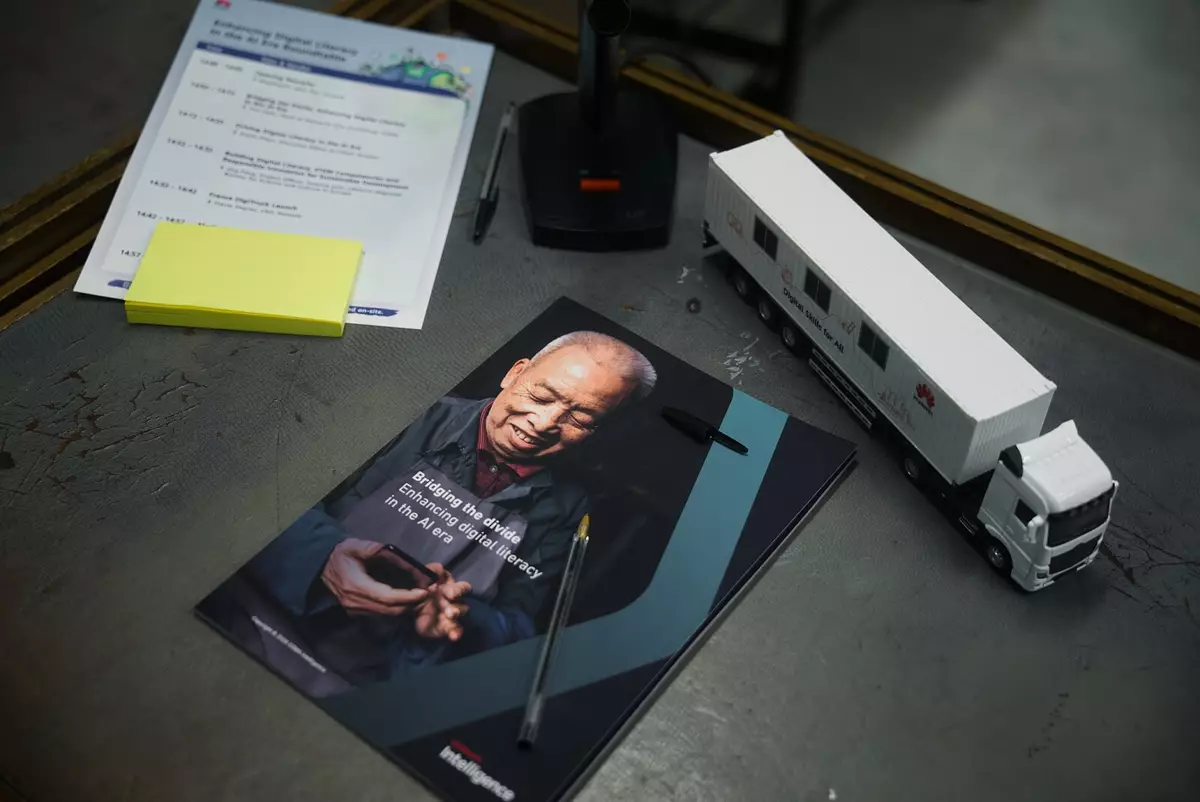
New report, authored by GSMA Intelligence in partnership with Huawei, released at UNESCO’s Digital Learning Week
- Digital literacy – not coverage – is the main barrier keeping 3.1 billion people offline.
- AI could potentially widen the digital literacy gap.
- Bridging the usage gap could boost global GDP by $3.5 trillion from 2023 to 2030.
- Citing Huawei's Skills on Wheels initiative, the report urges policymakers, telcos, and tech vendors to treat AI literacy as critical infrastructure.
PARIS, FRANCE – Media OutReach Newswire – 10 September 2026 – More than one in three (38%) people remains offline despite being covered by mobile broadband – and a lack of digital literacy skills is often to blame, according to new research published today.
Closing Digital Literacy Gap Could Unlock Trillions of Dollars in Global GDP Growth
The new report, "Bridging the Divide: Enhancing Digital Literacy in the AI Era," authored by GSMA Intelligence and produced in collaboration with Huawei, identifies a digital divide impacting 3.1 billion people caused by a shortage of digital skills, user trust and AI literacy.
AI raises both access and risk
Existing industry projections suggest closing the capability gap could add around $3.5 trillion to global GDP by 2030, with more than 90% of those gains flowing to low- and middle-income countries (LMICs). Physical mobile broadband coverage currently reaches 96% of people worldwide.
The report, unveiled at UNESCO's Digital Learning Week, suggests artificial intelligence could act as both a bridge and a barrier for underserved communities. AI-powered voice assistants and applications that work with images, audio and video can all help low-literacy users bypass the need to input text. At the same time, they raise the security and critical-thinking standards required to participate safely. However, the study warns that users must now be able to understand data privacy and identify risks such as fraud and deepfakes.
The research cites World Bank statistics that GenAI literacy represents the highest-value skill category, with wage premiums up to 36%, far exceeding returns for both digital and traditional AI skills.
Without targeted interventions in basic digital training, the authors warn, rapid AI adoption risks entrenching existing inequalities even in areas with full network coverage.
Mobile classrooms build skills in remote areas
Digital inclusion initiatives typically target those most at risk of digital exclusion, including rural and remote communities, children and teachers in rural schools, older people, and women and girls.
The report emphasizes the need for community-based delivery models, citing Huawei's Skills on Wheels initiative as a field-tested example — particularly its solar-powered DigiTruck mobile classrooms, which bring hardware, rural connectivity and hands-on training, including AI literacy, to off-grid regions.
Since 2019, training courses delivered by Skills on Wheels projects have reached more than 130,000 people across 21 countries, with more people benefiting indirectly. DigiTruck trainers encourage trainees to share their new skills, which is shown to occur in practice. A report on DigiTruck by Kenya's Ministry of Information, Communications and Digital Economy shows that 79% of DigiTruck trainees surveyed had passed on their newly acquired digital skills to family members and peers.
Policymakers urged to treat AI literacy as core infrastructure
To bridge the usage gap, the report urges policymakers, telecom operators and technology vendors to work together and focus on four priorities:
- Treating practical AI awareness, online safety and information verification as a baseline national qualification.
- Adopting multilingual voice and conversational interfaces across public services to minimise user-side technical hurdles.
- Scaling up mobile learning units through cross-sector partnerships that combine operator connectivity, vendor technology and local NGO networks.
- Measuring performance by independent task completion and fraud resilience rather than trainee numbers.
"Digital literacy can no longer be defined by static thresholds," said Tim Hatt, head of research and consultancy at GSMA Intelligence. "Connectivity alone is insufficient — capabilities, system design and trust must evolve together. To capture this multi-trillion-dollar opportunity, stakeholders must integrate layered AI literacy directly into daily livelihoods through trusted community channels."
"Mobile classrooms have demonstrated immense value in helping underserved populations break through physical and psychological barriers to technology," said Gavin Allen, Executive Editor-in-Chief at Huawei. "We will continue working alongside local governments and industry partners to drive digital literacy, ensuring that no one is left behind as we transition into the AI economy."
A new DigiTruck program will launch in France this autumn, covering several cities in the Île-de-France region and targeting low-income and underserved communities with digital skills training.
The full report is available on the GSMA Intelligence research portal:
https://www.gsmaintelligence.com/research/bridging-the-divide-enhancing-digital-literacy-in-the-ai-era
FAQ
Q1: What is the main purpose of this report?
A: The report analyzes the critical importance of enhancing digital skills in the AI era, highlighting digital literacy as a layered and evolving capability. It calls on all stakeholders to collaborate in accelerating global digital inclusion and skill development.
Q2: What does it mean for policymakers to treat "AI literacy as core infrastructure"?
A: It means shifting policy focus from just building physical base stations to funding human capabilities. The report urges governments to integrate baseline AI awareness, online security, and media verification into national qualification frameworks, treating digital skills as an essential public utility alongside electricity and broadband.
Hashtag: #Huawei
The issuer is solely responsible for the content of this announcement.
** This press release is distributed by Media OutReach Newswire through automated distribution system, for which the client assumes full responsibility. **
According to the GII 2025 report themed "Innovation at a Crossroads," the global innovation system is reaching a critical turning point. This comes amidst rapid advancements in emerging technologies—such as Artificial Intelligence (AI), clean energy, biotechnology, and digital systems—while nations simultaneously navigate economic challenges, technological competition, and geopolitical shifts.
Thus, the GII serves as more than just a national ranking; it is a crucial tool that reflects the strengths, weaknesses, and potential of each country's innovation ecosystem. Thailand is ranked 41st globally and continues to perform above expectations relative to its economic development level (Innovation Overperformer) within the upper-middle-income group. The nation shows strong innovation potential, particularly in digital infrastructure, innovative business development, and the linkage of knowledge between academia and industry.
This ranking highlights Thailand's progress toward an innovation-driven economy through the promotion of research and development, support for innovative entrepreneurs and startups, and the strengthening of the national innovation ecosystem. Key organizations like the National Innovation Agency (Public Organization) or NIA play a pivotal role in bridging collaboration among universities, the private sector, and government agencies to ensure research and technology are commercially deployed.
One of the key innovation indicators in the GII is "University–Industry R&D Collaboration," which reflects the depth of joint research and development between academic institutions and industrial sectors—a fundamental driver for creating innovation and sustaining long-term national competitiveness.
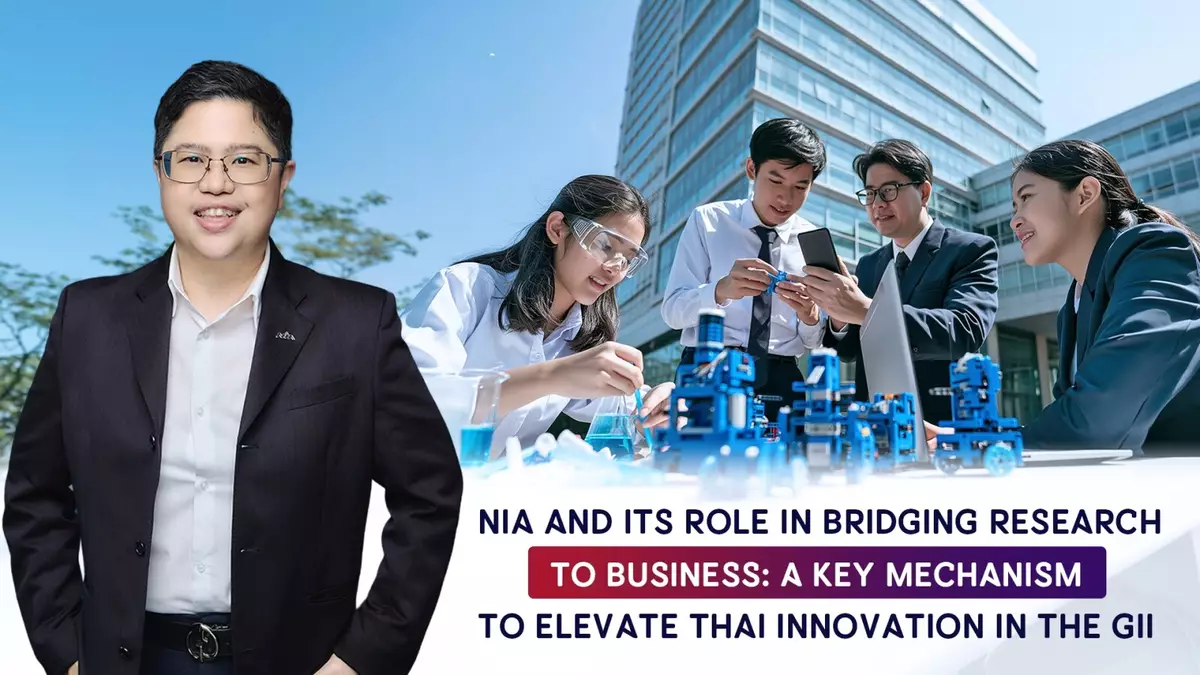
Dr. Krithpaka Boonfueng, Executive Director of the National Innovation Agency (NIA), explained that the NIA acts as a crucial "Innovation Intermediary" among academia, private enterprises, government sectors, and financial institutions. Its mission is to facilitate the translation of knowledge, research, and technology into tangible commercial and social benefits. Currently, Thailand's main challenge is not a shortage of research, but rather the "gap" between academic research and its industrial application. Many university research projects possess high potential but lack the supporting mechanisms for business prototyping, market testing, or connecting with entrepreneurs and investors. Therefore, the NIA's role is essential in building platforms and support programs that enable efficient collaboration between universities and the business sector.
The NIA supports University–Industry R&D Collaboration across multiple dimensions, including providing innovation grants, incubating and accelerating deep-tech startups, creating collaborative networks between universities and private entities, and promoting Innovation Ecosystems in strategic sectors such as FoodTech, AgTech, HealthTech, ClimateTech, and Deep Tech. These areas heavily rely on combining academic expertise with market capabilities and industrial investment.
Furthermore, the NIA actively promotes "Open Innovation" and "Co-Creation"—core concepts aligned with the direction of GII 2025, which indicates that the global innovation system is entering an era of multi-stakeholder collaboration and co-creation. The NIA creates platforms to match industry demands with university research capabilities, while also supporting activities such as Hackathons, Accelerator Programs, Innovation Bootcamps, and Regulatory Sandboxes to test innovations in real-world environments.
Another key responsibility is developing "Innovation-Based Enterprises" and "Startups" originated from university research (University Spin-offs). Spin-offs serve as a major driver in leading innovative nations like the United States, South Korea, and China to turn university knowledge into global tech enterprises. The NIA offers early-stage support ranging from business model development and capital access to investor networking and market connection locally and internationally.
Trends in GII 2025 demonstrate that countries with strong university-industry collaboration consistently generate continuous innovation and maintain high competitiveness. Hence, the NIA operates not merely as an innovation support agency, but as a "systemic mechanism" that bridges the gap between research and business, connects knowledge with market demand, and drives Thailand toward a long-term, knowledge-based economy.
Ultimately, elevating Thailand's performance in the University–Industry R&D Collaboration indicator requires concerted efforts among universities, the private sector, government entities, and innovation-enabling organizations like the NIA. Together, they build a comprehensive ecosystem covering knowledge creation, research, testing, investment, and market expansion—forming a solid foundation to boost the country's future competitiveness.
Lessons Learned: Startup Success Through University–Industry R&D Collaboration
Mr. Krerkchai Panyabaramee, Managing Director of Tleum Co., Ltd., shared that the commercial application of advanced material technology—derived from R&D by Dr. Supan Yodyingyong from the Institute for Innovative Learning, Mahidol University, who holds a patent for "Synthesis of Silica Aerogel from Sodium Silicate Solution at Atmospheric Pressure"—stands as a clear case study of University–Industry R&D Collaboration. The business originated from translating pilot-scale research on Silica Aerogel within the university into industrial-scale manufacturing in partnership with the private sector.
Currently, Tleum Co., Ltd. has successfully commercialized Silica Aerogel into a diverse range of products, including heat-reflective paints for buildings and industrial applications, heat-resistant cement and materials, oil absorbents for spill remediation, and cosmetic ingredients. This demonstrates the immense potential of Thai Deep Tech in value creation through advanced materials and collaborative research.
This success was not achieved by any single entity, but through the synergy of academia, business, and supporting bodies like the NIA. The NIA stepped in to bridge knowledge gaps, provide resources, and mitigate technology development risks, allowing entrepreneurs to overcome cost, testing, and scaling limitations rapidly. This highlights the NIA's role as an "Innovation Bridge" turning academic research into commercial reality.
Dr. Krithpaka concluded: "The 'University–Industry R&D Collaboration' indicator under Pillar 5: Business Sophistication measures the level of R&D collaboration between universities and industry in each country. It relies on data from the Executive Opinion Survey conducted by the World Economic Forum (WEF), which assesses business leaders' perceptions regarding the quality and effectiveness of joint R&D efforts—specifically how well they meet industry needs, achieve practical application, and generate economic value."
Therefore, this indicator does not merely evaluate the volume of research papers or joint projects; it reflects a country's capacity to transform knowledge into economic impact through cross-sector collaboration—a core hallmark of a mature innovation ecosystem.
The case of Tleum Co., Ltd. serves as a clear illustration of this concept. By licensing pilot-scale research and patents for Silica Aerogel, the private sector scaled the technology into full industrial production, yielding various commercial products globally—ranging from heat-reflective coatings and heat-resistant materials to oil absorbents and cosmetics.
This outcome underscores the importance of the NIA as an Innovation Intermediary that reduces technical and financial risks for businesses. Beyond this case, the NIA continues to drive numerous initiatives—funding, networking, tech startup incubation, and University Spin-offs—ensuring academic innovations translate into market-ready products, services, and new ventures that deliver true economic impact and strengthen Thailand's long-term competitive position.
Hashtag: #NIA #NationalInnovationAgency
https://www.nia.or.th/
The issuer is solely responsible for the content of this announcement.
** This press release is distributed by Media OutReach Newswire through automated distribution system, for which the client assumes full responsibility. **
NIA and Its Role in Bridging Research to Business