STOCKHOLM (AP) — Sweden is holding an election on Sunday that will determine whether a conservative leader remains in charge and a hard-right party wins ministerial jobs for the first time, or whether the center left returns to power.
Prime Minister Ulf Kristersson is seeking a second four-year term at the helm of the European Union nation that is also NATO’s newest member. His predecessor hopes to win the job back. The question of who will govern has taken up more space than actual policy issues.
Click to Gallery
Sweden's Center Party leader Elisabeth Thand Ringqvist, left, campaigns with former party leader Annie Lööf in Stockholm, Sweden, Saturday Sept. 5, 2026, ahead of the general election on Sept. 13. (Stefan Jerrevång/TT via AP)
Sweden Democrats party leader Jimmie Åkesson (SD) presents the party's election manifesto for 2026 at Stora torget in Nyköping, Sweden, Monday, Sept. 7, 2026. (Magnus Lejhall/TT News Agency via AP)
Sweden Democrats party leader Jimmie Åkesson (SD) presents the party's election manifesto for 2026 at Stora torget in Nyköping, Sweden, Monday, Sept. 7, 2026. (Magnus Lejhall/TT News Agency via AP)
Sweden's Social Democratic Party leader Magdalena Andersson gives a speech in Stockholm, Sweden, Saturday Sept. 5, 2026, ahead of general election on Sept. 13. (Jonathan Näckstrand/TT via AP)
Swedish Moderate Party Ministers, from left, Pål Jonson, Ulf Kristersson, Gunnar Strömmer, Elisabeth Svantesson and Maria Malmer Stenergard hold an election rally in Malmö, Sweden, Saturday Sept. 5, 2026, ahead of general election on Sept. 13. (Johan Nilsson/TT via AP)
More than 8 million people in the nation of about 10.6 million people are eligible to vote in the election for the 349-seat parliament in Stockholm, the Riksdag, which will elect the next prime minister.
Kristersson has led Sweden since 2022 with a three-party center-right coalition. It relies on outside support from the Sweden Democrats, an anti-immigration party that has far-right roots but has moved toward the political mainstream, for a parliamentary majority. If the right is reelected, it can expect Cabinet posts this time.
He's up against Magdalena Andersson of the center-left Social Democrats, a party that more often than not led Swedish governments since World War II. Andersson served as prime minister from 2021 until she lost power at the last election.
Experts say the campaign has been fragmented and incoherent, with policy questions such as how healthcare should be organized drowned out by the question of which parties will be able to put together a government.
“Crime has come down, inflation has come down. So these topics are not really what people discuss,” said Zeth Isaksson, a sociologist in electoral behavior at Stockholm University and a political scientist at the European University Institute in Florence, Italy. “People discuss who is going to be in government, and that’s what the election is about.”
There are two major political blocs: one with four parties on the right and another with four parties on the left. So the big question is not so much which party wins as which side can put together a majority. Individual parties need a minimum 4% of the vote to win parliamentary seats.
On the face of it, “it would be a sensation if the opposition parties, having been ahead in the opinion polls pretty much for four years since the last election, didn’t now win a majority,” said Nicholas Aylott, associate professor of political science at Södertörn University.
But he said that an “extremely defensive” campaign by the Social Democrats may have cost them some support, leaving some voters wondering why they should support the party. The right-wing bloc's hope of convincing voters that it's more united than its rivals may have had “a little impact,” he added.
One significant thing is different in this election. The Sweden Democrats, who in 2022 took 20.5% of the vote to become the biggest party on the right, can expect Cabinet seats if power doesn't change hands.
Kristersson announced in April that his conservative Moderates would allow them into government if the right has a majority — though he would remain prime minister, even if the Sweden Democrats are the stronger party.
The Sweden Democrats were founded in the 1980s by people who had been active in right-wing extremist groups, including neo-Nazis. They toned down their rhetoric and expelled openly racist members under Jimmie Åkesson, who has led them since 2005 and overseen their growth from what was once a marginal party.
“There’s some, I won’t say fear, but trepidation, apprehension about the possibility of Sweden Democrat ministers,” Aylott said, and the Social Democrats recently have tried to exploit that.
But even as parties on the populist right gain elsewhere in Europe, for instance in a far-right triumph in a weekend state election in Germany, the election may reinforce the impression that the Sweden Democrats “have peaked to some extent,” Isaksson said.
“The biggest threat to Sweden’s security is from the war in Ukraine and there is almost complete consensus in Sweden about support for Ukraine and deep antipathy toward Russia,” Aylott said.
Sweden's Psychological Defense Agency said that the country's election isn't Russia's top priority, as that broad support reduces the incentive for Moscow to interfere.
However, just over a week before the election, Expo magazine published a report alleging that a civil servant working in parliament for the Sweden Democrats had spread Russian state narratives on social networks. Her partner is the head of the party's office for coordination with the government, Gustav Gellerbrant.
Gellerbrant said her posts were taken out of context and were meant as irony and sarcasm. He said he decided to go on parental leave to avoid shifting the focus of the election campaign.
Kristersson, who said that “there is no room for pro-Russian narratives in Sweden,” welcomed that decision.
After decades of post-World War II neutrality and centuries of broader nonalignment with major powers, Sweden joined NATO in 2024 as the trans-Atlantic military alliance’s 32nd member. The move to join was initiated by Andersson's government after Russia launched its full-scale invasion of Ukraine in 2022 and completed under Kristersson.

Sweden's Center Party leader Elisabeth Thand Ringqvist, left, campaigns with former party leader Annie Lööf in Stockholm, Sweden, Saturday Sept. 5, 2026, ahead of the general election on Sept. 13. (Stefan Jerrevång/TT via AP)

Sweden Democrats party leader Jimmie Åkesson (SD) presents the party's election manifesto for 2026 at Stora torget in Nyköping, Sweden, Monday, Sept. 7, 2026. (Magnus Lejhall/TT News Agency via AP)

Sweden Democrats party leader Jimmie Åkesson (SD) presents the party's election manifesto for 2026 at Stora torget in Nyköping, Sweden, Monday, Sept. 7, 2026. (Magnus Lejhall/TT News Agency via AP)

Sweden's Social Democratic Party leader Magdalena Andersson gives a speech in Stockholm, Sweden, Saturday Sept. 5, 2026, ahead of general election on Sept. 13. (Jonathan Näckstrand/TT via AP)

Swedish Moderate Party Ministers, from left, Pål Jonson, Ulf Kristersson, Gunnar Strömmer, Elisabeth Svantesson and Maria Malmer Stenergard hold an election rally in Malmö, Sweden, Saturday Sept. 5, 2026, ahead of general election on Sept. 13. (Johan Nilsson/TT via AP)
WASHINGTON (AP) — More than a year after President Donald Trump deployed National Guard members to begin patrolling the streets of the nation's capital, a federal appeals court on Wednesday opened a hearing on the legality of his action by asking the government if there were any limits on a president's authority to do so.
The hearing began with the three-judge panel collectively questioning the government’s attorney, Eric McArthur. Judge Cornelia T.L. Pillard asked how the government's argument about an administration's authorities was “not federalization and therefore running up against" the Posse Comitatus Act, an 1878 U.S. law forbidding the use of the federal military for domestic law enforcement unless authorized by the Constitution or Congress.
McArthur, answering Judge Judith Rogers' question on the limits of a president's action, said, “I think the limiting principle in our position is the president has to be calling out the guard in aid of the civil authorities.”
Trump deployed the guard in August 2025 as part of what he said was a crime-fighting mission in Washington, D.C. The force, which rose to a peak of about 5,000 troops over the summer, has supported arrest operations, patrolled city streets and neighborhoods and participated in cleanup efforts.
Trump’s Republican administration says the deployment has contributed to a decrease in crime in the city, where crime was already on the decline before the National Guard arrived. Officials and activists in the overwhelmingly Democratic city say the deployment is a waste of taxpayer money and has normalized the militarization of a major American city.
Mitchell Reich, who was arguing for D.C., did not escape the hearing unscathed, with the panel concentrating on his argument that there are laws and guidelines that lay out a president's ability to call out the guard and there were circumstances when those steps would be unnecessary, including during an invasion or an insurrection.
“If there’s any kind of organized violence in the district, the president can deploy the guard for the purpose of suppressing the same,” he said.
The 90-minute hearing came months after a different three-judge panel paused a lower court’s ruling that Trump's deployment of the guard was illegal.
The three judges who issued the stay last December — two appointed by Trump and one appointed by President Barack Obama, a Democrat — said in a unanimous 32-page ruling that a number of factors favored the Trump administration, including the “disruption to the lives of thousands of service members,” as well as what it said was the president’s interest “in the protection of federal governmental functions and property within the nation’s capital.”
The three judges on the panel on Wednesday were nominated by Democratic presidents: Pillard by Obama, Rogers by Bill Clinton and Bradley Garcia by Joe Biden.
At the heart of the court case, brought by D.C.'s attorney general, is whether the president has the authority to deploy the National Guard to the city, which, as a federal district, has limited autonomy over its own affairs. The U.S. Constitution gives federal lawmakers authority over the District of Columbia, while the Home Rule Act of 1973 lets residents elect a mayor, a council and neighborhood commissioners.
The city has argued that the mobilization is an illegal use of the military for domestic law enforcement, a point Reich made during the hearing.
Last December, the three-judge panel that paused the lower court's ruling said Trump might prevail in his argument that the president “possesses a unique power” to mobilize the guard in Washington.
Those judges found that the district “has not identified any ongoing injury to its statutory interests.”
Even if D.C. wins at the appeals court level, the Trump administration will undoubtedly go to the U.S. Supreme Court, which has already shown deference to the president in a number of cases.
Syracuse law professor William Banks said D.C. might have a slim argument under its home rule, questioning whether National Guard units can be deployed to the city when it isn’t authorized by local law.
But, he said, outside of that argument “there is no overarching federal principle that would bail out the district in this case."
Because D.C. is not a state and because the president is commander in chief, there’s a "tremendous amount of leeway and discretion for the president” to control or delegate control of the local National Guard and out-of-state units, Banks said.
U.S. District Judge Jia Cobb concluded last November that Trump’s military takeover in Washington illegally intrudes on local officials’ authority to direct law enforcement in the district.
Cobb, a Biden nominee, found that while the president does have authority to protect federal functioning and property, he can’t unilaterally deploy the D.C. National Guard to help with crime control as he sees fit or call in troops from other states.
The appeals court stayed the order and has allowed the guard to remain in place while the case is pending.
The mobilization, extended until January 2029 by the Defense Department, has taken on a sense of permanence, despite the court case.
The federal government awarded a $292 million contract to a private company to provide members of the Joint Task Force-D.C. with apartments. The numbers have grown as well, ballooning to around 5,000 during the height of the semiquincentennial celebration. As of last week, that number had dropped to about 2,900.
Before the hearing began, several dozen people rallied outside the courthouse to oppose the continuing presence of the military in the city.
David Barrows, a retired office manager and city resident, was dressed in a Trump costume. “It’s easier to boss around the people in Washington, D.C., because we don’t have any representation in either House or Congress. So we’re basically an abused people,” he said. “We pay the highest federal taxes in the land, and we get no representation in both houses. So we’re a cheated people, and we’re scapegoats for Trump.”
He also questioned the premise of the guard's presence: “There's no national emergency here in Washington,” he said.
Jennifer Pace, a longtime resident and former banker, said she suspected the case would continue through the courts.
“But I really want it to move forward so they can just go home,” Pace said. "I’m sure they want to go home, too, because it’s clear they’re bored. They’re just standing around.”
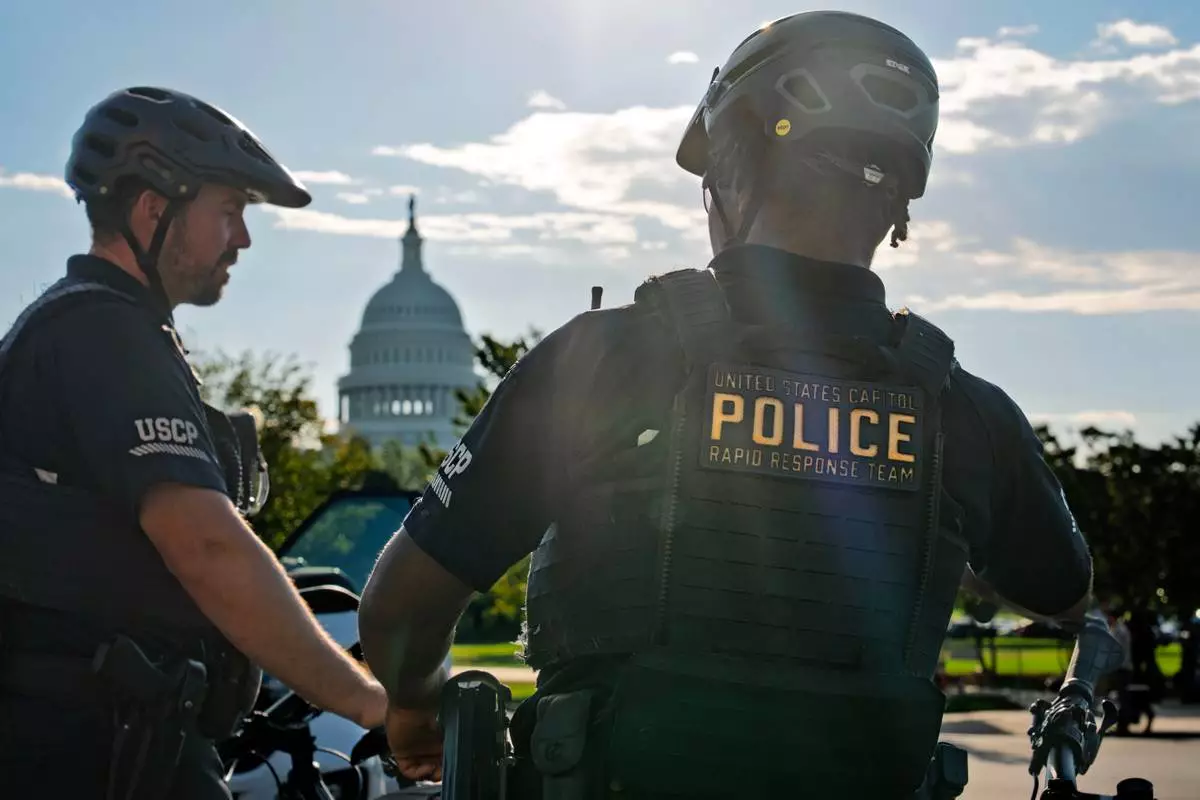
U.S. Capitol Police secure an intersection near the Capitol as activists stop traffic and call for the ouster of President Donald Trump's National Guard deployment in Washington, Wednesday, Oct. 14, 2026. (AP Photo/J. Scott Applewhite)
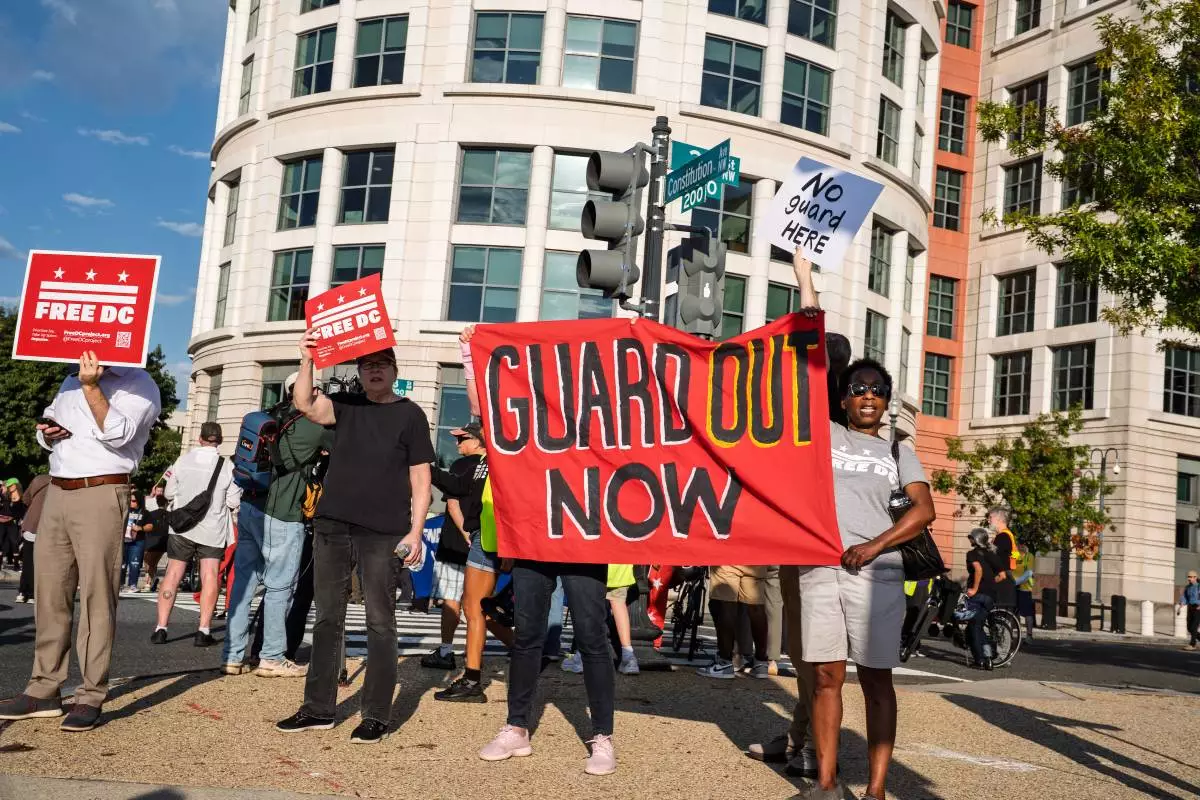
Protestors near the federal courthouse stop traffic and call for the ouster of President Donald Trump's National Guard deployment in Washington, Wednesday, Oct. 14, 2026. (AP Photo/J. Scott Applewhite)
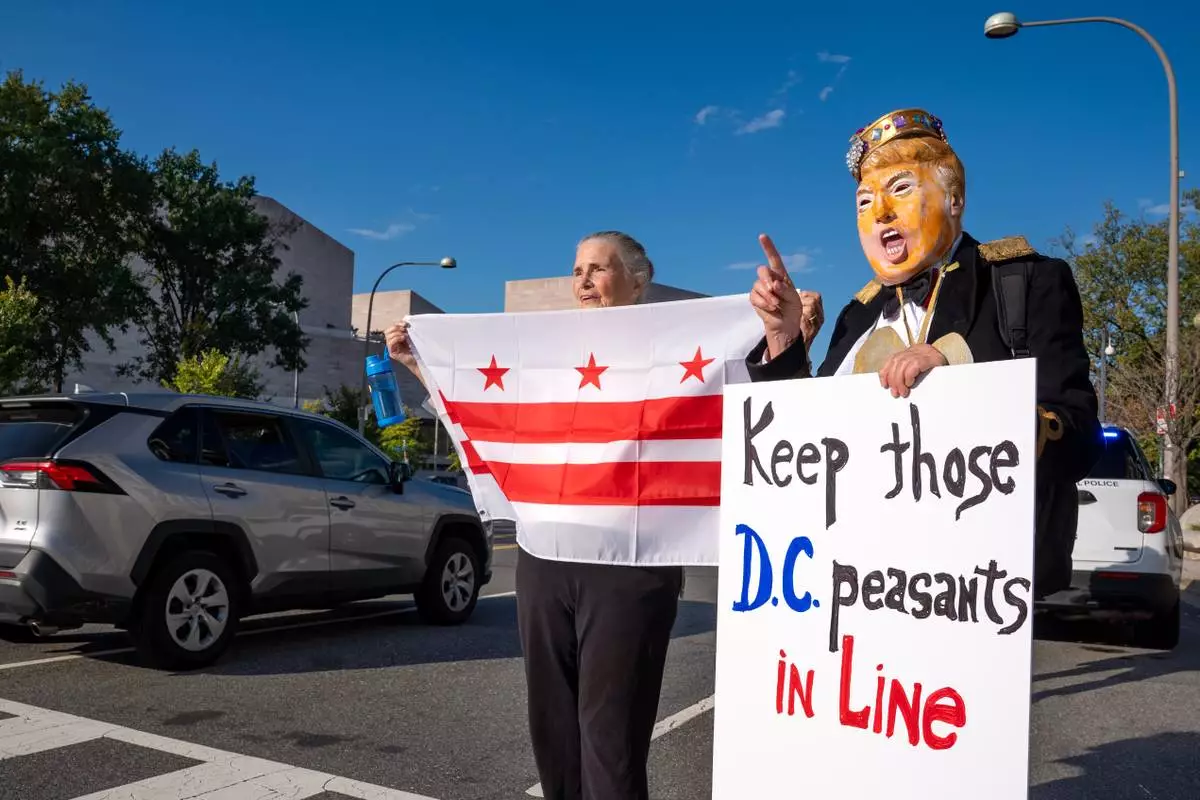
Protestors near the Capitol stop traffic and call for the ouster of President Donald Trump's National Guard deployment in Washington, Wednesday, Oct. 14, 2026. (AP Photo/J. Scott Applewhite)
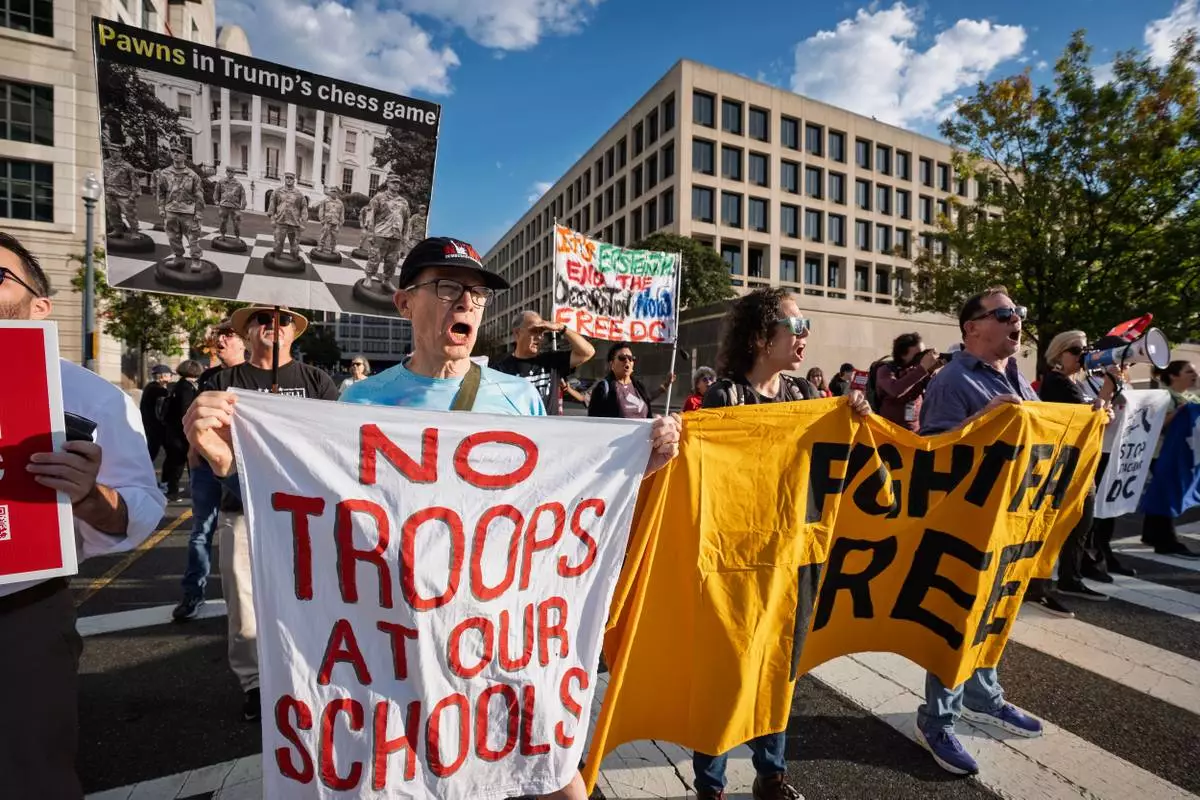
Protestors near the federal courthouse stop traffic and call for the ouster of President Donald Trump's National Guard deployment in Washington, Wednesday, Oct. 14, 2026. (AP Photo/J. Scott Applewhite)
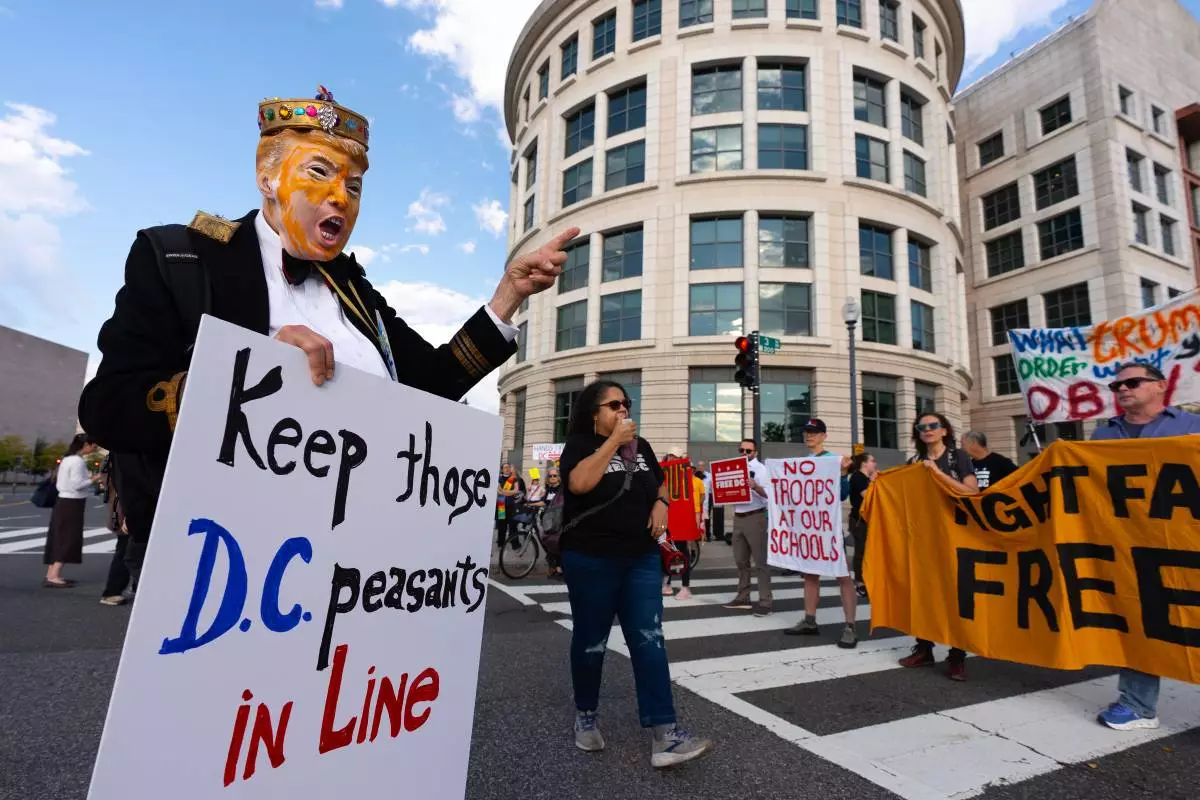
Protestors near the federal courthouse stop traffic and call for the ouster of President Donald Trump's National Guard deployment in Washington, Wednesday, Oct. 14, 2026. (AP Photo/J. Scott Applewhite)
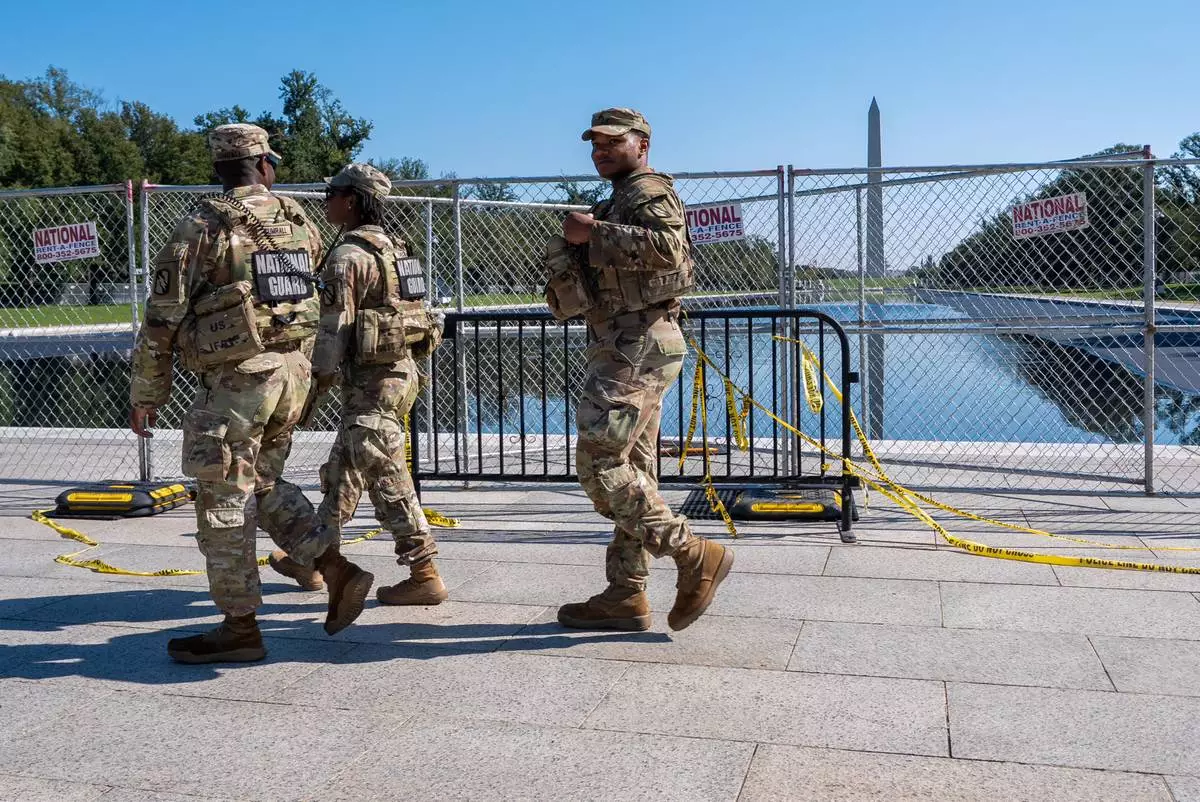
Members of the National Guard walk past the Lincoln Memorial Reflecting Pool, where some water can be seen, Tuesday, Oct. 13, 2026, in Washington. (AP Photo/Jacquelyn Martin)