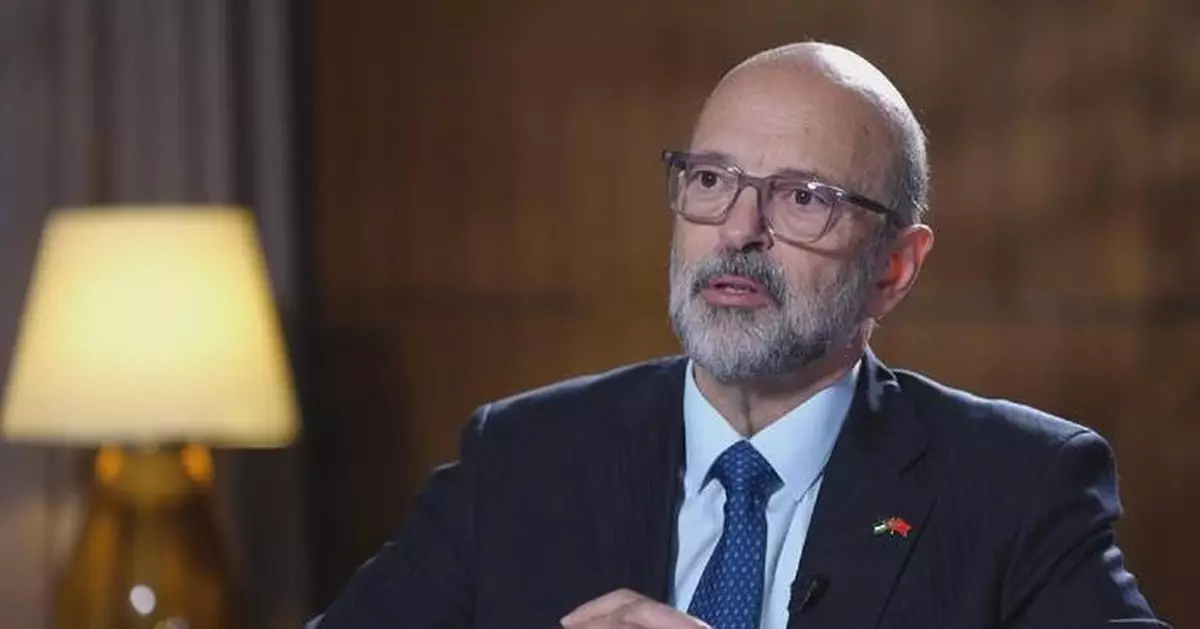
Former Jordanian Prime Minister Omar Razzaz has praised China's rapid development and breakthroughs in artificial intelligence (AI) and its approach to global AI governance, echoing China's call for inclusive international collaboration rather than unilateral technological dominance.
In an interview with China Media Group (CMG) in Beijing, Razzaz said China is taking a lead in translating foundational research into commercial applications, robotics, and digital infrastructure that reshape people's daily life.
"It's obvious that China leads the way in terms of taking basic research and turning it into applied research, turning applied research into production of goods and services. And we're entering the age of artificial intelligence and robotics and digital technology and all of these things. And they have, obviously, huge impact on people's lives. And so, we should make the best of that kind of technology, and China is doing that," said Razzaz.
While acknowledging that emerging innovations carry dual-use risks, Razzaz pushed back against calls to stall technological progress, advocating for proactive regulatory tracking and risk mitigation.
"Now, any technology has its positive potential or negative potential. It could do good and it could do harm. The answer is not to stop technological advancement; the answer is to try to keep up with it, understand its limitations and do something about that," Razzaz said.
Discussing global governance frameworks for emerging technologies, Razzaz highlighted Chinese President Xi Jinping's remarks at the 2026 World Artificial Intelligence Conference and High-Level Meeting on Global AI Governance in July, where the Chinese leader likened AI development to a symphony of international cooperation rather than a solo performance by one country.
"China has taken a lead in looking at the global governance issues. [AI] This is highly productive technology. President Xi Jinping in July made a statement that was quite amazing, quite telling. And when he said AI development needs to be done not as a solo by one country, but as a symphony of everybody. You want countries to come together and say this is what's in the interest of humanity, of dignity, of prosperity," said Razzaz.
Former Jordanian PM praises China's AI development, approach to global governance
Fu Cong, China's permanent representative to the United Nations, expressed concern over a heightened escalation in hostilities in Yemen at an emergency meeting of the UN Security Council on Thursday.
He urged all parties to achieve a ceasefire at an early date and resolve differences through dialog as a fragile four-year truce collapsed.
The emergency meeting on Yemen was held as the renewed war effectively marks the end of the relative calm the country had experienced since a UN-brokered truce in 2022 largely halted major hostilities.
The Houthis announced a ban on Saudi shipping on July 20 and have since claimed a series of attacks on Saudi tankers and oil facilities in Saudi Arabia.
The group seized Yemen's entire western coast and pushed its offensive beyond the strategic Bab al-Mandab Strait into the southern province of Lahj on Friday, firing ballistic missiles at retreating government forces, government and military officials said.
The advance followed the Houthis' Thursday capture of Mocha, a strategic Red Sea port city in southwestern Yemen.
The Bab al-Mandab Strait, which connects the Red Sea with the Gulf of Aden and the Indian Ocean, is a major route for international trade and energy shipments.
Yemen has been mired in conflict since late 2014, when the Houthis seized the capital Sanaa and much of northern Yemen, prompting a Saudi-led coalition to intervene the following year in support of the internationally recognized Yemeni government. "The situation in Yemen has reached a critical juncture. The international community should heighten its sense of urgency, remain steadfast in its commitment to peace, and step up peace efforts to help Yemen break the cycle of recurring turmoil and embark on a path toward lasting peace," Fu said.
Fu stressed that Yemen's future and destiny should be in the hands of the Yemeni people themselves. Dialog and consultation must be vigorously advanced, he said.
China called on the parties to the conflict to meet each other halfway, work together to de-escalate the situation, and create conditions for a political settlement of the Yemen issue.
"China emphasizes its consistent support for upholding Yemen's sovereignty, unity, and territorial integrity. It stands ready to continue working with the international community to make unremitting efforts toward a political settlement of the Yemen issue and for peace and development in the country. China will play a constructive role in promoting a comprehensive ceasefire and the start of national reconstruction, and fostering long-term stability, security, development, and prosperity across the region," Fu said.

China calls for ceasefire, political dialog in Yemen