GAINESVILLE, Fla. (AP) — Florida guard Denzel Aberdeen has joined a growing list of players suing the NCAA in hopes of gaining a fifth year of eligibility.
Aberdeen’s attorney, Jesse Panuccio, filed the lawsuit Friday in Gainesville. His motion notes that more than 30 courts across the country have ruled that the NCAA’s “arbitrary decision” against student-athletes who began college careers during the 2022-23 season and completed four seasons of eligibility is “unlawful.”
“The NCAA’s refusal to honor its current eligibility framework breaches its contract with UF, which is intended to benefit student-athletes like Aberdeen,” the suit said.
The NCAA’s move to a five-year, age-based eligibility model has led to a series of court fights across the country.
Aberdeen played three seasons at Florida before transferring to Kentucky last year. He reenrolled at Florida earlier this year in hopes of finishing his undergraduate degree. He has worked out and practiced with the Gators all summer.
He initially planned to convince the NCAA that his freshman year in Gainesville should be considered a redshirt season. The 6-foot-5 Orlando native played just 12 games in 2022-23, scoring 19 points in 41 total minutes. He had hoped to get a waiver from the NCAA to secure another year of eligibility.
But the NCAA has since adopted the five-year eligibility model, which is scheduled to be fully implemented next fall, that will allow players to have five years of eligibility with the clock starting when athletes turn 19 or graduate from high school, whichever is earlier.
That change quickly led to lawsuits from four-year players in the high school class of 2022, like Aberdeen.
As of last week, the NCAA said there have been 79 lawsuits with a total of 450 plaintiffs across all sports involved in litigation tied to the five-year rule, with 234 of those coming in men’s basketball and 33 in women’s basketball. Of that group, 154 men’s players and 26 women’s players have received some type of relief from the courts allowing them to play while the rest are currently ineligible.
If granted a temporary restraining order, Aberdeen would slide into a starting spot to replace Xaivian Lee.
The Gators already are the betting favorite — and likely to be ranked No. 1 in preseason polls — to win it all in 2027. Coach Todd Golden retained most of last year’s roster, most notably big men Alex Condon, Thomas Haugh and Rueben Chinyelu.
Aberdeen started 35 games for Kentucky last season, averaging 13.5 points, 3.4 assists and 2.5 rebounds. He came off the bench the previous two years at Florida and averaged 7.7 points as a junior in 2024-25.
Sign up for Top 25 poll alerts here, visit the Top 25 here and see AP’s full men’s basketball coverage here

FILE - Florida guard Denzel Aberdeen shoots a free throw during the first half of their NCAA college basketball game against Mississippi State, Feb. 11, 2025, in Starkville, Miss. (AP Photo/Rogelio V. Solis, File)
Attacks on a key Saudi oil pipeline were launched from Iraqi territory, said Iraq's government on Saturday, pledging to probe further. U.S. President Donald Trump appeared to blame Iran for the attack that halted the pipeline.
Iraq closed two key border crossings with Iran, halting all passenger and commercial traffic until further notice, Iran’s state-run media reported Saturday.
Meanwhile, fears mount that gas and oil prices may rise and international shipping could be further disrupted after Yemen's Iran-backed Houthis seized a key island and captured a Red Sea port.
Here’s a look at the latest news in the Middle East. Full coverage can be found here.
Asked by reporters whether he thinks Iran was behind the attack on the Saudi pipeline, Trump said: "Well, I think they are. Probably they are. You know, they’re on the balls of their feet right now. But I think they are.”
Trump, speaking in Dublin, where he met Irish leaders, also said his administration has “had discussions” with the Houthis, though he did not provide details on when those talks took place.
“The Houthis called us, and they don’t want to fight with us,” Trump said. “They would much prefer not having us involved, and they’re letting most ships go through.”
Asked about a recent call with Saudi’s crown prince, Trump said: “He’s a good friend of mine, and I can just say everything’s going to work out fine and dandy. It’s going to be very good.”
The White House did not immediately respond to a request for comment about the timing of the talks.
__
Darlene Superville and Jill Lawless in Dublin
Iran's President Masoud Pezeshkian and the United Arab Emirates' President Sheikh Mohamed bin Zayed Al Nahyan held talks on the sidelines of the BRICS summit in New Delhi on Saturday, signaling efforts by the two regional powers to maintain diplomatic engagement despite growing instability across the region.
The leaders discussed regional and international issues, de-escalation, stability, and efforts to advance regional peace and development, a UAE government statement said.
Tehran has sharply criticized the security partnerships some Gulf states maintain with Western powers, while Abu Dhabi has backed efforts aimed at containing Iran’s military influence amid the ongoing conflict.
The meeting highlights the UAE’s balancing act of maintaining strong ties with Western partners while expanding dialogue with Iran, experts say.
“From clashing at the BRICS foreign ministers meeting not so long ago to engaging on the sidelines at BRICS summit, Iran and UAE have shown diplomatic sagacity to make use of this rare opportunity for a direct meeting,” said Praveen Donthi, senior analyst with the International Crisis Group.
Prime Minister Ali al-Zaidi ordered an investigation into the operations command in Maysan province and dismissed its commander after authorities determined that attacks targeting Saudi Arabia were launched from a site in the province, the Iraqi government said in a statement early Saturday.
Saudi Arabia shut down the major, cross-country oil pipeline on Friday, saying it was a “precautionary measure."
The Saudi Foreign Ministry blamed the attacks on several drones that came from Iraq and, in a statement, said the kingdom would not retaliate to give the Iraqi government “an opportunity to take the necessary measures.”
The East-West pipeline has been vital to Saudi Arabia’s continued oil exports in the months since the Iran war disrupted shipping in the Strait of Hormuz. According to the International Energy Agency, Saudi oil exports through the Red Sea port at the pipeline’s end have more than doubled since the Iran war erupted.
Tehran-backed Iraqi militias have launched attacks on U.S.-linked targets both inside and outside of Iraq since the U.S. and Israel attacked Iran on Feb. 28 and have coordinated with Yemen’s Houthi rebels to attack Saudi Arabia.
Crude prices this week soared again above $100 a barrel, giving Tehran more leverage in any talks. Analysts worry that the Houthis’ seizure of Yemen’s port city of Mokha may create further complications for shipping on the Red Sea and raise oil prices.
Valiollah Hayati, the deputy governor of Iran’s southwestern Khuzestan province, said Iraqi officials had announced the closure of the Shalamcheh and Chazabeh crossings.
Hayati urged traders, drivers and travelers not to approach the crossings until further notice. He said relevant authorities would release additional information.
Shalamcheh and Chazabeh are among the main official border crossings between Iran and Iraq.
Lebanese and Israeli negotiators are scheduled to meet in Rome in October for U.S.-brokered talks, after a planned round this month was postponed without a reason being given.
The U.S. State Department also said Lebanese and Israeli ambassadors to the U.S. will meet at its headquarters in Washington next week to discuss ongoing developments and the continued implementation of the framework agreement reached in late June.
It said the framework agreement remains the only viable mechanism to restore Lebanon’s sovereignty and Israel’s security.
Lebanon and Israel have so far held seven rounds of talks in Washington and Rome over the past months.
A large-scale oil spill, believed to be from a tanker struck by the U.S. military, has doubled in size between Wednesday and Thursday, endangering two protected areas off Oman and Iran, said Nina Noelle of Greenpeace Germany.
The crude oil tanker RIESCO was one of four tankers attacked on Tuesday in the Gulf of Oman. A fifth was destroyed in the Strait of Hormuz off Iran’s Kharg island the same night.
The visible area of pollution measured about 400 square kilometers (154 square miles) on Thursday, twice the size compared to the day before, Noelle said.
Satellite images reviewed by The Associated Press showed the spill stretching almost 70 kilometers (43 miles) long.
The spill is located between the Musandam protected area on the Omani side, which includes one of the region’s most important seabird breeding islands.
On the Iranian side, the Hara-e Roud-e Gaz Protected Area in Iran’s Hormozgan province includes mangrove forests, tidal creeks, mudflats, salt marshes, sandbanks and offshore islands.
“The current situation in the Strait of Hormuz, together with our experience of oil spills since the beginning of the war, unfortunately suggests that an effective response is unlikely,” Noelle said.
Israeli troops opened fire Saturday at a group of Palestinians who did not appear to be posing a threat in the occupied West Bank, wounding one man, according to video obtained by The Associated Press.
The video, shot by an eyewitness, showed the man falling to the ground near the Palestinian village of Faqqua, north of the West Bank.
At least 14 shots in total were fired during the duration of the video. They continued as several men rushed to move the injured man to safety before setting him down and tying a tourniquet around his leg in an apparent attempt to stop the bleeding.
Mahmoud Shahin, a resident of the village, said the Palestinians had rushed to the area after receiving reports that Israeli settlers had arrived there with a flock of sheep. He said Israeli soldiers then came and began firing in the air and toward the Palestinians.
He added that the wounded man was undergoing surgery at a hospital in Jenin.
Israel’s military said the video AP obtained from an eyewitness was authentic and confirmed its forces had fired toward the Palestinians, wounding one man, and said commanders would review the incident.
Under the ultranationalist government of Israeli Prime Minister Benjamin Netanyahu, settler violence in the West Bank has surged. The international community largely considers Israeli settlements to be illegal and obstacles to peace.
Over 700,000 Israelis now live in the West Bank and east Jerusalem, areas captured by Israel in the 1967 Mideast war and claimed by the Palestinians as parts of a future state.
_
This report will be updated throughout the day as new developments emerge.
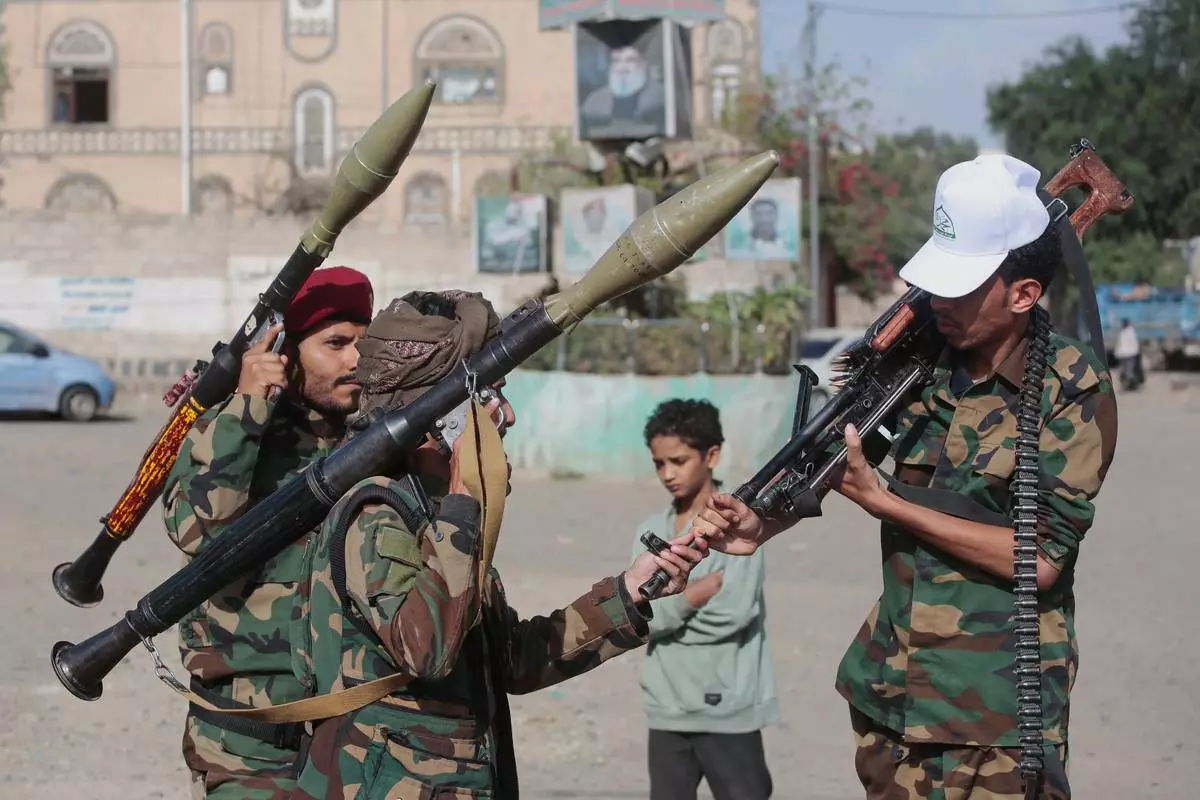
Yemen's Houthi rebels chat as they check their weapons during a mobilization campaign in Sanaa, Yemen, Thursday, Sept. 10, 2026. (AP Photo)