SHANGHAI, Sept. 14, 2026 /PRNewswire/ -- Qunabox Group's "99 Quna Festival" drew to a close on the evening of Sept. 13, when the last AI interactive terminal in Shanghai shut down its experience channel for the day. Over the five-day event, the focus fell not only on the group's already-proven multi-sensory interactive marketing business but also on the physical AI entertainment segment it opened to the public for the first time. Consumer queues and spontaneous approaches from brands, cultural tourism operators, game companies, intellectual property owners and offline venue operators all pointed to one signal: the consumer-facing entertainment second curve that Hong Kong-listed Qunabox Group Limited (00917.HK) is trying to build with physical AI technology has won early recognition from the market.
On site: long lines at the motion-sensing game zone, digital avatars as "social currency"
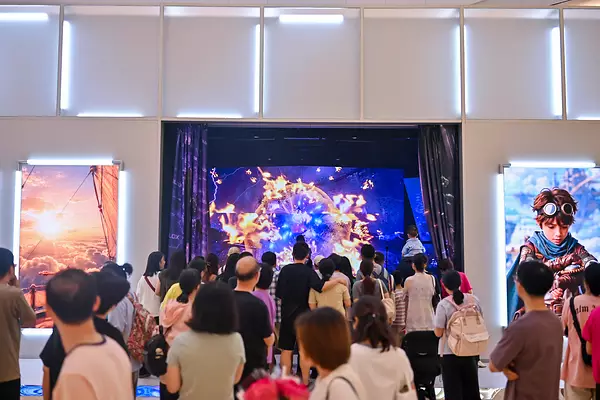
Around dusk on the closing day, reporters saw that while foot traffic had thinned at most brand interaction areas, the physical AI entertainment experience zone stayed busy. More than a dozen people lined up at the wearable-free motion-sensing game zone built on the Q-Sense engine. Experience-seekers wore no equipment at all, standing in front of a naked-eye 3D screen and controlling game characters with body movements alone, drawing gasps from onlookers. This is the "Game Reality" that Qunabox has brought to life ahead of others — using physical AI to bring virtual gaming into the real world, so that consumers can interact in real time with virtual imagery in physical space for an immersive gaming experience, with nothing worn on their bodies.
On the other side of the venue, a large real-time digital human runway display built on the Q-Gen engine likewise drew heavy interest. Visitors took a single photo and got a personalized 3D digital avatar soon, then joined the runway interaction on the big screen. Reporters noted that many young women posted the short videos straight to social platforms after trying the service, making it a form of "social currency" at the event. Staff said the service's interaction conversion rate far exceeded expectations during the festival, with many users not only trying runway looks in different themes themselves but also recommending the experience to friends who came with them.
Brands: several partners move to lock in next year's campaigns
For the group's core multi-sensory interactive marketing business, the festival extended the growth trend seen in previous periods. During the event, AI terminals equipped with the Q-Sense engine rolled out brand-customized interactive campaigns spanning fast-moving consumer goods, tea drinks and other industries. Through the combined engagement of sight, hearing, smell and touch, participating users spent significantly longer and posted significantly higher interaction conversion rates than with traditional offline display formats.
"We used to run trial campaigns at traditional counters, where consumers stayed for only a minute or two on average," a marketing executive at a leading brand that took part in the festival told reporters. "This time, with Qunabox's AI interactive terminals, the average stay topped five minutes, and the trial conversion rate was much higher than what our own campaigns delivered." Several partner brands have already begun discussing marketing plans for the coming year, according to reporters at the event, with results exceeding expectations.
Industry: dozens of game companies and IP owners seek partnerships
Even more noteworthy than the brands' renewal interest was the enthusiasm from industry players drawn to the physical AI entertainment business. During the festival, dozens of leading cultural tourism attractions, game companies and well-known IP owners approached Qunabox staff on their own initiative, expressing intent to jointly develop offline experience projects based on the group's physical AI technology base.
"We've been looking for the right offline scenario to bring our game's world to life," an executive at a leading game company who visited the event told reporters. "Traditional VR arcades don't deliver a good experience, and escape rooms are too operation-heavy. Qunabox's wearable-free approach stood out immediately. If we can turn our game IP into an offline immersive experience space, that would be very valuable for user acquisition and brand exposure."
Venues: major commercial districts extend overtures
Beyond consumers and industry players, feedback from offline venue operators also stood out. Multiple operators of major commercial districts have offered to bring in Qunabox's physical AI entertainment equipment to build permanent, regularly operated experience points, according to reporters at the event.
"What offline commercial properties lack most is experience content that keeps drawing traffic," a commercial real estate operator involved in the talks told reporters. "Traditional arcades and escape rooms no longer bring young people back. Qunabox's devices don't take up much space, their content can be updated continuously and they can connect with our membership system — they're well suited to regular operations in atriums or at key points along customer flows."
Investor view: second-curve logic gets early validation; execution pace is the key
Industry observers noted that the closing feedback from this year's "99 Quna Festival" validated the feasibility of Qunabox's dual-engine logic — a B2B marketing base plus a consumer entertainment second curve — across several dimensions. Continued renewals by brands confirmed the stability of the base business; unsolicited approaches from industry players confirmed the cross-scenario reusability of the physical AI technology base; and positive feedback from venue operators has cleared some obstacles for subsequent scale-up.
Qunabox has obtained a business license in Singapore and is advancing the first physical AI entertainment space project, while Dubai, Australia and other high-value overseas markets are also included in its strategic deployment. Still, some analysts cautioned that large-scale commercialization of the consumer entertainment business will take time to prove out, and that the pace at which IP partnerships and gaming tie-ups move from concept to reality, along with the group's ability to operate overseas markets locally, remain core variables to watch.
** This press release is distributed by PR Newswire through automated distribution system, for which the client assumes full responsibility. **
'99 Quna Festival' Wraps Up as Qunabox's Physical AI Entertainment Debut Draws Crowds, Giving Its Second Growth Curve Early Market Validation