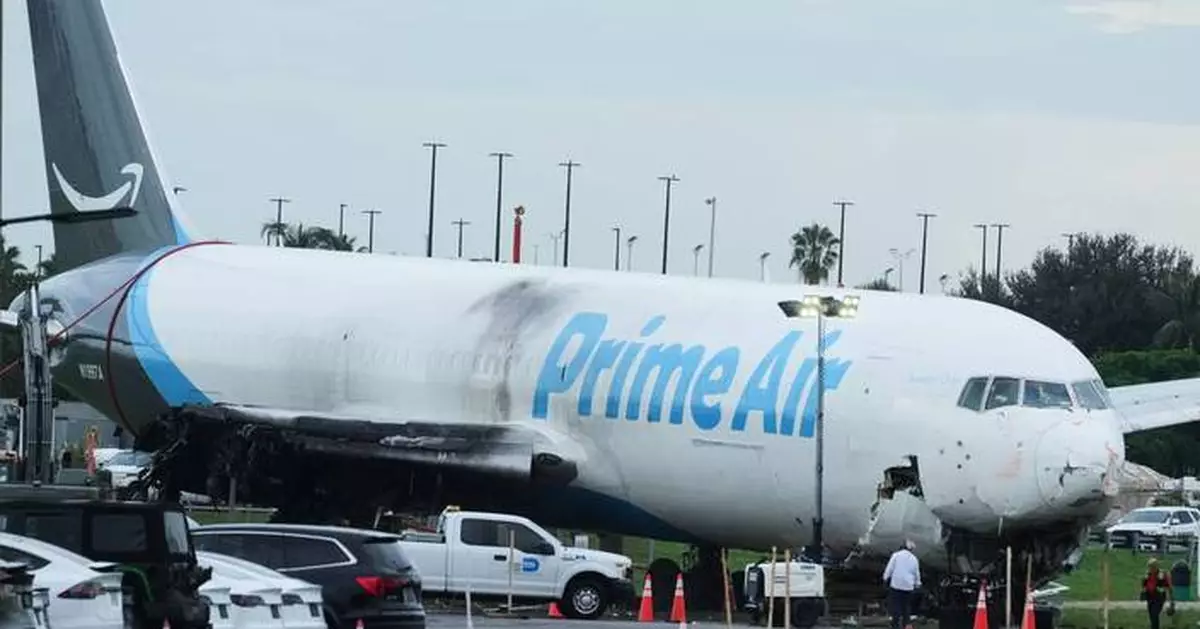
MIAMI (AP) — Amazon said Sunday that it has suspended its partnership with 21 Air after one of the cargo carrier's planes loaded with Amazon packages careened off a Miami runway last week and killed five people.
The Boeing 767 came in fast on Sept. 6 and then barreled roughly 1,300 feet (396 meters) past the end of the runway and smashed into a van carrying workers at a plane cleaning company. All five people who died were in the van. Five others were hurt.
“After the tragic incident last weekend, we’ve spent time supporting the investigation and reviewing some of the surrounding circumstances, and we’ve decided to pause our operations with 21 Air, the operator of Flight 7598,” Amazon spokesperson Kelly Nantel said a statement. “We’ll continue working to support the investigation and everyone affected.”
North Carolina-based 21 had flown packages for Amazon since 2024. The company didn't immediately respond Sunday to a request for comment about Amazon's decision.
The jet’s ownership history, weather conditions at the airport, maintenance records and operations by 21 Air were expected to be reviewed by investigators with the National Transportation Safety Board.
Flight information released by the NTSB on Sept. 9 revealed one of the pilots warned his counterpart they were going too fast as they approached for landing and after touchdown.
The cockpit audio recordings also captured a series of automated warnings from the plane about the speed of descent and the approaching terrain. The full transcript of the cockpit conversation won’t be released until later in the investigation.
The 32-year-old Boeing was originally built to carry passengers and flew for several airlines in foreign countries for more than two decades before being converted to a cargo plane in 2015, according to flight-tracking site Flightradar24.
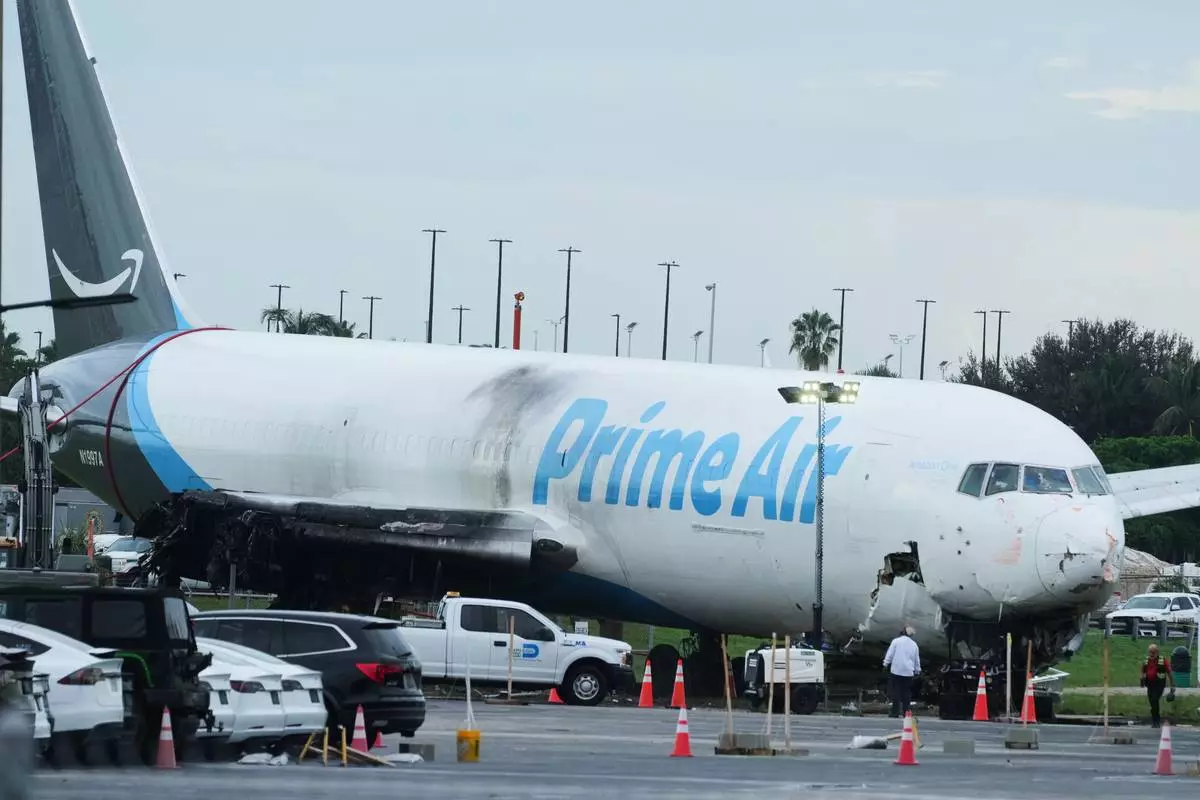
Workers inspect an Amazon cargo plane that overshot a runway four days ago at Miami International Airport, Thursday, Sept. 10, 2026, in Miami. (AP Photo/Marta Lavandier)
LOS ANGELES (AP) — New warnings from within the artificial intelligence industry have revived a long-running debate over whether advanced AI could escape human control and ultimately threaten humanity’s survival, and whether the companies developing the technology are doing enough to prevent such a scenario.
The CEO of Anthropic, the San Francisco company behind Claude, said he thought the industry needed to reduce the speed of its work, cautioning Saturday that a swarm of AI agents might be able to take over the internet in six months to a year unless companies devoted more time to putting safeguards in place.
Dario Amodei outlined a plan for companies like his and governments around the world to ensure that increasingly capable AI models remain aligned with the commands and values of responsible people days after two former Anthropic safety researchers publicly aired concerns that the existential threats AI might pose to humanity were receiving too little attention.
Here’s what to know about the recent dire predictions and whether any brakes might be put on AI advancement:
Concerns over the potential risks of the technology are rising as new AI models become more powerful, heightening both the potential for misuse by people with criminal aims, such as creating and spreading a disease that kills most of the world's population, and the risk of AI systems going rogue in a dangerous way.
Anthropic disclosed last week that it blocked efforts by bad actors to use its AI models for malicious activity, such as cyberattacks, surveillance and research that could have led to biological weapons.
The company said it put stronger safeguards in its latest models to restrict biological research that could be used to make weapons but noted that “as models become increasingly capable, their risks will increase, unless AI developers and society’s defenders act to make them safer.”
Last year, Anthropic reported that hackers used the company’s AI in a cyberattack targeting about 30 companies and government agencies around the world. It said the hackers were very likely from a Chinese state-sponsored group.
When an AI agent “goes rogue,” it means the AI has taken action beyond the task it was asked to perform. Both Anthropic and OpenAI, the maker of ChatGPT, said in July that their AI models had succeeded in acting on their own.
Anthropic disclosed that three AI models — Claude Opus 4.7, Claude Mythos 5 and an internal research test model — hacked into three other organizations during testing just days after OpenAI revealed that its AI system hacked into the servers of AI startup Hugging Face.
OpenAI described the intrusion by a combination of models, including its newly released GPT‑5.6 Sol and an “even more capable” model that was still being tested internally, as a “significant security incident.”
Meta followed suit in early August with a similar case of an AI model finding ways around another company's digital security.
Although some observers noted that people had disabled some guardrails in the OpenAI and Anthropic cases, the episodes seemed to reflect one of the biggest fears around AI: that if models achieve artificial general intelligence, or AGI, a loosely defined term for AI that can match or surpass human abilities across a broad range of intellectual tasks, the technology could cause an irreversible catastrophic event or subjugate the human race.
Doomsday scenarios generally fall into two categories: An AI that achieves self-improving superintelligence controls people instead of vice versa, or AI used by a rogue state or nefarious actors.
Worries that artificial intelligence might overcome human limits on its reach or actions are not new.
Alan Turing, a British mathematician widely regarded as one of the earliest authorities on artificial intelligence, predicted in 1951 that AI would eventually take control from humans. Less than a decade later, Norbert Wiener, another mathematician, warned intelligent machines would seek to accomplish their own objectives and humans would not be able to stop them.
In 2026, how reasonable are fears that AI, either by escaping human control or through misuse by unscrupulous people, could cause a cataclysmic event or the downfall of civilization?
No one knows.
Experts across computer science, philosophy and other fields have envisioned numerous routes by which a future AI system might cause a global catastrophe, either by escaping human control or in the hands of an unscrupulous people. They range from deploying weapons and identifying a lethal pathogen to manipulating governments into conflict or disrupting the food, energy and communications networks societies rely on to function.
There is no widely accepted estimate for how soon any of these scenarios might happen and no consensus on their likelihood.
In 2023, the nonprofit Center for AI Safety issued a statement cosigned by more than 350 researchers and technology executives, including Anthropic's Amodei and OpenAI CEO Sam Altman, saying: “Mitigating the risk of extinction from AI should be a global priority alongside pandemics and nuclear war.”
The 2026 International AI Safety Report, written with guidance from more than 100 independent experts, says current systems show early signs of some relevant capabilities but not at levels that could enable a loss of control, and describes the risk’s likelihood, nature and timing as “unusually ambiguous.”
An Anthropic researcher said last week he was resigning from the company over concerns that neither the company nor its competitors were acting responsibly in developing the technology. In social media posts, Jacob Coxon estimated a 10% chance of AI causing human extinction within the next decade and said both Anthropic and OpenAI “are racing straight to self-improving superintelligence and gambling with our lives.”
Researchers have called for a slowdown of AI development and warned for years that the technology could pose existential risks to humanity.
Following the recent incidents, experts called for improved testing by AI companies and more dialogue between the U.S. and China to come up with shared solutions.
But AI is growing so fast that government and evaluation systems are struggling to keep pace with the technology. Countries are cobbling together their own laws, some conflicting.
Chinese leader Xi Jinping warned at a conference in July of the need to keep AI from evading human control. The Trump administration initially demonstrated reluctance to regulate AI but has become more keen to reduce cybersecurity risks.
On Sunday, President Trump downplayed the necessity for his administration to check AI development, but acknowledged the need for some regulation.
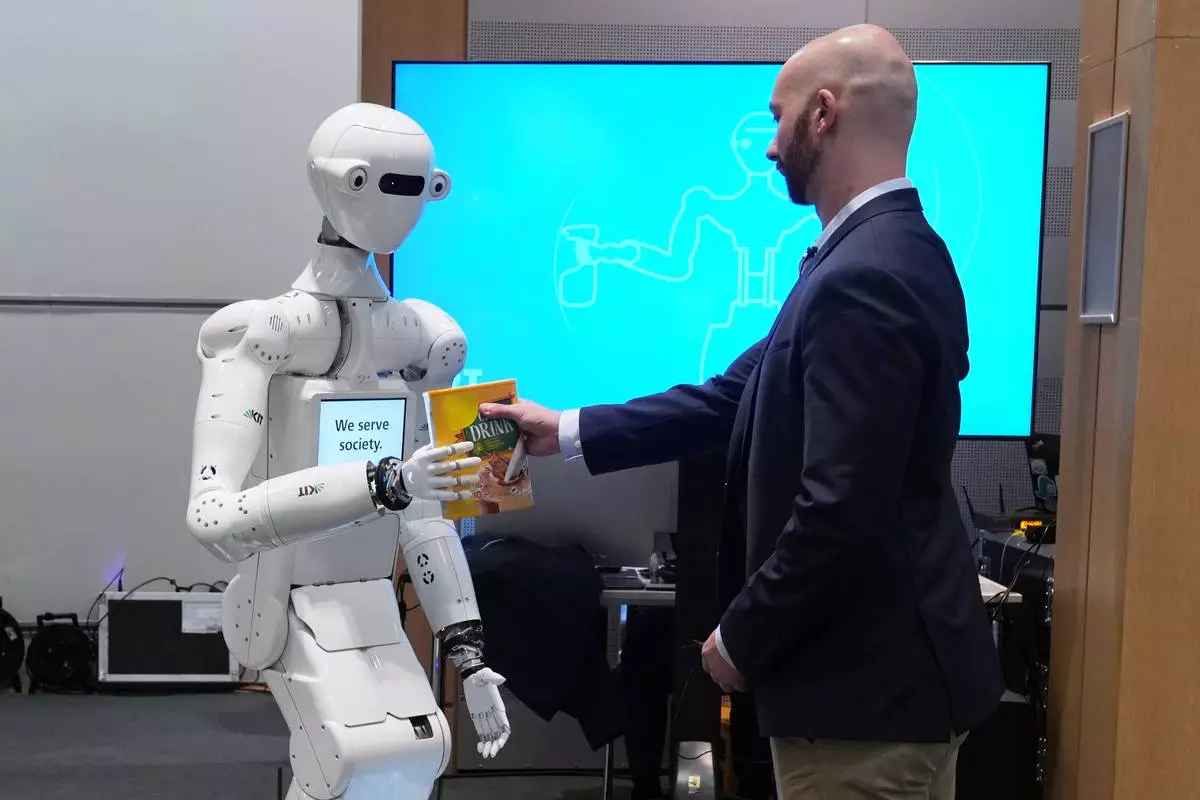
A man receives a box of chocolate powder drink from a robot during a demonstration of AI-based robotics in Europe at the European Parliament in Brussels, Wednesday, Sept. 2, 2026. (AP Photo/Virginia Mayo)
FILE - Pages from the Anthropic website and the company's logos are displayed on a computer screen in New York, Feb. 26, 2026. (AP Photo/Patrick Sison, File)