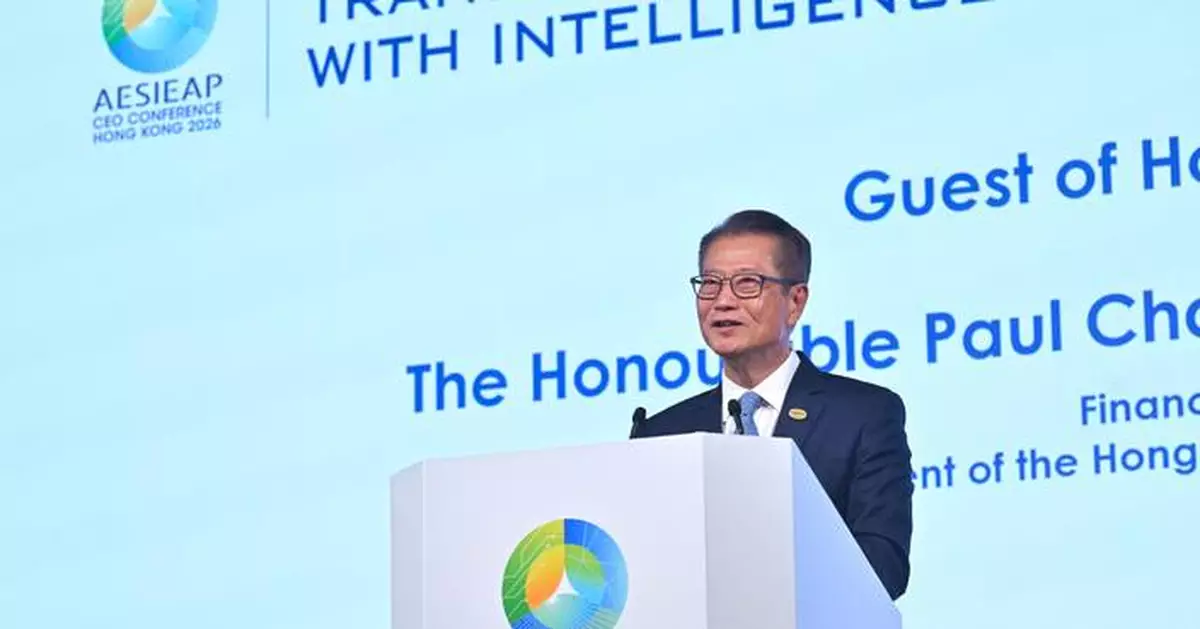
Speech by FS at AESIEAP CEO Conference 2026
Following is the speech by the Financial Secretary, Mr Paul Chan, at the Association of the Electricity Supply Industry of East Asia and the Western Pacific (AESIEAP) CEO Conference 2026 today (September 15):
Joseph (President of AESIEAP and Managing Director of CLP Power Hong Kong Limited, Mr Joseph Law), TK (Executive Director of CLP Holdings Limited, Mr Chiang Tung-keung), CEOs and representatives of power industries in Asia and the Pacific, distinguished guests, ladies and gentlemen,
Good morning. It is a pleasure to welcome you to Hong Kong for this AESIEAP CEO meeting.
This meeting brings together energy leaders from across Asia and the Western Pacific to share insights, strengthen partnerships and help shape the future of the power industry. It is an opportunity to learn from one another - and turn shared ambitions into practical progress.
The theme, "Transforming Energy with Intelligence", asks a timely question: how can we harness technology and human ingenuity to deliver cleaner, more reliable and more affordable energy for all?
Energy security and the green transition
In an unsettled world, no economy is an island when it comes to energy security. The continuing conflict in the Middle East this year, and disruptions to energy shipments through the Strait of Hormuz, have brought that into sharp focus.
Events far from our shores can quickly affect energy supplies, business costs and household budgets.
No economy can meet these challenges alone. Nor can we separate immediate energy security from the longer-term transition for climate change.
Diversifying supplies, expanding clean energy, strengthening grids and investing in storage will help us advance both. Regional co-operation will make those efforts more effective.
Technology, particularly artificial intelligence (AI), offers new possibilities. Smarter grids can integrate more clean energy, while advances in storage can keep power available when and where it is needed. AI can help anticipate demand, detect faults earlier and improve energy efficiency across buildings and industries.
Last year, the International Energy Agency estimated that applying existing AI technologies to industrial processes could save more energy than Mexico consumes annually. Faster detection of grid faults could also help shorten power outages by 30 to 50 per cent.
And with energy tech start-ups attracting US$27 billion in venture capital last year, the industry represents a significant investment opportunity.
Hong Kong's experience
Here in Hong Kong, we have also felt the pressures of volatile energy markets. But with our country's strong support, our energy supplies have remained stable. When fuel prices surged earlier this year, the Government introduced fuel subsidies and other concessions to support affected industries and ease pressures on livelihoods.
We will continue to monitor the developments closely and ensure that we are ready to respond as circumstances require.
Alongside these immediate measures, we remain firmly focused on the longer term.
We aim to cease using coal for daily electricity generation and increase zero-carbon energy to around 60 to 70 per cent of our fuel mix by 2035; and achieve carbon neutrality by 2050.
But Hong Kong's contribution extends beyond our own transition. We are putting our financial and technological strengths to work for the region.
Last year, green and sustainable bonds and loans arranged in Hong Kong exceeded US$76 billion. We also led Asia in issuing international green and sustainable bonds for the eighth consecutive year.
Our ambition is to finance not only businesses that are already green, but also those committed to becoming greener.
For established, high-emitting industries, the key questions are practical. Is there a credible transition plan? Are the targets measurable? Have investments been committed to delivering them?
This is where transition finance can make a real difference: supporting industrial modernisation that reduces emissions and raises productivity. In other words, leveraging finance to serve the real economy.
Technology is equally important. At Science Park and Cyberport, innovators are developing a broad range of green solutions. Examples include electricity-free cooling coatings, carbon capture technologies, AI-powered building energy management and hydrogen fuel-cell systems.
The Hong Kong Investment Corporation, the HKSAR (Hong Kong Special Administrative Region) Government's flagship for investing in emerging and future industries, provides patient capital to help promising innovations grow. Its work includes supporting charging technologies for deployment in Thailand, and combining storage with AI to help households make better use of solar power.
Our role is to bring capital, technology and market demand together - and help turn innovation into practical results.
Building a more resilient energy future together
Ladies and gentlemen, Asia will remain a major engine of global growth. China and ASEAN (Association of Southeast Asian Nations) together are home to around 2.1 billion people. As our economies expand, electrification gathers pace and AI becomes more widely used, our energy needs will continue to grow.
We must therefore look beyond how much electricity we will need, and ask what kind of energy system will best support the next chapter of Asia's development.
AI depends on chips, data and algorithms. But it also depends on reliable power. Increasingly, access to clean, reliable and affordable energy will help determine where businesses invest and where new industries take root.
Energy policy, in this sense, is also industrial policy.
Getting it right will require fresh thinking, creativity and closer collaboration across the region. By bringing together our best minds and drawing on our different strengths, we can achieve more than any of us could alone.
Let me offer three proposals for strengthening this co-operation. And Hong Kong is determined to play our part, as the "super connector" and "super value-adder".
First, deepen collaboration across borders and sectors.
Energy transformation involves the whole energy value chain, from generation and transmission to storage and use. No single technology or source of finance can deliver this alone.
That calls for closer co-operation among researchers, businesses and financiers, from early development through to commercial deployment.
Hong Kong Green Week, which concluded just last week, illustrates this approach. It brings together regional and global policymakers, financiers and innovators to share expertise and build partnerships.
During the week, the Green Accelerator was launched, which was joined by multilateral development banks, government bodies, think tanks and international financial institutions. It helps emerging markets prepare projects, access technical expertise and design financing packages that can turn promising technologies into viable investments.
We welcome you to build on these connections.
Second, make green standards work better across markets.
Investors need confidence in what they are financing. Businesses need clarity about what is expected of them.
Closer alignment in sustainable finance taxonomies, carbon accounting and technical certification can provide both, while respecting economies' different stages of development.
The aim is practical: reduce duplication, lower transaction costs and direct capital more effectively. Standards should make co-operation easier, not create new barriers.
Third, strengthen regional energy co-operation.
The APEC (Asia-Pacific Economic Cooperation) Energy Ministers' Meeting in Beijing called for a future-oriented Asia-Pacific energy community, and endorsed principles for energy security co-operation and recommendations on AI and energy.
We should turn that consensus into action through information sharing, emergency preparedness and co-ordinated planning for energy and computing infrastructure.
Under the "one country, two systems" framework, Hong Kong is the best connector between the Chinse Mainland and the world. We will use that strength to support dialogue, professional exchange and project partnerships that deliver tangible benefits.
Concluding remarks
Ladies and gentlemen, over the next two to three decades, Asia will play an increasingly important role in global development. We have both the capacity and the responsibility to chart a better path - one that does not repeat the patterns of the past, or leave the environmental costs of growth for future generations to address.
President Xi Jinping's observation that "lucid waters and lush mountains are invaluable assets" reminds us that protecting the environment and creating prosperity can go hand in hand.
Technology is already opening up new possibilities. We can turn waste into electricity, store the sun's energy to light our homes after dark, and use AI to make our power grids smarter and more resilient. With ingenuity and determination, we can achieve so much more.
But what really matters is our willingness to act: to invest for the long term, to share expertise, and to work across borders with purpose and trust.
Let us bring that spirit to this meeting. Together, we can provide the power our economies need - and build a cleaner, more secure future for the generations to follow.
I wish you a most successful conference.
Thank you.
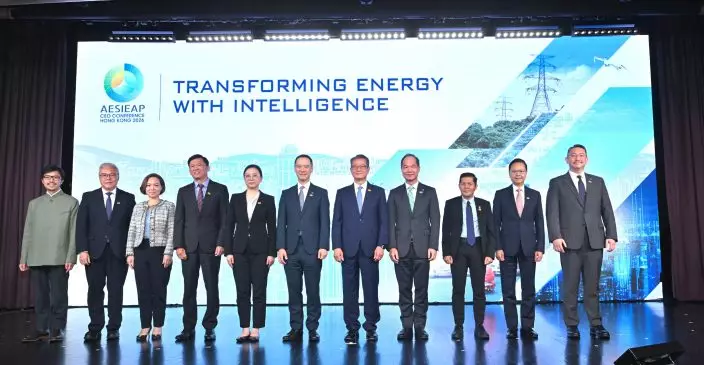
The Financial Secretary, Mr Paul Chan, attended the Association of the Electricity Supply Industry of East Asia and the Western Pacific (AESIEAP) CEO Conference 2026 today (September 15). Photo shows (from sixth left) the President of AESIEAP and Managing Director of CLP Power Hong Kong Limited, Mr Joseph Law; Mr Chan; Executive Director of CLP Holdings Limited, Mr Chiang Tung-keung, and other guests at the conference. Source: HKSAR Government Press Releases
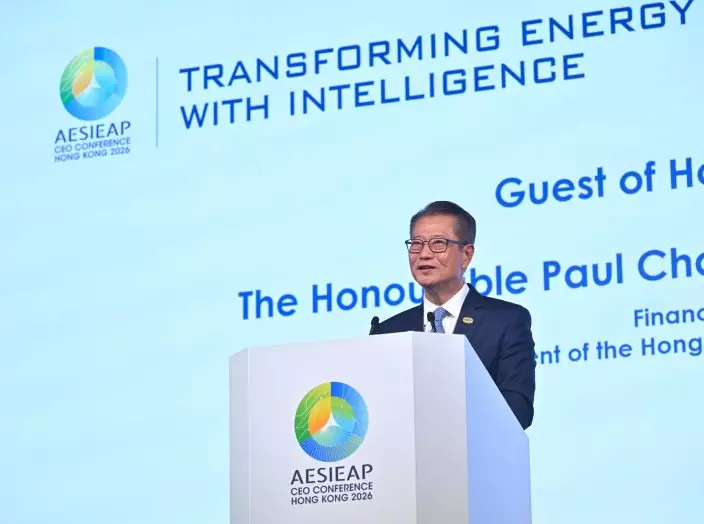
The Financial Secretary, Mr Paul Chan, speaks at the Association of the Electricity Supply Industry of East Asia and the Western Pacific CEO Conference 2026 today (September 15). Source: HKSAR Government Press Releases