GENEVA (AP) — Barcelona’s renovated Camp Nou was picked over Wembley Stadium in London to host the 2029 Champions League final, UEFA said Tuesday, in a further sign of their rebuilt relations after the divisive European Super League project.
The choice gives Barcelona a marquee game one year before Spain co-hosts the 2030 World Cup with Portugal and Morocco. Staging that final is a contest between Real Madrid’s renovated Santiago Bernabéu home and the 115,000-seat stadium being built in Casablanca.
UEFA’s executive committee also confirmed the 2028 Champions League final will return to Bayern Munich’s stadium, which was the only bidder, just three years after the 2025 edition.
Barcelona's victory comes seven months after its formal withdrawal from legal action against UEFA linked to the Super League driven by storied clubs led by Real Madrid that quickly failed in 2021.
The much-delayed rebuild of a 105,000-seat Camp Nou, which will be the biggest soccer stadium in Europe, is ongoing with the upper tier and roof still under construction.
“In addition to its size,” Barcelona said Tuesday in a statement, “it offers a hospitality and VIP experience that is unique in Europe, enabling new standards of service and comfort for guests and fans alike.”
The extra size also should allow more fans of the two finalist teams to get tickets. Paris Saint-Germain and Arsenal each got allocated 17,200 tickets from the 61,400 available to buy for the Champions League final played in May at the Puskas Arena in Budapest.
Barcelona last hosted the Champions League final in 1999, when Manchester United’s two stoppage-time goals stunned a dominant Bayern team. Camp Nou also staged the 1989 European Cup final.
Wembley has hosted three times since Barcelona's last turn — in 2011, 2013 and 2024 — and eight times in total since the European Cup started 71 years ago.
This season's Champions League final goes to Madrid at Atletico's Metropolitano stadium.
Record eight-time Women’s Champions League winner Lyon will host the final in 2028.
UEFA also picked Cardiff for the 2029 women’s final in the city center national stadium that will host the opening game of the men’s 2028 European Championship.
UEFA also picked hosts for two editions of the second-tier Europa League: Romania’s national stadium in Bucharest in 2028 and in 2029 at the new Serbian national venue being built on the outskirts of Belgrade.
Serbian soccer has developed closer to ties to UEFA and will co-host the men's Under-21 Euros next year with Albania.
The decision Tuesday comes just nine days after players and fans from Belgrade's biggest clubs, Red Star and Partizan, paid tribute at a game in the city's current main soccer stadium to convicted war criminal Ratko Mladic who died last month in The Hague.
UEFA fined Red Star this month for fans chanting in honor of Mladic at a Europa League game on the day he died.
The Europa League final this season is at Eintracht Frankfurt’s Waldstadion home.
Turin will get the 2028 final of the third-tier men's club competition at Juventus’ 41,000-seat stadium. The 2029 final will be at the 67,000-seat Puskás Aréna in Budapest.
The success of the Conference League since launching in 2021 has seen its finals venues outgrow the 20,000-seat venues for the first two title matches held in Tirana, Albania and Czech capital Prague.
Juventus also is rewarded by UEFA after it pulled out of the Super League legal action in 2023.
Real Madrid was the last of the 12 Super League founders to drop the project and settled with UEFA in February. The Bernabéu, now with crowds of 78,000 for the biggest games, has hosted a European Cup or Champions League final four times though not since 2010.
See AP’s full soccer coverage here
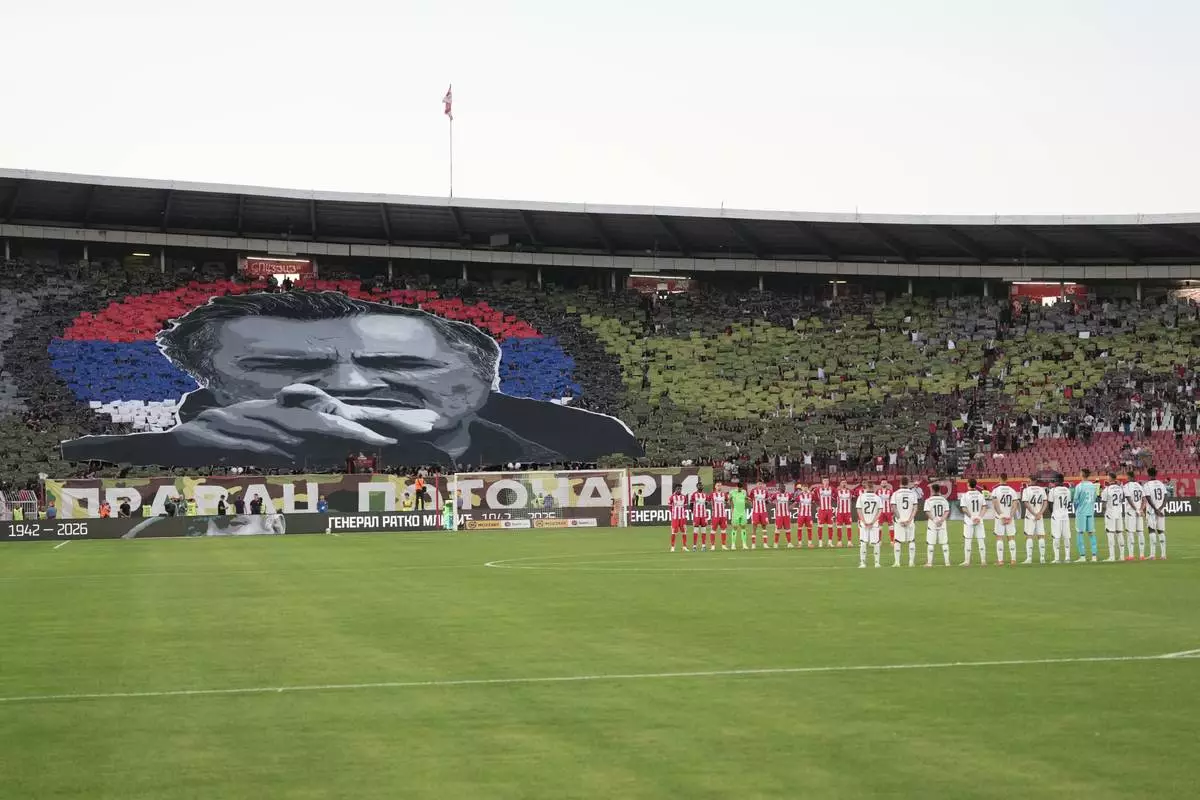
Players observe a minute of silence for former Bosnian Serb wartime general Ratko Mladic prior a Serbian National soccer league derby match between Red Star and Partizan in Belgrade, Serbia, Sunday, Sept. 6, 2026. (AP Photo/Darko Vojinovic)

Barcelona's Lamine Yamal celebrates after scoring his side's fourth goal during the Champions League opening phase soccer between Barcelona and Feyenoord in Barcelona, Spain, Wednesday, Sept. 9, 2026.(AP Photo/Emilio Morenatti)
VIENNA (AP) — A group of European countries announced on Monday that they aim to set up a “return hub” in Rwanda where rejected asylum-seekers could be sent from next year, a move that they hope will also deter more people from coming.
The European Union has worked for years to tighten migration rules, push down the number of asylum-seekers coming to the 27-nation bloc and increase deportations of migrants who aren’t entitled to stay. Sending people to centers outside Europe has emerged as a central plank of that effort.
Austria, Denmark, Germany, Greece and the Netherlands have spearheaded negotiations with non-EU countries.
The aim is for the first center to be set up in Rwanda next year, Austrian Chancellor Christian Stocker said alongside officials from the other European countries and Rwanda's interior minister.
“I think this will be a game changer making us able to confront the massive challenges with illegal migration,” Danish Prime Minister Mette Frederiksen said. “We will break down the business model of human smugglers. We will take back control of our borders and we will remove the incentives for illegal migration.”
She predicted that “many other European countries” would join in. Her immigration minister, Morten Bødskov, said that the plan is to have a fully negotiated agreement with Rwanda “within the next few months.”
Officials were vague about how many migrants might be sent to Rwanda, but emphasized the plan's deterrent effect.
“The most important number is the number that we will never see because hopefully they will not start their journey to Europe,” Frederiksen said. “So this is a milestone.”
Rwandan Interior Minister Vincent Biruta said that his country would give a “second chance” to people who have no right to stay in Europe. He said that those who arrive will be offered the opportunity “to voluntarily return to the countries of origin, integrate into Rwandan society or relocate to another destination where they have the legal right to reside, according to their preference.”
Asked how Rwanda would guarantee refugees' human rights, he said that Rwanda would bring on board organizations such as the U.N. refugee agency and “there will be an independent monitoring mechanism.”
Human rights groups have criticized plans to deport migrants to facilities in third countries, arguing that European nations can't guarantee that their rights will be respected there. European officials insist that the new hubs would abide by European and international law.
“Offshore deportation centers are the latest cynical expression of the EU’s drive to shift its responsibilities to other countries,” Human Rights Watch researcher Clementine de Montjoye said in a statement. “Paying Kigali to host a deportation program would not only cause suffering and harm to those deported, it would finance and provide political leverage to a government responsible for serious human rights abuses at home and abroad.”
Amnesty International Austria asylum and migration expert Aimée Stuflesser said in a statement that “today’s disgraceful deportation deal between European countries and Rwanda repeats mistakes of the past.”
“Sending people to a country they have never been to is irresponsible and there is a real danger that the Rwanda deal will, with its limited chance for scrutiny, become a cruel black hole for human rights,” Stuflesser said.
The U.N. refugee agency said that it only supports the possible use of return hubs in line with human rights standards, and as a way to help returns of people whose claims for asylum were denied after a full and fair assessment.
UNHCR spokesperson Matthew Saltmarsh said that the agency was involved in “constructive discussions” with the five EU countries “to provide advice on the compliance of the return hub process with international human rights law standards.” No agreement with the countries has been signed.
The United Nations' International Organization for Migration said that it doesn’t take part in or negotiate “state-to-state removal arrangements,” but was providing “technical input on the return hub process.” IOM said that it was prepared to provide help to migrants at the request of the receiving government if “necessary safeguards” are in place.
EU laws have changed in recent years because of persistent public and political pressure for tougher measures against migration.
European lawmakers voted in June to allow member states to set up centers outside the EU on their own or in small coalitions, and send rejected asylum-seekers there instead of to their home countries.
Rwanda struck a deal with the U.K. in 2022 under which migrants who arrived as stowaways or in boats would be sent to the African nation, where their asylum claims would be processed and, if successful, they would stay. The U.K. Supreme Court ruled that the policy was unlawful because Rwanda isn't a safe third country for migrants sent there.
Then Prime Minister Keir Starmer scrapped that deal immediately after taking office in 2024.
German Interior Minister Alexander Dobrindt said Monday that the European plan for Rwanda isn't comparable. He said that the U.K. had planned to outsource asylum proceedings to third countries, while the European plan involves people who have been through the asylum process and exhausted their appeals.
Geir Moulson reported from Berlin. Jamey Keaten contributed to this report from Geneva.
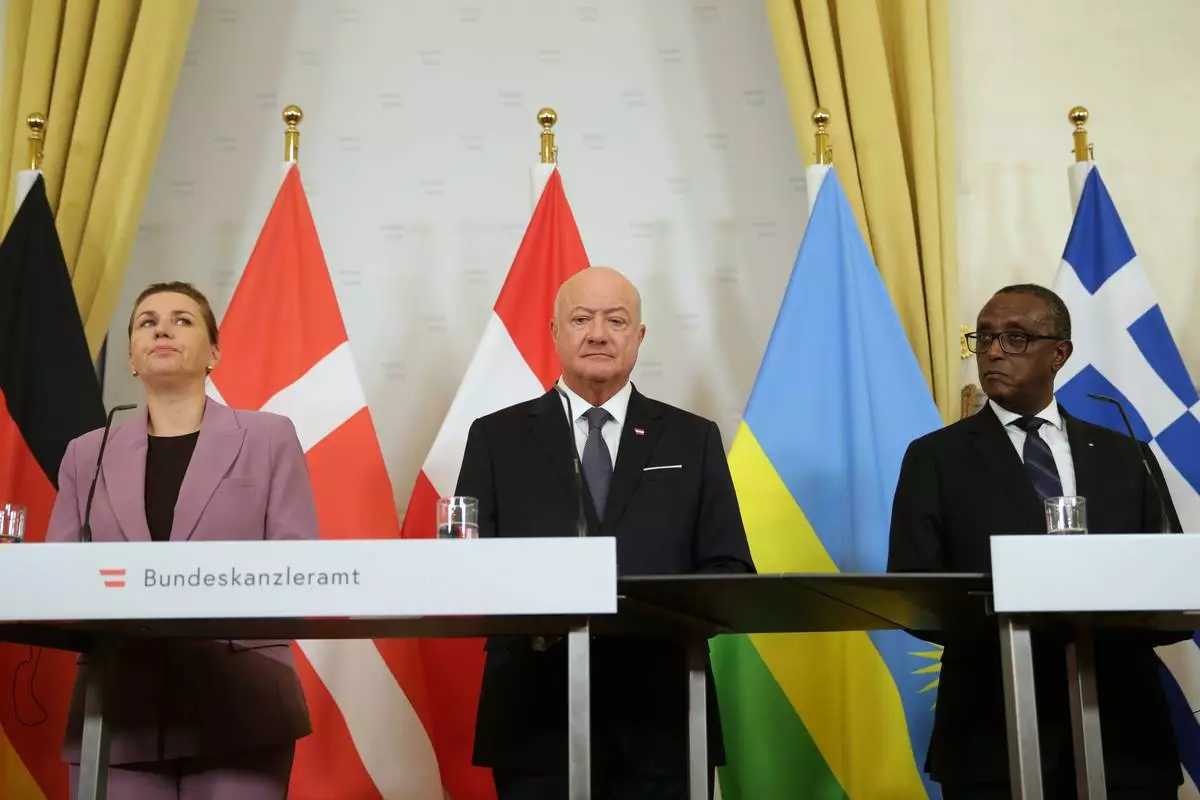
Austria's Chancellor Christian Stocker, center, Rwanda's Interior Minister Vincent Biruta, right, and Denmark's Prime Minister Mette Frederiksen listen to questions as they brief the media after talks at the migration conference in Vienna, Austria, Monday, Nov. 16, 2026. (AP Photo/Heinz-Peter Bader)
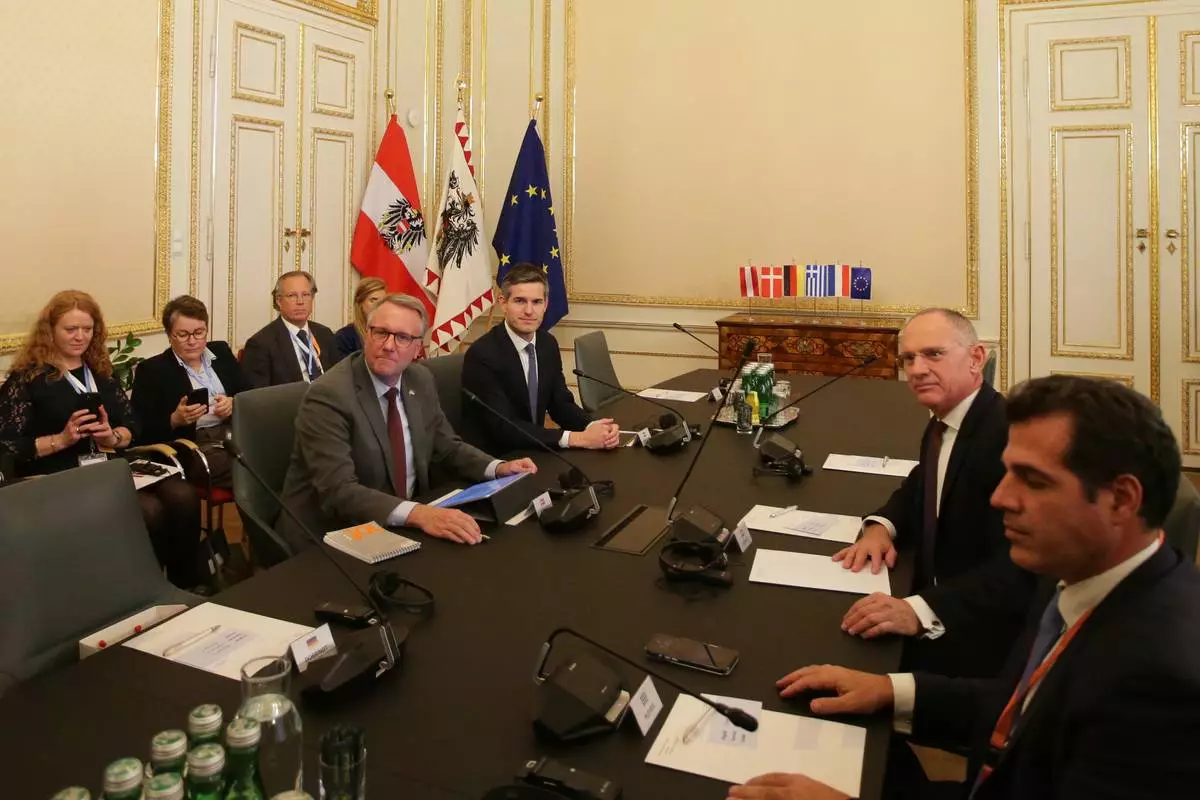
Austrian Interior Minister Gerhard Karner, background right, starts talks with Netherland's Foreign Minister Tom Berendsen, background center, Denmark's Integration Minister Morten Bodskov, left, and Greek Minister of Integration Athanasios Plevris, right, in Vienna, Austria, Monday, Nov. 16, 2026. (AP Photo/Heinz-Peter Bader)
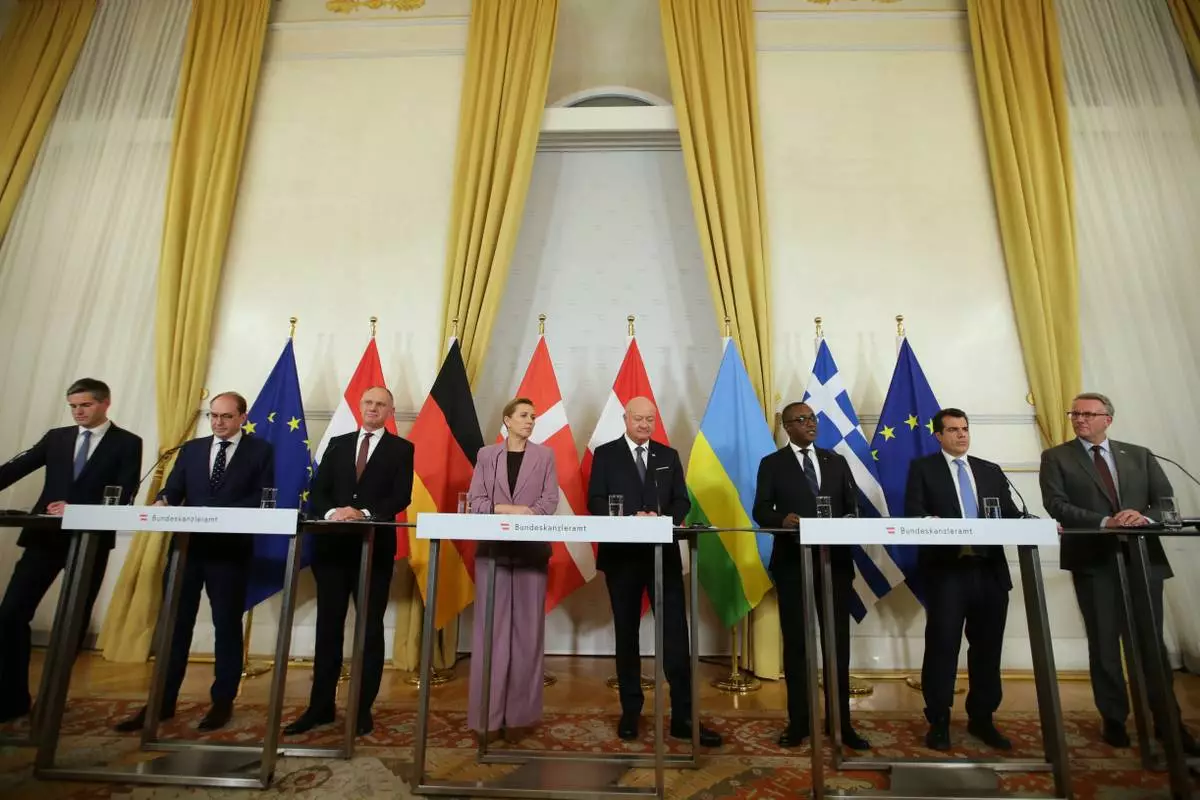
Rwanda's Interior Minister Vincent Biruta, Austria's Chancellor Christian Stocker, Austrian Interior Minister Gerhard Karner, Netherland's Foreign Minister Tom Berendsen, Denmark's Integration Minister Morten Bodskov, German Interior Minister Alexander Dobrindt and Greek Minister of Integration Athanasios Plevris attend a media conference after migration talks in Vienna, Austria, Monday, Nov. 16, 2026. (AP Photo/Heinz-Peter Bader)
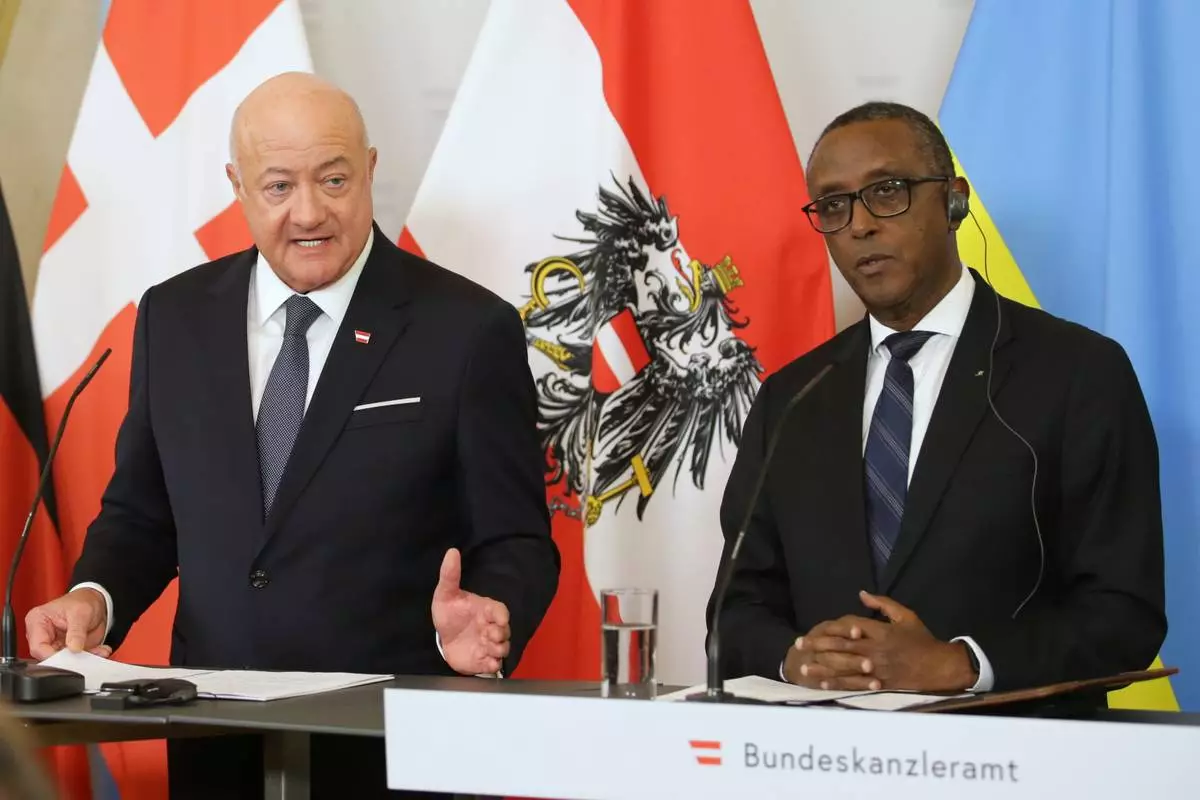
Rwanda's Interior Minister Vincent Biruta and Austria's Chancellor Christian Stocker brief the media after talks at the migration conference in Vienna, Austria, Monday, Nov. 16, 2026. (AP Photo/Heinz-Peter Bader)
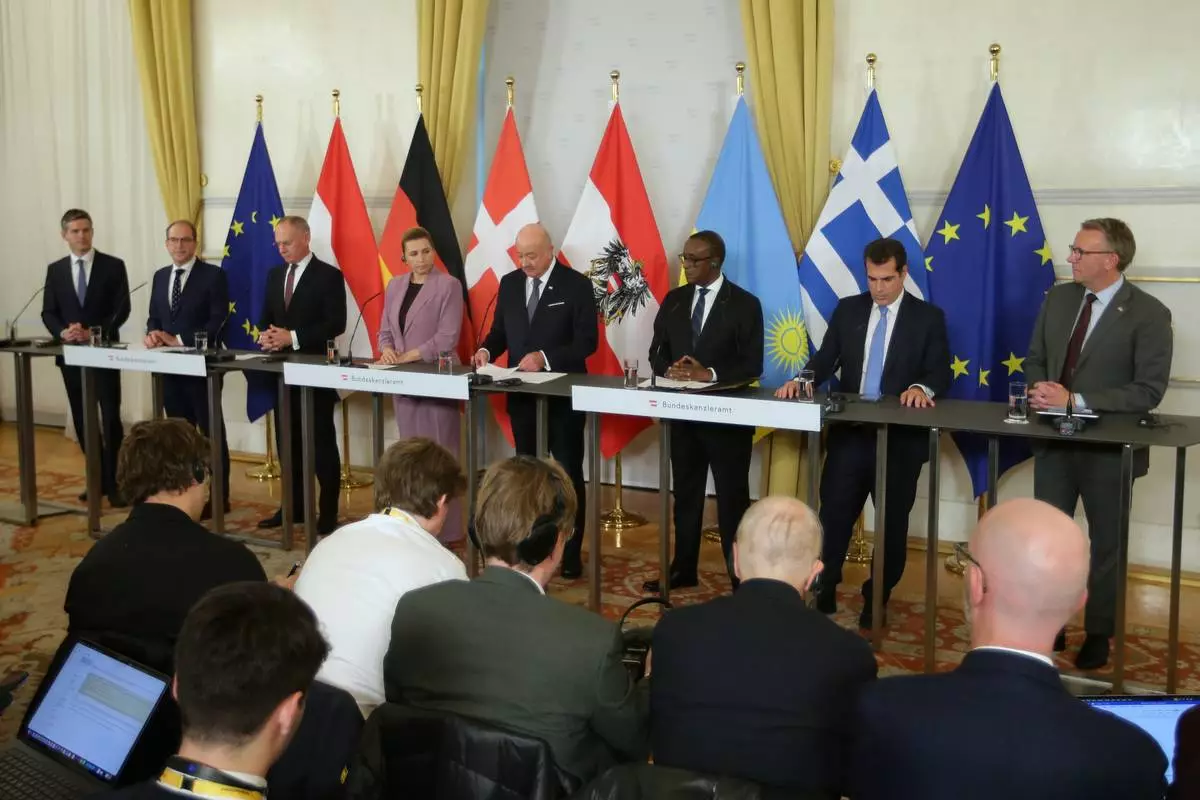
Rwanda's Interior Minister Vincent Biruta, Austria's Chancellor Christian Stocker, Austrian Interior Minister Gerhard Karner, Netherland's Foreign Minister Tom Berendsen, Denmark's Integration Minister Morten Bodskov, German Interior Minister Alexander Dobrindt and Greek Minister of Integration Athanasios Plevris attend a media conference after migration talks in Vienna, Austria, Monday, Nov. 16, 2026. (AP Photo/Heinz-Peter Bader)