The clock is ticking toward an unusual deadline in the NHL, and teams with players relevant to it are rushing to beat the final horn.
The new collective bargaining agreement goes into effect at midnight, at which time a seven-year contract will be the longest a player can re-sign with his own team — and six years in free agency. The final eight-year deals are getting done Tuesday.
Washington locked up Ryan Leonard for $84 million starting with the 2027-28 season. Making an average of $10.5 million a year through 2035, he will match new Capitals teammate Alex Tuch, who also got eight years in a sign-and-trade with Buffalo, for the highest-paid player on the team when Leonard's new deal kicks in.
“Ryan is a young and talented player who is still years away from entering his prime, and we believe he has tremendous potential to continue growing into an important player for our organization,” general manager Chris Patrick said in announcing Leonard's contract. “While reaching his full potential will take time, we have been impressed with his work ethic and the way he continues to develop his game. We are confident in Ryan’s ability to continue improving as a hockey player, and we believe this agreement provides him with the opportunity to grow and develop within our organization, while giving us the ability to keep a talented young player in our lineup for years to come.”
Leonard, a 21-year-old winger, is going into his second full NHL season after breaking in during the spring of 2025. This contract cements his place as part of the Capitals' young, post-Alex Ovechkin core, which is expected to also include brothers Ilya and Aliaksei Protas.
Washington forward Justin Sourdif also got an eight-year extension before the deadline: $50.8 million, for an annual cap hit of $6.35 million. Sourdif will be 25 when it goes into effect.
“Justin is a good young forward who has continued to develop steadily throughout his career,” Patrick said. “He is versatile and demonstrated his ability to play an important forward role for our team whenever the opportunity arose last season. ... We believe he has a bright future ahead of him and are confident that he will continue to make valuable contributions to our organization in the coming years.”
Ottawa signed Drake Batherson for $86 million, which is the most lucrative contract in Senators history. The previous record was Tim Stützle's eight-year, $66.8 million extension from September 2022.
Batherson will count $10.75 million against the salary cap starting in 2027, surpassing Stützle’s $8.35 million. He'll be 29 at that point.
“He was drafted and developed by our organization and has shown a commitment to wanting to be in Ottawa long term,” GM Steve Staios said of Batherson. “We view him as a key part of our core group.”
Batherson has set career highs in scoring each of the past seven seasons, topping out at 71 last year. He is just the second player in league history to do that seven times in a row, joining Vic Stasiuk from 1953-54 to '59-60 with Detroit.
Since the NHL and the NHL Players' Association came to an agreement on this CBA in late June 2025, 34 players have signed eight-year contracts. Thirteen of those have come in the past three months, including Colorado's Cale Makar setting the record for the most money at $163.2 million.
After being flat or nearly flat coming out of the pandemic, the salary cap is the middle of a series of record increases, now that revenues have caught up and are skyrocketing. The cap went from $95.5 million last season to $104 million this season and will be $113.5 million in 2027-28, when most of these new contracts will go into effect.
Philadelphia signing Anaheim’s Leo Carlsson to an offer sheet in July that made him the highest-paid player in the sport at $18 million a year — which the Ducks matched to keep him — led to a spike in salaries this summer.
Vegas center Jack Eichel, who is now making $13.5 million on his long-term contract signed last October, said agent Pat Brisson told him about what was coming and they had talks with NHLPA executive director Marty Walsh and others at the union and decided to go the full eight years anyway.
“It’s an incredible deal for me and my family, and we’re super grateful for the organization and the city believing in us,” Eichel said last week. “There’s no signer's remorse. Yeah, I'm a happy guy.”
Eichel led the Golden Knights to the Stanley Cup in 2023. He and fellow standouts such as Makar, Minnesota's Kirill Kaprizov, and Florida teammates Sam Bennett and Aaron Ekblad are proven commodities.
Many of the young players getting eight-year deals this offseason are team gambles of varying degrees.
As recently as Monday, Buffalo signed 22-year-old center Noah Ostlund for $52.8 million, banking on his potential. Ostlund has played in just 71 games in the league thus far.
Pittsburgh signed Ville Koivunen for $32 million over eight years in August. He has 14 points in 42 career games.
Beginning Wednesday, no contract can have more than 60% paid in signing bonuses. New Jersey and defending champion Carolina each got a deal done just in time.
The Hurricanes signed captain and Conn Smythe Trophy winner as playoff MVP Jordan Staal to a one-year extension, while the Devils extended recently acquired forward Luke Evangelista for five years and $36.25 million. Staal's contract is worth $900,000 in salary, with a $4 million signing bonus and up to $5.1 million in additional performance incentives.
“Jordan is not only our captain, he’s the bedrock of the culture we’ve established in this organization,” GM Eric Tulsky said. “His leadership and on-ice performance throughout last season and especially in the playoffs was a primary factor in bringing the Stanley Cup back to Raleigh.”
See AP’s full NHL coverage here

FILE - Ottawa Senators' Drake Batherson (19) celebrates his goal against the Carolina Hurricanes with teammate Nick Cousins (21) during the second period of an NHL hockey playoff game in Ottawa, Ontario, April 23, 2026. (Justin Tang/The Canadian Press via AP, File)

FILE - Washington Capitals right wing Ryan Leonard (9) in action during the third period of an NHL hockey game against the Utah Mammoth, March 3, 2026, in Washington. (AP Photo/Nick Wass, File)
NEW YORK (AP) — A trade war between the United States and Canada is making it more difficult and expensive for small businesses in the economically entwined countries to operate, according to business owners caught in the crossfire.
Canada imposed reciprocal tariffs on about $20 billion (CA$27.6 billion) worth of U.S. goods last week after President Donald Trump placed import taxes on Canadian goods worth the same amount. In response to Canada's action, Trump said the U.S. also would ban imports of wine, whiskey, selected motorcycles and the dairy ingredient whey from Canada.
The tariffs so far involve about 5.5% of the neighboring nations' bilateral trade in goods. Analysts say the overall economic impact therefore will be muted. But small business owners who depend on cross-border sales say a tax of up to 50% on their products and ill will created by the conflict have an outsize effect on them, especially when higher energy costs stemming from the Iran war are eroding their balance sheets.
The owners of four small businesses, two in the U.S. and two in Canada, spoke with The Associated Press about the ways the trade war is affecting their companies.
At Jasper Hill Farm, an artisan cheesemaker in Greensboro, Vermont, co-founder Mateo Kehler said Trump's opening salvo produced an immediate effect: canceled holiday orders from wholesale customers in Canada, whose border is only about 40 miles away.
Cheese wasn't among the products made subject to new U.S. tariffs last month. Kehler suspects his hopes for expanding business in Canada are stalling because residents there resent the way the president and members of his Cabinet treat their country, a longtime ally.
“The backlash on the market side is actually what’s affecting us the most,” Kehler said. “It’s the rhetoric that has inspired a boycott.”
Trump has needled America’s northern neighbor repeatedly since he returned to the White House. First, it was comments last year about wanting to absorb Canada as the 51st state. After trade negotiations broke down in August, he taunted Prime Minister Mark Carney and signed an executive order to change the name of Lake Ontario to Lake America.
The lost sales and higher prices for materials and equipment that Kehler buys from Canada are tough to swallow when the war with Iran has made fuel for Jasper Hill Farm's trucks and machinery more expensive too, he said. Some of his suppliers and distributors are adding surcharges to cover their costs, he said.
“It’s like death by a thousand cuts, because between the rising cost of energy and the tariffs, the inflationary pressure on the inputs across almost every aspect of our business — from the farming side all the way through to finished goods — is just being ratcheted up,” Kehler said.
Revival Stillworks makes equipment for distilling liquor like vodka, agave and whisky and helps design spaces for producing craft spirits from the company's base on Vancouver Island, less than 20 miles from Washington state's San Juan Island.
Until last month, the equipment could enter the U.S. tariff-free under the United States-Mexico-Canada Agreement, a trade pact Trump negotiated during his first presidency. Now, the company's stills, fermenters and other products incur a 50% tax for crossing the border, co-founder Darcy Lane said. The customs charges are considerable because the equipment costs $250,000 to $2 million, Lane said.
“We’ve got millions of dollars worth of orders that are supposed to be happening over the next four to six months, and then all of a sudden this happens again,” he said, recalling how a U.S. customer called off a project last year when Trump threatened to put tariffs on some Canadian products.
Clients in the U.S. make up about half of Revival Stillworks' business. With rising oil prices during the war driving up shipping costs, many already were evaluating whether they should move forward with projects that involve imported equipment, Lane said.
He and his partner are looking into other kinds of work. Since they employ engineers, welders and fabricators, their business could service the local marine industry, Lane said.
“Hopefully, cooler heads prevail and everything works out, and we can continue along as business as normal," he said. “But if not, we have to put a contingency plan in place anyway."
Cassandra Sotos is co-owner and CEO of AmpRx, a company in Nashville, Tennessee, that manufactures devices for musicians and recording studios to measure and adjust the voltage moving from a power outlet into a guitar amplifier.
Like Kehler, Sotos thinks the U.S.-Canada trade war is having a chilling effect.
Although the majority of her company's sales are within the U.S., Sotos counts musicians around the world as customers. The new U.S. tariffs do not apply to her bestselling product, a power adapter priced from $400 to $1,400, but demand from Canadian customers has fallen off anyway, she said.
Sotos said she isn't sure if customers are worried about unexpected import charges or if the stumbling block is “just optics with the United States” and how the country is perceived in Canada at the moment.
As a small business, "any piece of the puzzle that gets taken away from us is significant,” Sotos said. “There’s just as many guitar players in Canada as there are in the United States. And I’m currently only able to get to a tiny percentage of them because of all of this.”
She feels like trade policies are hampering AmpRx's growth at a time when fighting in the Middle East has brought unexpected expenses. Shipping costs for imported components are two to three times what they were before the war, Sotos said.
“At times, this aspect of the global situation acts as a silent killer for small to medium businesses,” she said. “Just as you figure out how to manage the increase from tariffs, you get the second punch to the gut with the shipping estimate.”
A new tariff on Canadian honey that the U.S. started charging in August came as a blow to beekeepers like Peter Awram, CEO of the family-owned Worker Bee Honey Co. in Rosedale, British Columbia. The U.S. was the market for about 60% of Canadian honey export volume, he said.
The reciprocal 50% tariff that Carney's government slapped on American-made honey does nothing to help because an influx from India and China of fake honey diluted with rice syrup has created pricing pressure on both sides of the border, said Awram, who began beekeeping more than 50 years ago.
“Most of what Canada is now tariffing is not American honey,” he said. “It is other countries’ honey carrying American paperwork."
Most Canadian beekeepers will likely try to increase their domestic sales, which could flood the market with honey and further depress prices, Awram said.
“The industry was in a precarious state before the tariff,” Awram said. “If this tariff stays in place for long, it will put a large number of commercial beekeepers out of business.”
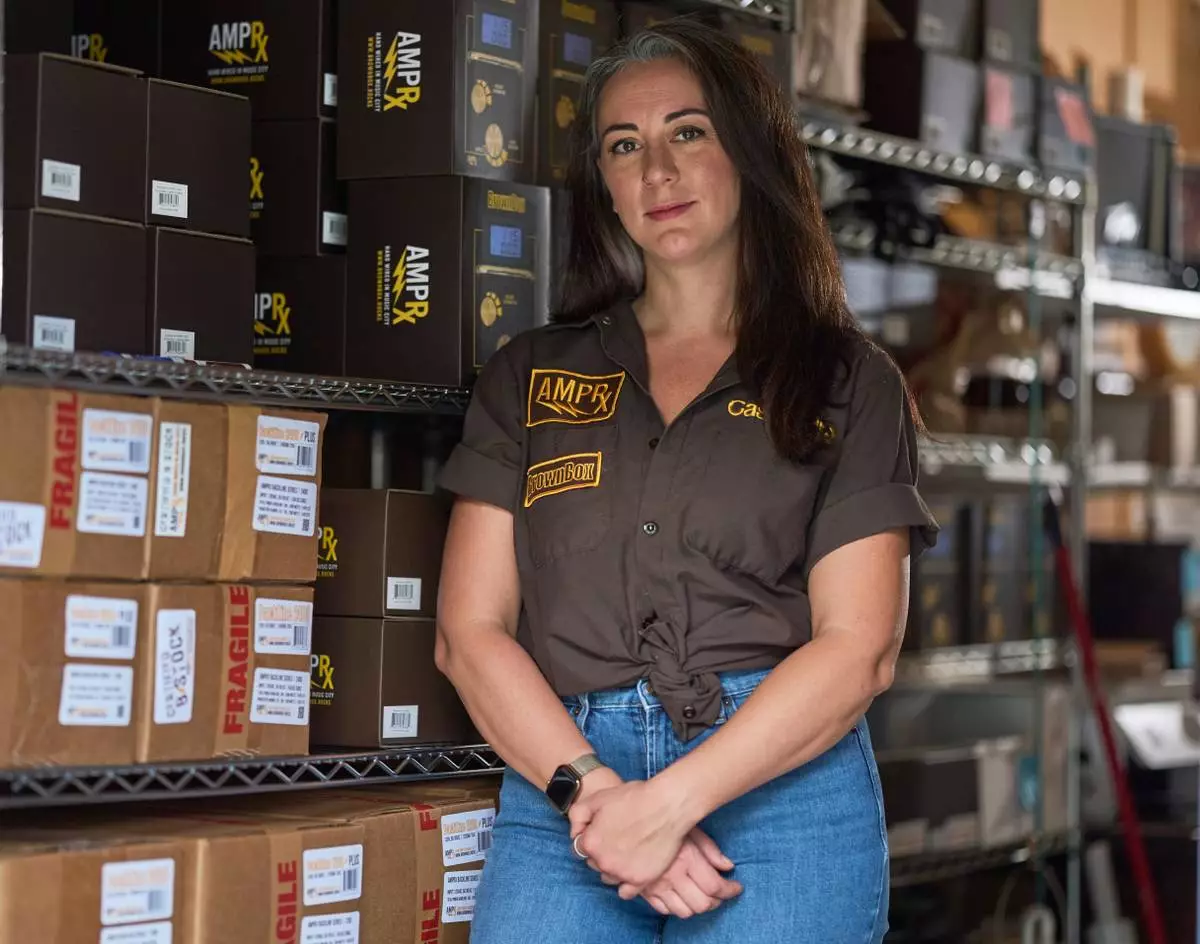
Cassandra Sotos, co-owner and CEO of AmpRx, poses for a portrait at the company's warehouse Saturday, Sept. 12, 2026, in Mt. Juliet, Tenn. (AP Photo/George Walker IV)

Cassandra Sotos, co-owner and CEO of AmpRx, poses for a portrait at the company's warehouse Saturday, Sept. 12, 2026, in Mt. Juliet, Tenn. (AP Photo/George Walker IV)

Cassandra Sotos, co-owner and CEO of AmpRx, poses for a portrait at the company's warehouse Saturday, Sept. 12, 2026, in Mt. Juliet, Tenn. (AP Photo/George Walker IV)