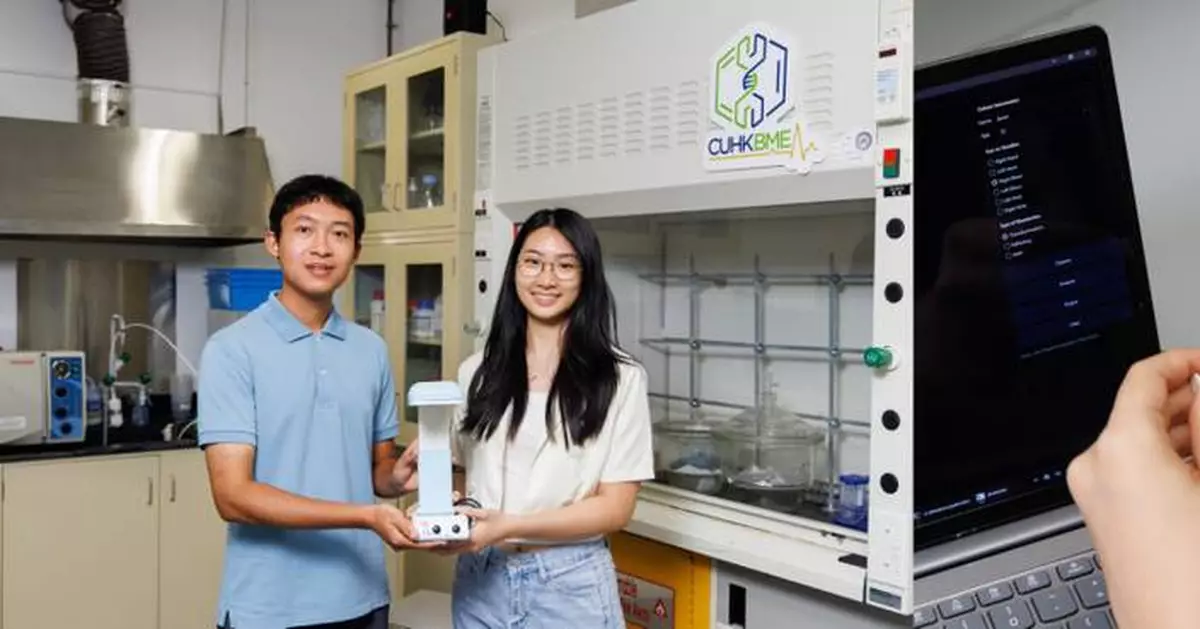
- Jarinyagon Chantawannakul and Wai Yan Phyo Oo from the Chinese University of Hong Kong has been named the Hong Kong winner of the James Dyson Award 2026 for DUALVein, a portable Intravenous insertion learning system. By leveraging AI, the HK$3,000 device drastically undercuts expensive market alternatives to solve a global healthcare crisis, tackling the 40% failure rate of first-time IV injections [1].
- This year's runners-up include Stairio, a stairwell inspection robot, and Musec, a wearable music interaction device.
- All three inventions will progress to the international stage of the James Dyson Award, for a chance to win £30,000
HONG KONG SAR – Media OutReach Newswire – 16 September 2026 - Intravenous (IV) insertion is one of the most commonly performed clinical procedures, yet its global failure rates remain alarmingly high. Nearly 40% of first IV attempts fail, causing unnecessary bruising, pain, and repeated needle sticks for millions of patients globally. Today, Jarinyagon Chantawannakul and Wai Yan Phyo Oo from the Chinese University of Hong Kong (CUHK) have been crowned the national winners of the James Dyson Award 2026 for a solution that aims to end this trial-and-error approach: DUALVein, a low-cost, AI-guided near-infrared (NIR) vein-imaging device that helps nursing and medical students accurately find veins across all skin tones, even without expert supervision.
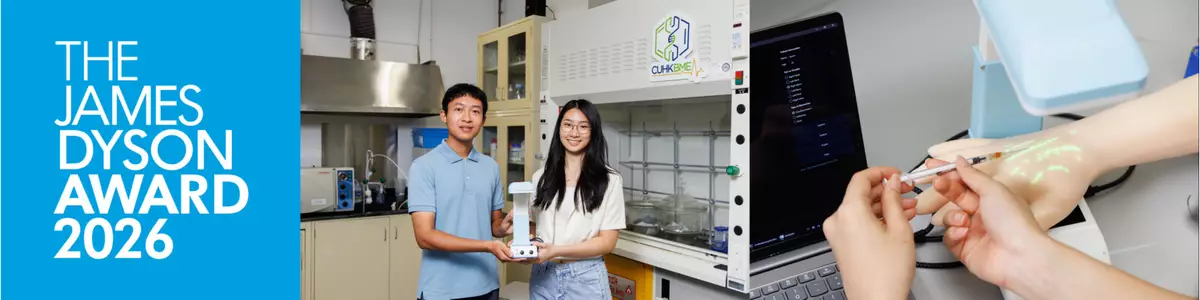
Tackling the 40% IV failure rate: CUHK students win the James Dyson Award 2026 with an affordable AI vein visualizer
Recognising the urgent need for accessible medical innovation, the James Dyson Award—which forms part of a wider commitment by Sir James Dyson to demonstrate the power of engineers to solve the world's problems—champions accessible solutions like DUALVein.
DUALVein
Newly-trained nurses operating without guidance achieve only a 56.28% accuracy rate in IV insertions[1]. Existing vein finders on the market have largely failed to bridge this training gap; they either offer a limited field of view with no direct guidance, or they rely on expensive optics that cost upwards of HK$15,000.
To address this, the CUHK team designed DUALVein to project patients' veins directly onto the skin in real time using AI segmentation and an 850nm NIR LED array. The device illuminates the hand using two combined methods: transillumination (light passing through tissue) and reflectance (light bouncing off it). Because each mode is independently adjustable, DUALVein is uniquely equipped to work reliably across diverse anatomies and light, medium, and dark skin tones.
Crucially, by utilizing AI instead of expensive optical hardware, DUALVein costs roughly HK$3,000—a fraction of the cost of current market alternatives. Furthermore, it is the only option that pairs its hardware with a built-in software platform, acting as a comprehensive self-learning tool to guide students from beginner theory straight through to physical IV practice.
The inspiration for the project struck after a medical professional revealed to Jarinyagon that standard vein finders are simply too expensive for many hospitals to adopt, leaving staff to rely purely on skill built through repeated practice. In under-resourced clinics lacking enough senior nurses to supervise trainees, students receive little hands-on guidance, leading to painful trial-and-error learning directly on real patients.
This sparked a rigorous two-year iterative design process to create a viable, affordable alternative. The team built four main functional prototypes, crafting non-functional testing models before finalizing each major version. These iterations underwent extensive real-world evaluation: early models were tested on 15 volunteers to validate the near-infrared principles, while later versions were evaluated by around 60 medical and nursing students from Thailand and Hong Kong.
Jarinyagon said: "Winning the James Dyson Award is a powerful validation that this is a problem worth solving. This recognition gives us the crucial momentum to push DUALVein out of the lab and into the hands of the frontline nurses and under-resourced hospitals who need it most."
Brian Hu, Judge for the 2026 James Dyson Award and Head of Electronics at Dyson said, "DUALVein stands out because it is a brilliant idea to leverage near-infrared technology and AI to solve a genuine, real-life clinical issue. By building multiple prototypes and continuously refining their device based on user feedback, they perfectly showcase Dyson's core engineering mindset of problem-solving through relentless design, testing, and iteration. This accessible solution has the potential to make a positive impact on the healthcare industry by improving training standards and reducing patient discomfort."
DUALVein takes home £5,000 (approx. HK$53,000) from the James Dyson Award national prize to support these next steps in commercialisation, which include shifting from 3D-printed PLA to injection-molded housing to further reduce costs for mass scaling.
The Runners-Up
Stairio
The first runner-up, Stairio, modernizes costly and tiring high-rise stairwell patrols. Instead of relying on manual checks that lack visual evidence of hazards, Stairio introduces a compact robot that clips to and travels along existing handrails. Equipped with cameras and AI-assisted cloud software, it automatically flags cleanliness issues, physical obstructions, and maintenance defects, making building operations significantly safer and more accountable.
Musec
The second runner-up, Musec, reimagines the modern music listening experience. To transform passive listening into a deeply interactive and immersive journey, the team developed an innovative wearable sleeve. By seamlessly blending gesture recognition, touch controls, and haptic feedback, Musec empowers users to interact with music through physical movement. Users can trigger sounds and feel real-time vibrations, effectively turning their own bodies into part of the musical performance. This breakthrough design offers music lovers and dancers a profoundly active and physical way to experience sound.
All three inventions will progress to the next stage of the James Dyson Award, with the international Top 20 shortlist to be announced in October, selected by a global team of Dyson engineers, and the global winners in November, chosen by Sir James Dyson.
James Dyson Award
The James Dyson Award is an international design competition which inspires and celebrates the next generation of design engineers. Now in its 21st year, the Award has supported more than 400 problem-solving inventions with over £1.5m in prize money. It operates across 28 countries and regions and is run by the James Dyson Foundation, Sir James Dyson's engineering-education charity.
James Dyson Foundation
The James Dyson Foundation, established in the UK in 2002, now supports design, technology and engineering education programmes not only in the UK but also in countries around the world, including the United States, Japan, Singapore, the Philippines and Malaysia. To date, James Dyson and the James Dyson Foundation have donated more than £155 million to charitable causes. This includes a £12 million donation to establish the Dyson School of Design Engineering at Imperial College London, an £8 million donation to support the creation of the Dyson Centre for Engineering Design and the James Dyson Building at the University of Cambridge and finally, a £7.8 million donation to fund Malmesbury Primary School's STEAM Centre and expansion project.
The issuer is solely responsible for the content of this announcement.
James Dyson Award
NOTES TO EDITORS
The James Dyson Award forms part of a wider commitment by Sir James Dyson, to demonstrate the power of engineers to solve the world's problems. The competition has supported more than 400 inventions with prize money and a chance to gain global media exposure, and is run by the James Dyson Foundation.
ABOUT THE COMPETITION
The brief. Design something that solves a problem. This problem may be a frustration that we all face in daily life, or a global issue. The important thing is that the solution is effective and demonstrates considered design thinking. Unlike other competitions, participants are given full autonomy over their intellectual property.
The process. Entries are judged first at the national level by a panel of external judges and a Dyson engineer. Each operating market awards a national winner and two national runners-up. From these winners, a panel of Dyson engineers then select an international shortlist of 20 entries. The top 20 projects are then reviewed by Sir James Dyson who selects his global winners.
The 2026 prizes
- Global winners, chosen by Sir James Dyson, each receive a prize of £30,000.
- Each national winner receives £5,000.
Previous global winners
A smart, assistive keyboard for people with Parkinson's
An autonomous water quality monitoring device.
A portable and affordable hair-loss prevention device for chemotherapy patients.
A reusable, nature-inspired sensor to improve weather forecasting and tackle e-waste.
A hands-free IV device for disaster zones.
A sustainable exterior wall coating with a high cooling effect, reducing environmental costs of air conditioning.
An off-road trailer ambulance for universal towing.
James Dyson Award on social media
- Website: https://www.jamesdysonaward.org/
- Instagram: @jamesdysonaward
- X: @jamesdysonaward
- TikTok: @jamesdysonaward
- LinkedIn: James Dyson Award
- YouTube: youtube.com/jamesdysonfoundation
** This press release is distributed by Media OutReach Newswire through automated distribution system, for which the client assumes full responsibility. **