Skip to Content Facebook Feature Image

Global experts call for joint efforts on AI security governance at Beijing Xiangshan Forum

China

China

China

Global experts call for joint efforts on AI security governance at Beijing Xiangshan Forum

2026-09-16 20:50 Last Updated At:21:27

Artificial intelligence is emerging as a key topic at the ongoing 13th Beijing Xiangshan Forum, where international experts warned that the accelerating military application of AI has become a new challenge demanding joint global governance.

With the theme "Build Consensus on Stability, Advance Security Governance Together", this year's forum opened on Tuesday and will run through Thursday, bringing together experts and scholars from about 100 countries, regions and international organizations.

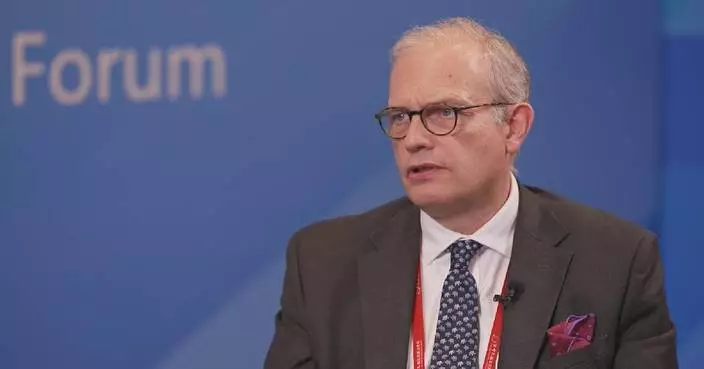
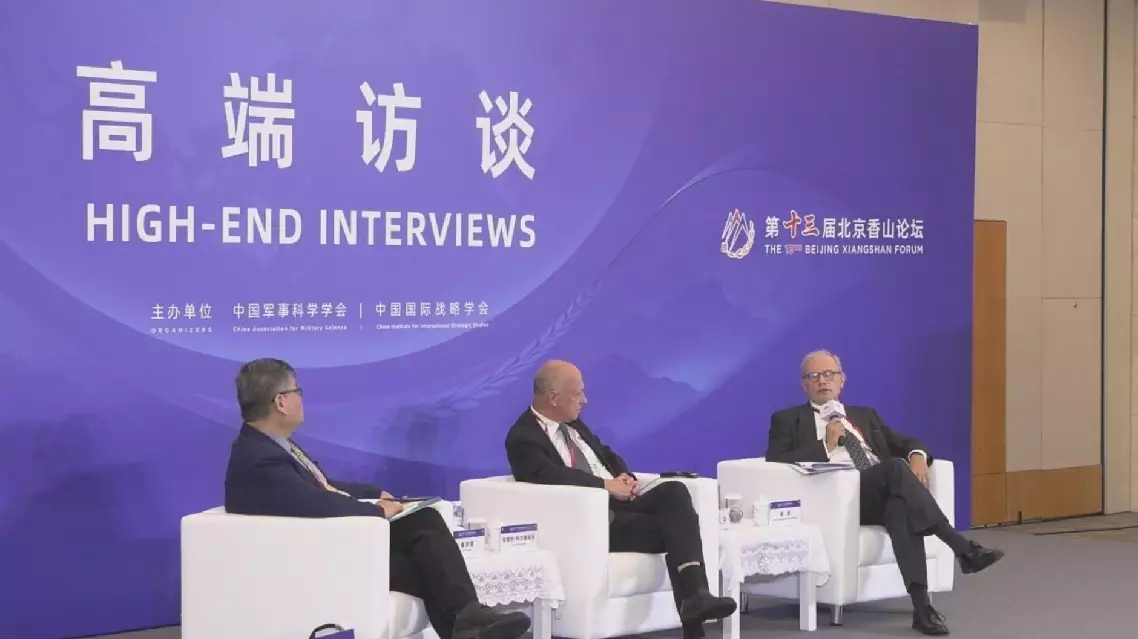
Speaking at the forum's "High-end Interview," British scholar Jean Christophe Iseux von Pfetten, chairman of the Royal Institute for East-West Strategic Studies in Britain, said that as some international security dialogue mechanisms are increasingly affected by bloc confrontation, truly effective security dialogue must first bring all parties with different positions to the table.

This is his fourth time attending the Beijing Xiangshan Forum.

"The Xiangshan [Forum's] competitive advantage is to be able to get everybody to sit at the same table and to have a dialogue, and to try to find a solution," he said.

The scholar noted that the forum has previously provided a platform for direct exchanges between representatives of different camps on hotspot issues such as the crisis in Ukraine. This year's forum has also held a special discussion on the Middle East, with the participation of representatives from different parties to the conflict. In addition to traditional security issues, the weight of emerging technology topics such as AI has further increased.

"I think that maybe something which is in the agenda I have seen, which I've not seen so much in the past, is around AI. There are a couple of panels on AI, and this is relatively new. The emphasis on technology is actually more prominent, I think, this year than last year," he said.

The rapid development of AI technology and its military application has also become a topic of concern for delegates at the forum. Representatives exchanged views on AI autonomous decision-making, the boundaries of military application and related governance mechanisms.

"Now, the development of AI which makes decisions itself, incorporating with other AI agents. That's why it is important [to have] more deep cooperation," said Vladimir Norov, chairman of the Central Asian Association for Artificial Intelligence, former secretary-general of the Shanghai Cooperation Organization and former foreign minister of Uzbekistan.

As AI technology continues to enter more decision-making and application scenarios, issues such as the determination of responsibility have also drawn the attention of delegates.

"But at the same time, we should not outsource responsibility to algorithms, to think that it is AI [that is] responsible - [it's] not, it is the responsibility of humans," said Norov.

Experts at the forum said emerging technologies such as AI are posing new practical challenges to global security governance. Strengthening communication and building consensus through multilateral security dialogue platforms such as the Beijing Xiangshan Forum will help advance discussions on relevant rules and reduce the risks of loss of control and miscalculation from the military application of new technologies.
Global experts call for joint efforts on AI security governance at Beijing Xiangshan Forum

Global experts call for joint efforts on AI security governance at Beijing Xiangshan Forum
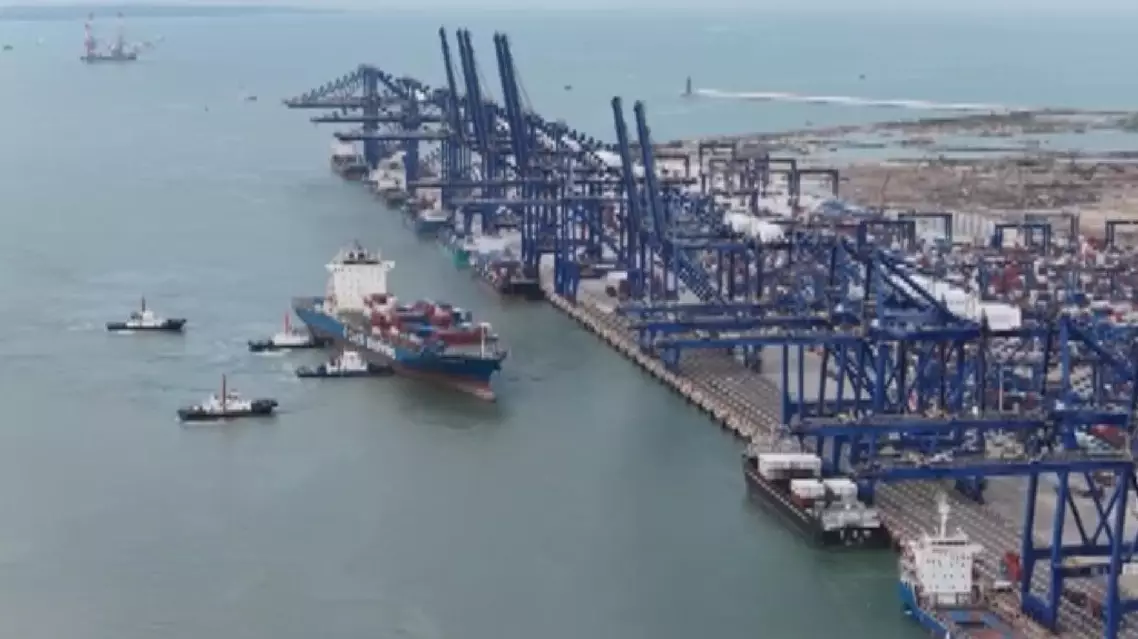
With the Pinglu Canal in the Guangxi Zhuang Autonomous Region officially open to shipping, Yangpu Port in south China's Hainan Province will fully leverage the policy and geographical advantages of the Hainan Free Trade Port (FTP) to accelerate its development into an international shipping hub, further connecting the New International Land-Sea Trade Corridor with global markets.

The canal stretches along the New International Land-Sea Trade Corridor, a strategic trade route connecting China's inland regions with ASEAN and other global markets. It is the first river-to-sea canal project planned and coordinated at the national level since the founding of the People's Republic of China in 1949.

Located in the northwest of the island province, Yangpu Port is the deep-water port closest to the main international shipping routes in the Beibu Gulf, and is also one of the maritime outlets of the New International Land-Sea Trade Corridor.

The opening of the Pinglu Canal to navigation has opened up a new sea-river intermodal transport corridor for goods entering and leaving the southwestern region, and has also brought new opportunities to some enterprises.

At a petrochemical enterprise in Danzhou City, robotic arms are bagging and packaging chemical products on a conveyor belt, and these goods will be shipped to southwest China's Guizhou Province and other places.

Most of this enterprise's customers in the Chinese mainland are concentrated in the southwestern Chinese provinces of Yunnan, Sichuan and Guizhou. At present, the enterprise is adjusting its future shipping plans in response to the logistics changes brought by the opening of the Pinglu Canal to navigation.

"We plan to shift about 70 percent of our goods to this new sea-river intermodal transport corridor, and overall logistics costs are expected to drop by 30 to 40 percent. Next year we also plan to build another plant in Hainan, which will allow us to take advantage of the free trade port's policies, import raw materials from places like Indonesia, and after processing, sell the products to the southwestern region or re-export them. This is expected to add about 200,000 tons of production capacity," said Wei Jianqiang, head of Hainan Oxiranchem Co., Ltd.

Behind the enterprises' expansion of production and the busier flow of goods, there is also the upgraded service support made possible by the opening of the Pinglu Canal to navigation. In this regard, the relevant authorities have also made full preparations.

"After the Pinglu Canal opens to navigation, we will strengthen safeguard measures in areas such as facilitating the entry and exit of container ships on fixed routes, credit-based regulation, and cross-regional coordination," said Jiang Yufeng, head of the Xiaochantan Maritime Patrol and Law Enforcement Brigade, Yangpu Maritime Safety Administration.

Pinglu Canal underscores growing role of Yangpu Port as int'l shipping hub

Pinglu Canal underscores growing role of Yangpu Port as int'l shipping hub

Recommended Articles