LOS ANGELES (AP) — A federal judge has issued an order blocking immigration officers from making warrantless arrests in Southern California unless they determine the person is likely to escape.
In a preliminary injunction granted Sept. 2 and unsealed Wednesday, U.S. District Judge Maame Ewusi-Mensah Frimpong said the government must consider the “totality of the circumstances known to the agent or officer” regarding a person's likelihood of escape before making a civil immigration arrest without a warrant.
The lawsuit was filed last fall by the American Civil Liberties Union of Southern California, Public Counsel, and Los Angeles immigrant advocacy groups during an unprecedented surge of immigration enforcement in the region. The order applies in the Central District of California, which includes Los Angeles, Orange, Riverside, San Bernardino, Ventura, Santa Barbara and San Luis Obispo counties.
Frimpong also ordered the government to thoroughly document the probable cause that leads to an arrest before a warrant could be obtained. The mere fact that someone is in the country illegally is not enough to justify a warrantless arrest, she said in her order.
“Without this, Defendants cannot show that any arrest was proper,” Frimpong wrote. She denied the government's request to stay or delay the order to give them time to appeal.
The U.S. Department of Homeland Security did not immediately respond to a request for comment.
The lawsuit also sought to block roving patrols making stops and arrests based solely on race, language and occupation, and to protect access to counsel rights for people in detention.
Frimpong previously issued a temporary restraining order to restrict these sweeping immigration operations, but it was lifted by the U.S. Supreme Court last September. Justice Brett Kavanaugh said apparent ethnicity could be a relevant factor for a stop if combined with other information.
The unsealed preliminary injunction on warrantless arrests was issued after a hearing Aug. 13 where Frimpong signaled in a tentative ruling she was inclined to side with the plaintiffs.
Federal judges in Portland, Colorado, Washington, D.C., and the Eastern District of California have already blocked similar warrantless arrest practices.
Plaintiffs argued in court documents that in many arrests they tracked in Southern California, no documentation was ever produced showing the arresting officers documented the likelihood of escape.
“There's no statutory requirement to document,” said federal attorney Daniel Mummolo, adding that different arresting officers handle things differently.
He cited a memo issued in January 2026 by former acting director of U.S. Immigration and Customs Enforcement Todd Lyons that said officers could make an “on-the-spot” determination about likelihood of escape.
“You have not presented evidence of officers saying, ‘Yeah I didn’t write it down but I did do it,' ” Frimpong said in response.
Plaintiffs' attorney Laura Perry Stone said the memo requires officers to determine both that the person was likely to leave the location and is unlikely to be found at another identifiable location, such as their home or workplace.
In her order, Frimpong said that a “wealth of record evidence” including government directives, arrest narratives, agent depositions and video evidence showed the government's current policy and practice was to conduct an escape risk assessment based solely on unlawful status or “false assertions,” or to not conduct one at all.
In one instance, the government claims that an individual was “running away” from immigration agents before being questioned. But a video of the arrest showed him walking at a normal pace and texting on his phone before the agent began questioning him, Frimpong wrote.
“This court order should put an end to hundreds – if not more – of unlawful arrests that continue throughout Southern California,” said Mayra Joachin, an attorney with the ACLU of Southern California. "We will closely monitor compliance with this court order, and expect the federal government to abide by it.”

FILE - People gather on the steps of Los Angeles City Hall during a protest on Jan. 30, 2026 in Los Angeles. (AP Photo/Jae C. Hong, File)
BUENOS AIRES, Argentina (AP) — An Argentine federal judge on Wednesday ordered British and Israeli companies to stop developing an oilfield off the Falkland Islands, opening a new legal front in the decades-old sovereignty dispute between Argentina and Britain that Argentine President Javier Milei has revived in recent weeks.
The injunction by Judge Mariel Borruto, a copy of which was obtained by The Associated Press, targets the Sea Lion oil project 220 kilometers (140 miles) north of the British-controlled archipelago in the South Atlantic, barring drilling, offshore installations and port construction until Argentine authorities can conduct an environmental review and issue a decision.
But in practice, Wednesday's order is unlikely to halt progress on the project. Judge Borruto acknowledged that enforcement “depends on international cooperation and the conduct” of the two companies, Israel's Navitas Petroleum and Britain's Rockhopper Exploration, which have already vowed to press ahead with the project despite Milei's threats of tougher sanctions against them and other companies operating around the islands.
Rockhopper declined to comment, and Navitas did not immediately respond to a request for comment on the injunction.
With its commercial oil production expected to start in 2028, Sea Lion has raised the stakes of a territorial dispute that led Britain and Argentina to a short and bloody war in 1982.
For the territory’s roughly 3,500 residents, the oilfield promises to transform an economy long dependent on fishing. For Argentina, which calls the islands the Malvinas, the project would allow foreign companies to extract oil riches it regards as its own. Its claim to the archipelago, roughly 480 kilometers (300 miles) off its coast, is enshrined in the constitution and woven into national identity, drawing support across the country’s political divisions.
U.S. President Donald Trump, a close ally of Argentina's radical libertarian leader, has brought new uncertainty to the dispute in recent weeks. Citing Britain’s lack of support for his war against Iran, he has suggested that Washington could change its historically neutral stance on the islands’ sovereignty.
Speaking to reporters in Dublin on Saturday, Trump again expressed skepticism that Britain would be able to retake the Falklands as it did after Argentina's military dictatorship invaded in 1982, saying, “I don’t know if they’re going to be willing to travel that far."
Milei seized on what he called “winds of change” following Trump’s comments earlier this month, using a Sept. 3 national address to announce measures against companies developing oilfields around the islands. He warned that the projects posed a “clear and urgent danger” to Argentina’s sovereignty claim and pledged to use all “diplomatic, economic, judicial and legal tools” to defend it.
His administration is now preparing legislation to broaden sanctions against companies involved in oil projects around the islands and filed three criminal complaints against Tel Aviv-listed Navitas and nine other companies and their executives, accusing them of violating Argentine law by pursuing oil operations without the country's authorization. It's unclear what impact the charges have on the project.
Britain has responded to the Argentine government’s legal campaign with defiance. It argues that the people who live in the Falklands should determine its status, citing the results of a 2013 referendum in which islanders overwhelmingly voted to remain a British territory.
“Argentine domestic law does not apply within the Islands,” the British government said Tuesday in guidance aimed at reassuring businesses operating there.
Wednesday's ruling issued by the federal court in Argentina's southernmost province of Tierra del Fuego stems from a separate civil lawsuit brought by environmental lawyers and veterans of the 1982 war seeking to prevent environmental damage from the project. The complaint cites ecological threats ranging from chemical pollution and underwater noise to ship traffic and potential oil spills.
Borruto warned that allowing drilling and construction to proceed could alter the marine ecosystem in ways that would be difficult to reverse.
“The risk is neither hypothetical nor remote,” she wrote, noting that work on the project’s infrastructure had already begun.
Associated Press writer Débora Rey contributed to this report.
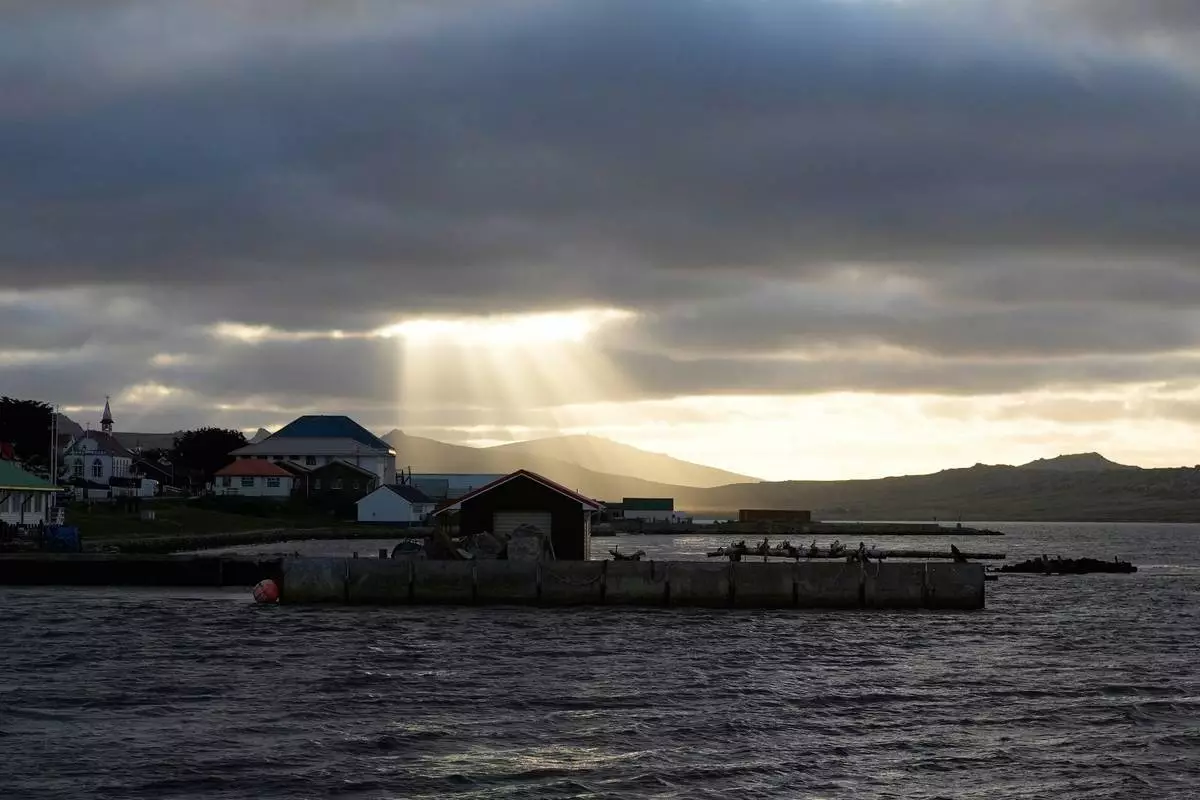
FILE - Sunlight breaks through the clouds over Stanley on the Falkland Islands, also known as Islas Malvinas, March 14, 2026. (AP Photo/Ricardo Mazalan, File)