BEIJING (AP) — Chinese technology giant Huawei launched new chip technologies in a challenge to global leaders such as Nvidia that highlights the narrowing gap between China and the U.S. in artificial intelligence.
Huawei's announcement Thursday at its annual key conference in Shanghai came just days before an expected meeting between U.S. President Donald Trump and Chinese President Xi Jinping in Washington on Sept. 24.
China has rapidly pursued technological self-reliance, including in chips, as U.S.-led restrictions barred it from accessing some of the world’s most advanced AI chips and cutting-edge chipmaking machines.
Huawei introduced the Atlas 960 SuperPoD computing cluster at the event, a faster successor to the model it launched only months ago with improvements in AI training and “inference,” referring to the process when a trained AI makes predictions or decisions.
Huawei also plans to launch the Ascend 970 and 980 chip series in 2028 and 2029, with expectations of significant improvements in computing power.
“The timing — less than two weeks before President Xi Jinping’s visit to Washington — underscores Beijing’s confidence and ambition in technology and innovation,” said George Chen, a partner and chair of digital practice at The Asia Group consultancy.
Huawei’s announcement also came as Trump downplayed AI leaders’ call to slow development of the technology for safety purposes. Trump insisted the U.S. must maintain its lead over China, saying “whoever wins in AI, wins.”
“AI developments move so quickly that no one can be certain of holding the lead forever,” Chen said.
Advanced technologies in China such as the training of AI models still often rely on U.S. chips, including those from Nvidia, analysts say. But Huawei has made its own advanced chips and maintains a lead over Chinese chip developers, as AI companies in China increasingly embrace the use of domestic chips.
The Atlas 960 SuperPoD computing cluster raised eyebrows among some technology analysts by coming soon after the company rolled out the Atlas 950 SuperPod late last year.
“The fact that Huawei achieved this upgrade in just a year, far quicker than before, will only heighten U.S. anxiety about the accelerating AI competition,” Chen said.

FILE -Visitors stand near the Huawei Atlas 950 SuperPod during the World AI Conference in Shanghai, Friday, July 17, 2026. (AP Photo/Ng Han Guan, File)

Visitors past by the Huawei booth display of the Atlas 950 SuperPoD during the World AI Conference in Shanghai, China on Friday, July 17, 2026. (AP Photo/Ng Han Guan)
CAIRO (AP) — As Houthi rebels closed in, Eshraq Abdel Gelil and her husband fled their home, walking through the mountains before catching a ride to a nearby city. Four months pregnant, she feared another miscarriage.
They are among more than 125,000 people who have fled as the Iran-backed rebels have advanced down the Red Sea coast to a key maritime chokepoint. The offensive, linked to the wider Iran war, has threatened Saudi oil exports, pushed up global fuel prices and rattled markets.
The cost has been far greater for Yemenis caught in the crossfire. Many have fled their homes with only what they could carry. The Arab world’s poorest country was pushed to the brink of famine in an earlier phase of the civil war, which killed an estimated 150,000 people.
A Saudi-led blockade, along with the Houthis’ repressive rule and detention of U.N. and aid workers, has made life miserable in the now-expanding territory under rebel control. Yemen’s Saudi-backed government, weak and fragmented, has struggled to push them back.
Abdel Gelil is now sheltering with family in the southwestern city of Taiz, while others are sleeping in the streets or erecting makeshift tents out of plastic.
Her husband, Mohamed Thabet, said the latest fighting was “extremely fierce” and more intense than a battle in 2017 that had also forced him to flee. “There was shelling and shrapnel near the house,” he said.
They walked for 5 kilometers (3 miles) before taking a vehicle for around 60 kilometers (37 miles) on mountain roads.
When they arrived in Taiz, a doctor told them that the baby had moved lower in the womb. Abdel Gelil miscarried at the same point in a previous pregnancy.
“My wife cried from the shock and was very fearful,” Thabet said.
Now they are packed into a home with extended family. They can only afford to eat twice a day, and they worry that Abdel Gelil is not getting enough nutrients for her and the baby.
Thabet also worries about his sister, who hasn't been able to afford her diabetes medication for over a month. She and her two daughters, 8 and 13, have a blood condition that makes them susceptible to anemia, he said.
The civil war dates back to 2014, when the Houthis seized much of northern Yemen, including the capital, Sanaa. Saudi Arabia intervened the following year in support of Yemen's internationally recognized government. A 2022 ceasefire largely halted the fighting.
Hostilities erupted again in July, when the Houthis renewed attacks on Saudi Arabia in what the rebels said was an attempt to lift the blockade. The attacks on Saudi Arabia's oil industry came as the U.S. was having some success in reopening the Strait of Hormuz.
The fighting in Yemen has killed eight civilians and wounded another 32, according to the U.N. humanitarian office, which says an estimated 125,000 people have fled their homes. The U.N. children's agency, known as UNICEF, says the displaced include more than 57,000 children.
“This is one of the most fast-moving and volatile displacement waves Yemen has seen in years,” said Obia Achieng, a UNICEF representative in Yemen. “Families are fleeing with little or no warning, often at night, carrying only what they can grab.”
“The situation is particularly concerning because it comes on top of an already severe humanitarian crisis,” Achieng added.
Before the latest fighting, the U.N. had warned that around 5 million Yemenis were experiencing “crisis or worse levels of acute food insecurity.”
Milena Murr, of Prosper Global, a humanitarian group previously known as Mercy Corps, said some people arriving in Taiz had walked for over 16 hours, arriving at displacement camps exhausted, dehydrated and with some of the children appearing malnourished.
Iman Abdullahi, country director for CARE, another aid group, said there's an urgent need for food, maternal and newborn healthcare, hygiene supplies, private latrines and mental health support.
“One woman had to wash her only clothes and remain inside her tent until they dried because she had nothing else to wear. Another was forced to flee just two weeks after giving birth,” he said.
Nashwan Ahmed Said was stitching together a tent from plastic wheat sacks. He said this is the third time he's been displaced since the start of the war.
“We are in such a state! We have no home, no toilet, no food and nothing to drink,” he said.
Arwa Ahmed, who was displaced with her five children, said she and her family ate nothing but rice for days.
“We need everything. We need tents, we need food and all the essentials, because we were displaced and took nothing with us,” she said.
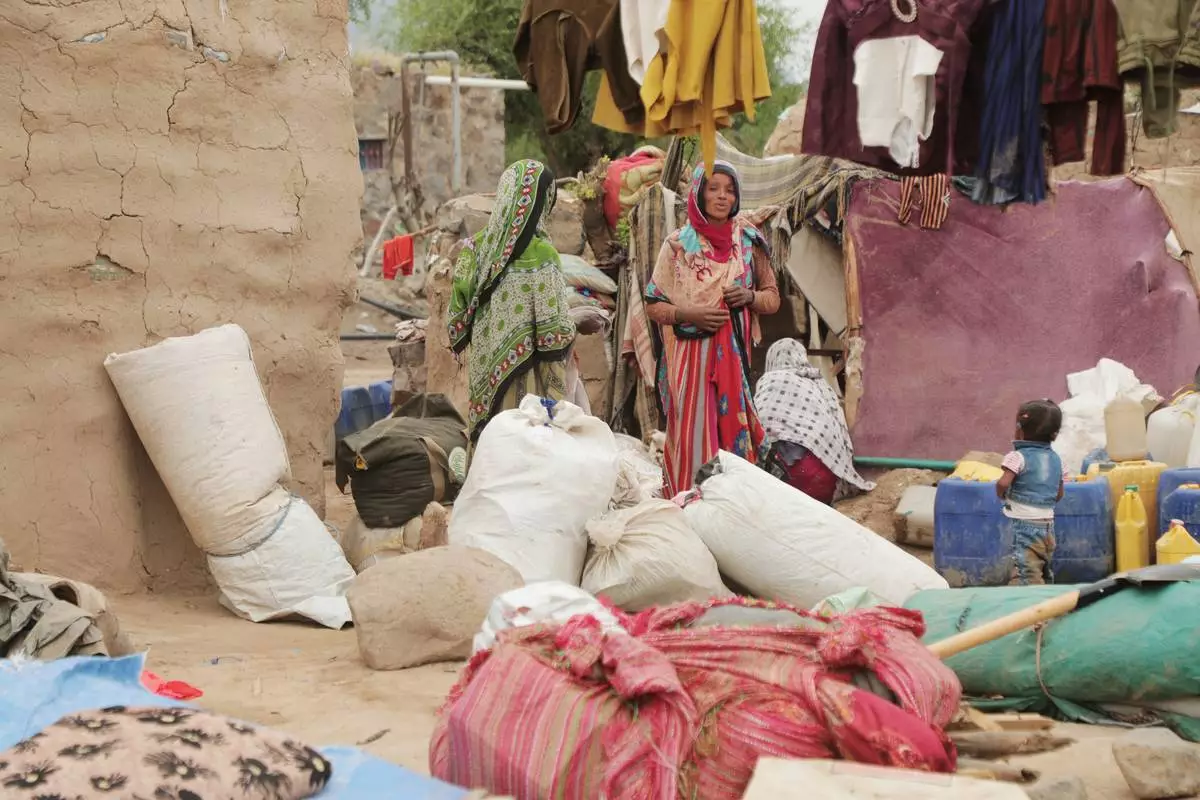
Displaced Yemenis prepare their camp in Taiz province, Yemen, Tuesday, Sept. 15, 2026. (AP Photo/Marzouq Al Jabri)
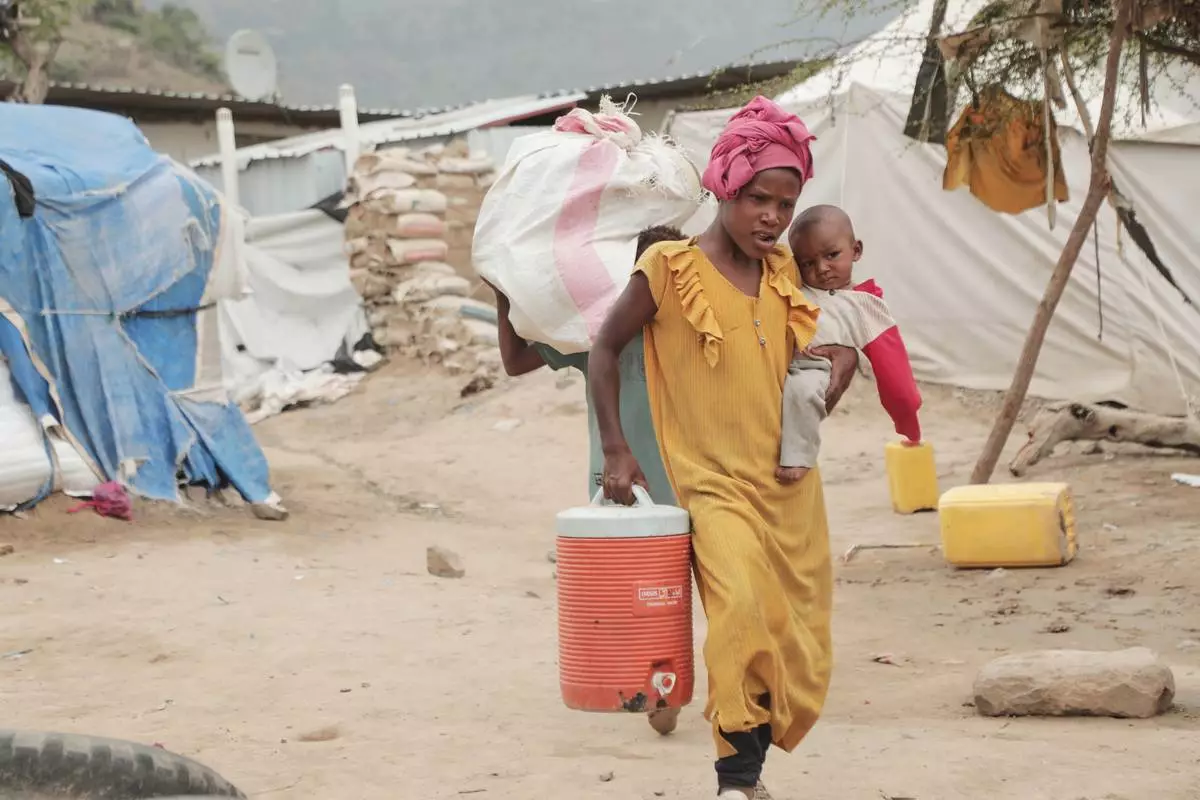
A displaced person walks through a camp in Taiz province, Yemen, Tuesday, Sept. 15, 2026. (AP Photo/Marzouq Al Jabri)
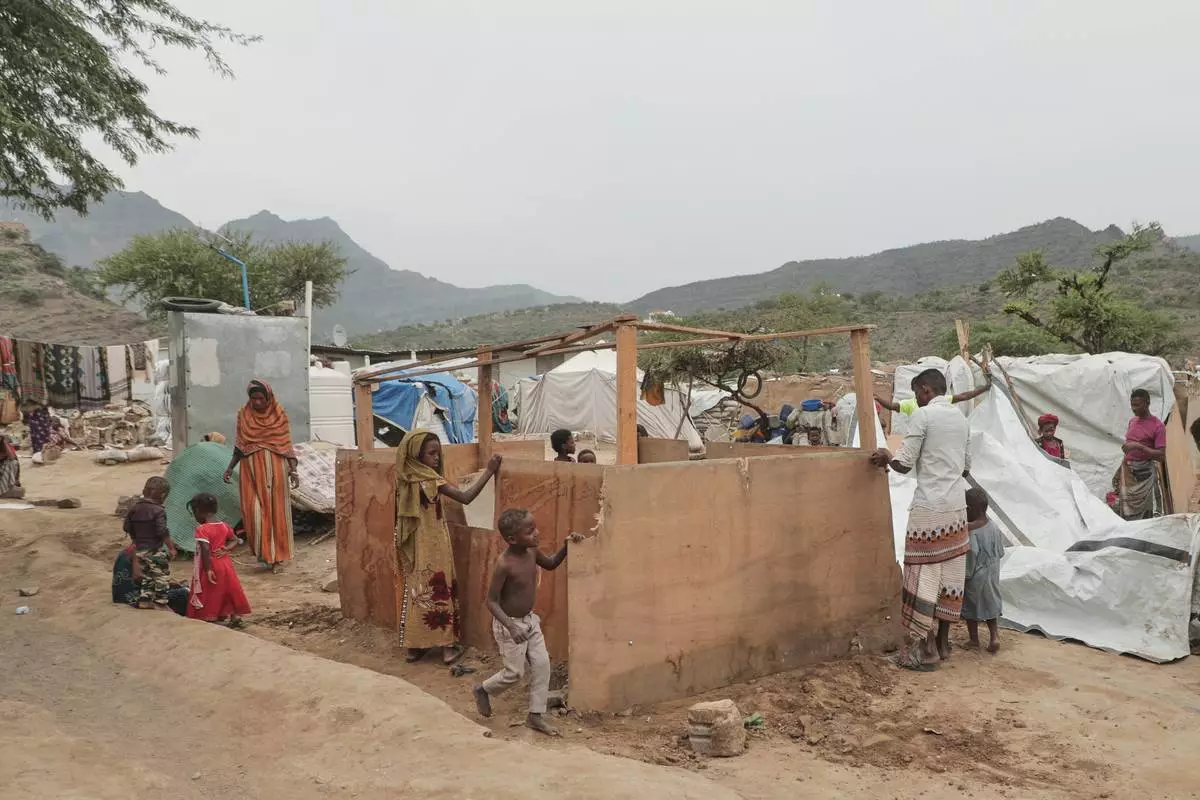
Displaced people set their camp in Taiz province, Yemen, Tuesday, Sept. 15, 2026. (AP Photo/Marzouq Al Jabri)