Bijan Robinson can do it all on the football field as one of the NFL’s best all-around running backs.
The Atlanta Falcons’ All-Pro is impressive on camera, too.
Robinson studied acting in college and has looked like a natural in a few television roles, including a Colgate commercial.
It helps to have fellow Texas alum Matthew McConaughey give him advice. Robinson is also close to Outer Banks star Jonathan Daviss.
“It’s been great. My best friend, he’s an actor; Jonathan Daviss. He’s about to do a movie. ... So just seeing his process has been awesome,” Robinson said on AP’s “Football Unfiltered.” “But then with Matthew, we talk all the time just about life and just how everything’s going. But then seeing what he’s doing and seeing how he’s still doing it at a high level, I think he’s about to come out with a show.
“It’s been pretty special like having that relationship with him, just how much that we’ve grown in that space and the influence that he has on me and in acting and all the things that he’s accomplished. I think it’s something that I want to continue to keep doing down the line and get better at, but having those guys in my corner has been pretty cool, too.”
Robinson led the NFL with 2,298 scrimmage yards last season in his third year in the NFL. He made his second Pro Bowl and was named first-team AP All-Pro running back and second-team at All-Purpose behind Christian McCaffrey.
The two do-everything backs are friends and workout partners in the offseason.
“He’s a big brother to me and we talk a lot” Robinson said about McCaffrey. “We talk about random stuff, talk about, obviously football, like from week to week. But just having him is super cool, man. His experience is second to none in this league and the things that he’s done has been incredible. And so for having him as a mentor, as a guy that can have my back and can teach me little things on the field, it’s been fun to learn from him and I’m gonna continue to learn for him. And hopefully I can even him some things on the field that he might have never heard of or never seen before. It’s that kind of relationship that I feel can always get us better.”
Watch “Football Unfiltered with Rob Maaddi” here or listen here
See AP’s full NFL coverage here

Atlanta Falcons running back Bijan Robinson (7) runs in for a touchdown during an NFL football game against the Pittsburgh Steelers, Sunday, Sept. 13, 2026, in Pittsburgh. (AP Photo/Gene J. Puskar)

Atlanta Falcons running back Bijan Robinson (7) runs in for a touchdown during an NFL football game against the Pittsburgh Steelers, Sunday, Sept. 13, 2026, in Pittsburgh. (AP Photo/Gene J. Puskar)
KYIV, Ukraine (AP) — Ukraine has long argued that Russia will only negotiate seriously if the cost of continuing the war becomes too high.
For Kyiv, punitive sanctions that impose real economic costs on Moscow are a key part of that strategy.
This week’s passage of a long-sought, sweeping package of U.S. sanctions aimed at cutting off some of the financial resources President Vladimir Putin relies on to fund the war gives Ukraine another potential source of leverage, but its impact may depend on whether and how aggressively the measures are implemented by the United States.
The House on Wednesday approved the sanctions package targeting Russian officials and key sectors of the economy. On Thursday, Ukrainian President Volodymyr Zelenskyy called the vote “symbolic,” adding that the House passed the bill on the same night Russia launched another large-scale attack across Ukraine, capabilities the full implementation of the deal would derail.
Kremlin spokesman Dmitry Peskov said Thursday that if the United States imposes additional sanctions on Russia, it would hinder the Washington-led effort to end the war in Ukraine.
“We are, of course, monitoring the passing of this document. This falls into the category of unfriendly actions. And, of course, the U.S. imposing some additional sanctions would definitely complicate the efforts to find a peace settlement in Ukraine,” Peskov told reporters during his daily conference call.
“For Ukraine, the immediate benefit is political, not economic. Congress signaling political solidarity with Ukraine via its legislative support sends a valuable message to the Kremlin,” said Tom Keatinge, director of the Centre for Finance and Security at RUSI.
Here’s why the sanctions package matters to Ukraine:
For Kyiv, the sanctions package offers another, powerful, way to increase economic pressure on Moscow.
Existing Western sanctions have imposed significant costs on Russia, but Kyiv has argued that they have not delivered the swift, severe economic impact needed to force a change in Moscow’s calculations.
“The U.S. House of Representatives’ passage of the Graham bill last night marks an important step toward further pressuring Russia, raising the cost of its continued aggression, and depriving the Russian war machine of resources," said Ukrainian Foreign Minister Andrii Sybiha in comments to the press on Thursday. "It is crucial not to stop there. We very much hope that this decisive move will...signal the start of a new round of intensified pressure from other partners as well.”
The new legislation targets Russian officials, financial institutions and the network of tankers used to move Russian oil while evading sanctions. It also gives President Donald Trump the authority to impose tariffs of up to 100% on major buyers of Russian oil and gas, subject to specified exemptions.
The measure passed the Senate 86-11 in August and cleared the House 262-159 on Wednesday, sending it to Trump for his signature.
Kyiv has also sought to bring the costs of the war deeper into Russia through long-range strikes on oil refineries and energy infrastructure. The sanctions add to that military pressure by adding economic repercussions, especially if the sanctions target buyers and networks helping sustain Russian energy.
Securing that economic pressure has been a central focus of Zelenskyy’s lobbying and diplomatic efforts.
The bill is named after the late Sen. Lindsey Graham of South Carolina. Helping get it across the finish line was his final legislative effort: Graham spent more than a year negotiating the measure and secured an agreement with the White House shortly before his death.
Graham and Democratic Sen. Richard Blumenthal, along with other supporters of Ukraine, spent more than a year building support for the legislation and negotiating a version that could win backing from both the White House and Congress.
Zelenskyy also intensified his lobbying of U.S. lawmakers, including a closed-door meeting with senators following Graham’s funeral.
He used the meeting to make the case for continued U.S. support, describing Ukraine’s efforts to take the fight to Russia while pressing for sanctions aimed at cutting into the oil and gas revenues financing Moscow’s war effort.
He told lawmakers that the legislation was needed not only to weaken Russia’s ability to sustain the war, but also to bolster the morale of Ukrainian troops and civilians.
For Ukraine, the central question now is how aggressively the Trump administration will use the new powers to pressure Moscow.
“Sanctions must be strong so that all efforts for peace, and in particular our joint diplomatic efforts with the United States, Europe, and other friends, are effective,” Zelenskyy said Thursday.
There are caveats. The bill gives the president discretion over how it is implemented, including authority over imposing tariffs and the ability to waive certain sanctions under specified conditions.
“Ultimately, this comes down to Trump’s commitment. He already has the tools to sanction Russia on his desk but has chosen to ignore supporting Ukraine in favor of a belief that his skill as a negotiator can end the war. Perhaps he has finally realized that economic pressure - his preferred response to all disputes - is the right tool in this case too,” said Keatinge.
That has raised concerns among some lawmakers that the administration could either wield the tariff powers too broadly, potentially affecting U.S. allies, or choose not to enforce the sanctions as aggressively as supporters envision.
Trump has so far favored diplomacy with Moscow, leaving open the question of how aggressively his administration will use the new sanctions powers to pressure Russia.
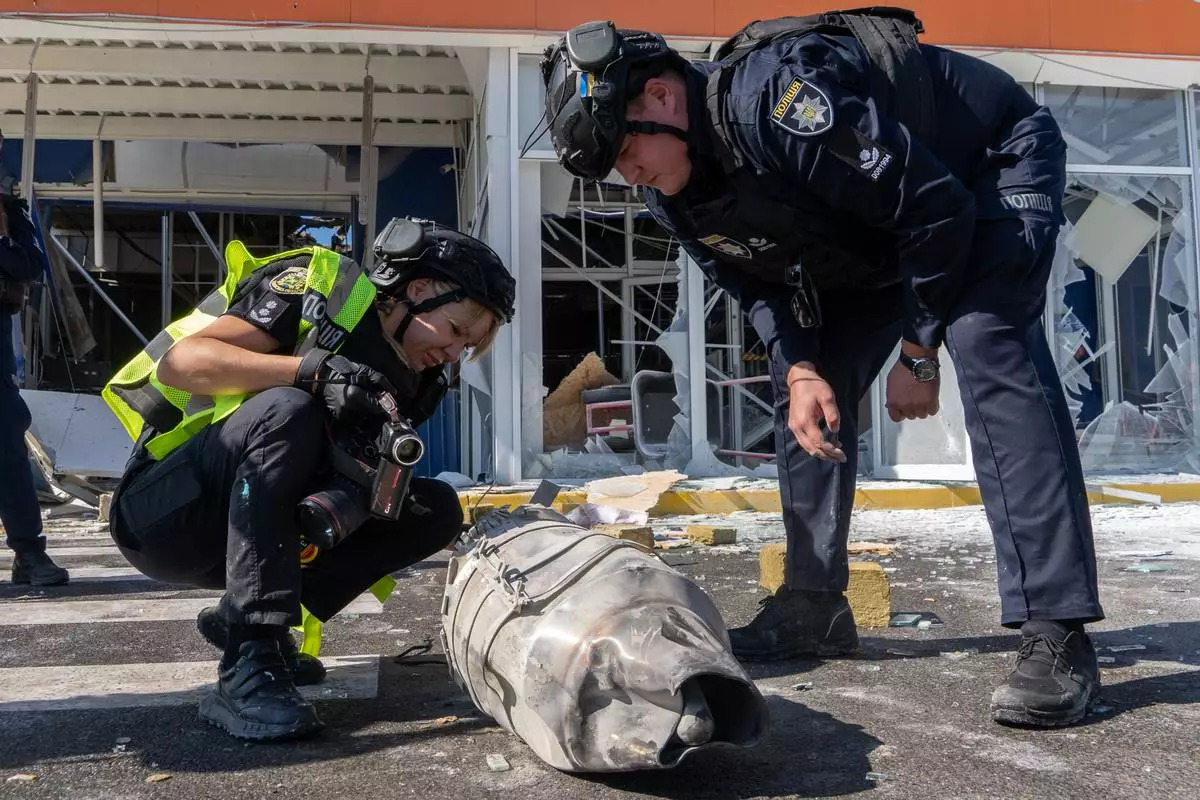
Police officers inspect fragments of a Russian drone after an air attack on a commercial infrastructure in Kharkiv, Ukraine, Thursday, Sept. 17, 2026. (AP Photo/Andrii Marienko)