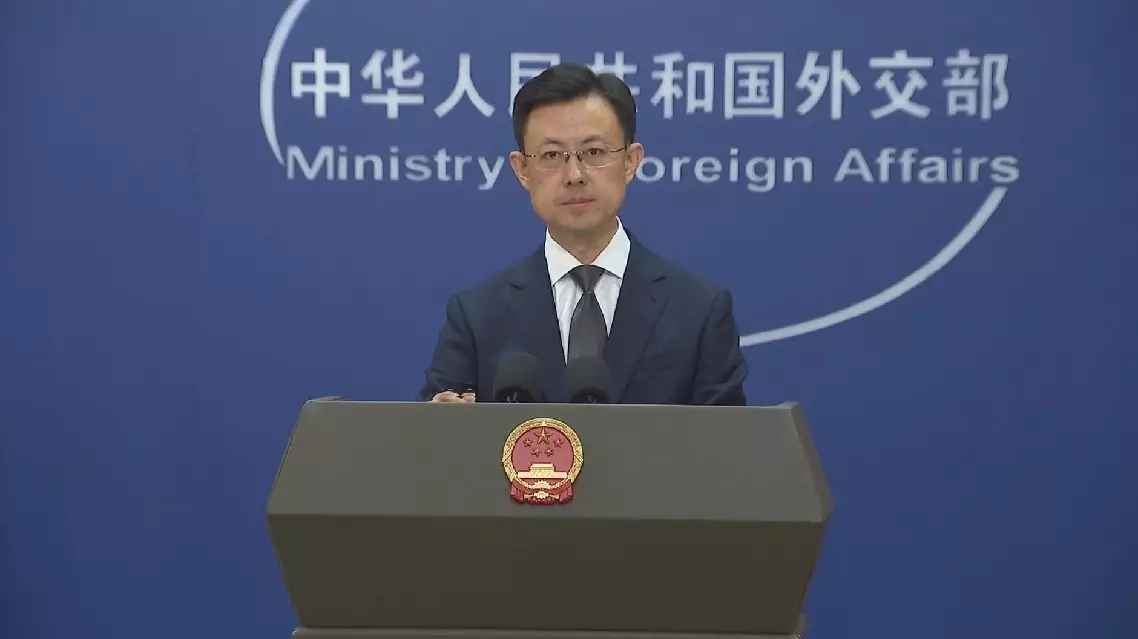
A Chinese foreign ministry spokesman on Friday urged the Philippines to immediately stop its maritime infringement and provocations, stop spreading false narratives, and stop distorting facts.
Guo Jiakun, the spokesman, made the remarks at a daily news briefing when asked to comment on the recent situation in the South China Sea.
"The spokesperson of the China Coast Guard (CCG) has made a statement on the facts. On the morning of Sept. 18, a Philippine vessel provoked trouble in waters near Xianbin Jiao of China's Nansha Qundao and deliberately collided with a CCG ship. This seriously threatened the safety of Chinese personnel and vessels and seriously violated international law and the basic norms governing international relations," he said
"The Philippines should immediately stop its maritime infringement and provocations, stop spreading false narratives, and stop distorting facts. China will continue to firmly defend its territorial sovereignty and maritime rights and interests, and firmly uphold peace and stability in the South China Sea," said Guo.
China urges Philippines to immediately stop maritime infringement, provocations
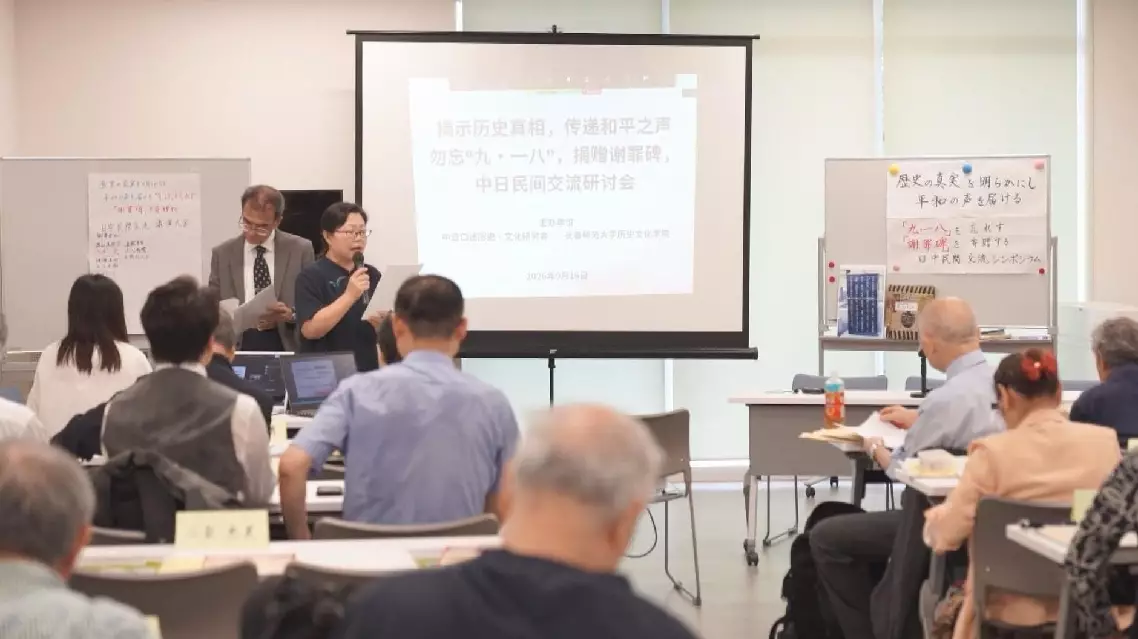
A group of Japanese history scholars and peace activists recently held a symposium in Tokyo to commemorate the 95th anniversary of the September 18 Incident, which marked the start of Japan's 14-year invasion of China.
Under the theme "Historical Memory and Inheritance," participants shared views on war memory, accountability for wartime aggression, and the transmission of peace ideals.
The symposium was held simultaneously on Wednesday in Tokyo and northeast China's Changchun city via video link.
Attendees observed a moment of silence before the symposium began.
In their remarks, several participants pointed out that Japanese militarist aggression inflicted enormous suffering on the Chinese people, and that Japan should confront its history of aggression, reflect on its responsibility for the war, uphold the pacifist constitution, and ensure that memories of Japan's history as an aggressor are passed on to future generations.
"Japan's understanding of history itself is flawed. For the things it has done in the past and for those facts that should be apologized for, it must admit and apologize. Facts are facts. These facts should be truthfully told to everyone. I think such education is necessary," said a participant.
"If we study history earnestly, we must truly reflect on the mistakes we have made in the past. Otherwise, we will not be able to move forward. One must seriously reflect on and apologize for what has been done in the past, and further consider how to prevent the same thing from happening again in the future," said another participant.
Ayako Kurahashi, the 79-year-old daughter of a former Japanese Kwantung Army soldier who invaded China, has donated a replica of her father's monument of apology to Changchun Normal University, expressing hope that the monument will stand forever.
"My father passed away due to illness in 1986 at the age of 71. Just two or three days before his death, he lay in the hospital bed and took out a piece of paper from beside his pillow, saying to me, 'After I die, have these words carved on my gravestone. Please'," she said.
Kurahashi's father, Yukichi Osawa, served in the military police troop of the Japanese Kwantung Army during Japan's invasion of China. He was stationed in places including Tianjin, Beijing, and Dongning in northeast China's Heilongjiang Province.
As he lay dying in 1986, Osawa took a slip of paper from beside his pillow, handed it to his daughter, and asked that the words be carved on his gravestone.
In 1998, she had a separate monument erected in a corner of the family cemetery, with her father's full statement of apology carved on the stone. In addition to recounting his participation in the invasion of China, the inscription states: "I feel deep remorse for everything I did to the Chinese people. I can only offer my profound apologies to them."
"The donation of this monument is to record the true history. Of course, everyone has said that this is not to prolong the hatred. The monument of apology conveys the voice of peace, allowing history to illuminate the future. It is a memory of history and a wake-up call for peace," said Li Suzhen, a distinguished professor at the Changchun Normal University. The participants said Japanese imperialist aggression caused immense sacrifices for the Chinese people, and Japan should adhere to the path of peace and ensure that the memory of the harm caused by the war is continuously passed down.
"Textbooks that can earnestly convey historical facts are decreasing, and I think this is the real problem. In today's Japan, these historical understandings are gradually fading, and I think this is indeed a dangerous thing," said Yuichi Hashimoto, a professor at the Tokyo University of Foreign Studies.
"I was born after the war, so I myself have never killed Chinese people on the battlefield. But that doesn't mean I have no responsibility at all. So, what kind of responsibility do I actually bear? It is necessary to seriously face and accept these historical facts and pass them on as a historical lesson to later generations, so that such incidents will not recur in the future era. This is the responsibility of our generation," said Hyoue Katayama, vice president of the Sino-Japanese Oral History and Culture Research Association.
Japanese activists urge confronting history of aggression ahead of September 18 Incident anniversary