WASHINGTON (AP) — The appeal of telehealth is easy to explain: Instead of calling a doctor, booking an appointment and hoping to eventually get a prescription, you can log onto an app or website and get approved for a new medication within minutes.
Since the COVID-19 pandemic, scores of online health services have launched with the promise of quick, convenient access to drugs for ADHD, sexual dysfunction, anxiety, weight loss and more.
Increasingly, though, government regulators are accusing these companies of deceptive, unethical business practices, including disclosing their customers’ health data, signing them up for hard-to-cancel subscriptions and bypassing real-time consultations with doctors.
The Federal Trade Commission’s latest lawsuit alleges that telehealth pioneer Hims & Hers engaged in all of those tactics, running afoul of U.S. consumer protection laws.
Hims has disputed the government's claims, calling them “an effort to generate headlines at our expense.”
In recent years, FTC officials have filed similar cases against more than a half-dozen telehealth companies, including online therapy provider BetterHelp and pharmacy discount service GoodRx. In both cases, regulators said the companies shared users' health data with online platforms such as Meta and Google, without getting permission.
Experts say part of the problem is that federal laws that govern the handling of health information generally don’t apply to telehealth companies.
“There’s an entire universe of companies collecting huge amounts of consumer health data every day that aren’t covered by our current health sector-specific laws,” said Andrew Crawford, an attorney with the nonprofit Center for Democracy and Technology.
Here are some things to know before signing up for a telehealth service:
Nearly all telehealth visits begin with a questionnaire in which users provide details about their medical history and possible medications they’re interested in.
According to the FTC’s lawsuit, Hims customers were automatically enrolled and billed for recurring prescriptions with “virtually no opportunity to review the provider’s recommended treatment.”
Researchers have documented similar practices across the industry, even for injectable weight-loss drugs that typically require a physical exam and other precautions before beginning treatment.
A recent analysis of nearly 50 telehealth companies selling GLP-1 drugs found that less than a third actually required any real-time video or audio consultation with a physician. In some cases, the prescriptions were approved within minutes.
“What we saw overwhelmingly was that it was incredibly easy to get access to the GLP-1s,” said Dr. Reshma Ramachandran of Yale University, who led the study. “Most of the time, the prescription was automatically sent, without even an opportunity to stop the dispensing.”
The lack of a real-time conversation means many patients aren’t getting the type of care recommended by medical societies that prescribe GLP-1s, including discussions about weight-loss goals, past efforts and eating disorders.
Only a little more than half the websites had a question about eating disorders — which GLP-1 drugs can induce or worsen — on their intake questionnaires, the researchers found.
Americans often assume that any personal health information they share is protected by HIPAA, the federal privacy law that governs the handling of medical information. But the law generally only applies to specific types of health businesses, including medical offices, hospitals and insurers, not telehealth companies offering prescriptions, counseling, DNA tests and other online services.
Privacy experts say that legal gap is one reason companies continue to disclose sensitive health information to advertisers and search engines.
“There isn’t a clear federal law saying: ‘Don’t do this,’” said Justin Brookman, Consumer Reports' director of technology policy. “There’s just a body of soft law and settled cases with the FTC that many companies probably aren’t even aware of.”
Because HIPAA does not cover every direct-to-consumer health platform, the FTC has generally used its broader authority to take action against “fraudulent, deceptive or unethical business methods.” In practice, that means showing that telehealth companies disclosed their customers' health information after initially saying they wouldn't.
Hims told customers that its platform offered a “100% online, private and secure” means of sharing information with the company's medical professionals, according to the FTC complaint. But instead the company shared the data with Meta and other online platforms, the FTC alleges.
Still, experts say the penalties available to regulators are limited. In most cases, companies sign a legal agreement stating that they'll stop the practices cited by regulators.
Lawmakers in California, Connecticut, Maryland and other states have passed new online privacy laws that include special protections for health information. But there's been little enforcement against telehealth companies that break those rules.
For now, privacy experts recommend using ad blockers and private web browsers — sometimes called “incognito” windows — when logging onto telehealth websites. Those tools can make it harder for companies to track your location, online history and other personal information.
It's also a good idea to read any user agreements to get a sense of how the company plans to use your personal data, said Crawford. Some telehealth sites, for example, explicitly state in their privacy policies that they have the right to sell data about users' sex lives.
The only surefire way to protect your information may simply be to decline the terms of service, usually one of the first steps required before accessing telehealth.
“The system we have now overly burdens consumers to do a ton of work in terms of understanding how each piece of technology collecting their personal data is going to handle it,” he said. “But even if you do all that work, you often have little agency.”
The Associated Press Health and Science Department receives support from the Howard Hughes Medical Institute’s Department of Science Education and the Robert Wood Johnson Foundation. The AP is solely responsible for all content.
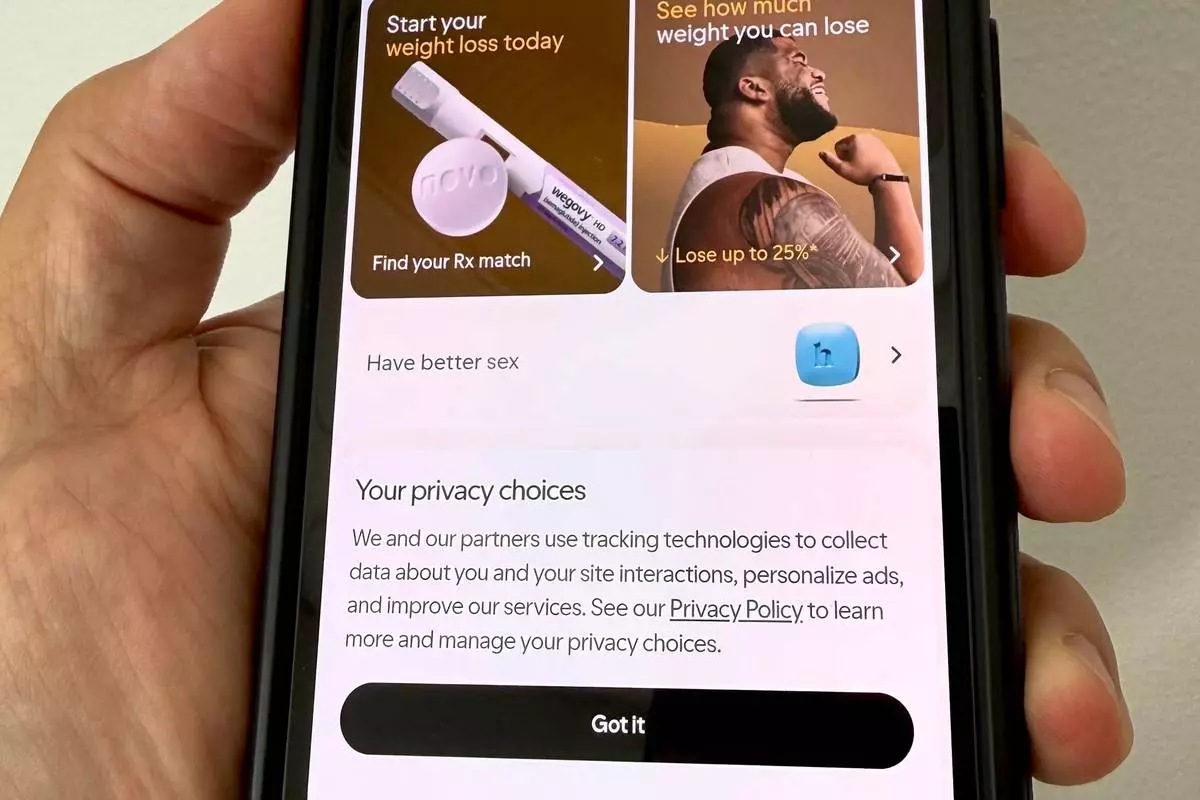
The Hims website is displayed on a smartphone in Philadelphia on Wednesday, Sept. 16, 2026. (AP Photo/Jonathan Poet)
Saudi Arabia warned of a “hostile aerial threat” and issued a string of emergency alerts across the kingdom, including in its capital, late Friday and early Saturday.
Also Saturday, Iran’s state TV reported that a man was executed after being convicted on charges of spying for Israel’s intelligence agency Mossad.
Here is the latest news from the Middle East on Saturday. Full coverage is available here.
Saudi Arabia warned of a “hostile aerial threat” after issuing emergency alerts, and at least one explosion was heard in Riyadh.
The alert in Riyadh was the first for the Saudi capital since the latest escalation with Yemen's Iran-backed Houthi rebels.
No casualties or damage were reported after the alerts were lifted. Saudi authorities didn't say what prompted the alerts or the cause of the audible explosions, but they previously reported intercepting incoming Houthi missiles and drones.
The U.N.’s most powerful body said late Friday that the Houthis' military escalation, attacks and threats “risk further expanding the conflict, threatening maritime security and international trade,” while undermining regional and international efforts to secure peace in Yemen.
It warned that continued escalation would exacerbate the already dire humanitarian situation in the country.
The council's 15 members called for “practical cooperation” to prevent the Iran-backed Houthis from acquiring arms, military training, financing and other military-related assistance needed to carry out their attacks. They stressed that all countries must enforce the U.N. arms embargo against the rebel group.
Iran's state TV reported on Saturday that a man identified as Hossein Pedram was executed after being convicted on charges of spying for Israel’s intelligence agency Mossad.
The report said Pedram passed on to Israel classified information on “sensitive military sites” in Iran's Isfahan province. It didn't say how he accessed the classified information.
Pedram was reportedly arrested after those sites, which included missile bases, were targeted in the 12-day air war by the U.S. and Israel against Iran in June last year.
A recent surge of executions in Iran prompted an international outcry by human rights groups.
Gaza’s Health Ministry and Shifa Hospital officials said one man was killed in the Shijaiyah neighborhood of Gaza City. Another man, identified as the son of the ministry's director general, was killed as he walked in the Jabaliya refugee camp in northern Gaza.
The Israeli military said it struck “several military operatives” and that it would provide more details later.
The heaviest fighting between Israel and Hamas has subsided since a ceasefire took effect last October, but Israeli fire has killed more than 13,780 Palestinians in Gaza since then, according to health officials in the territory.
The U.N. agency for Palestinian refugees (UNRWA) says more than 280,000 children in Gaza are attending school in tents and heavily damaged classrooms after years of war.
At a UNRWA-run school in Nuseirat, some classrooms have no desks, leaving children to sit on blankets on the floor. Still, some families say that a return to school brings back a familiar sense of routine that was upended by war.
UNRWA education program chief Tawfiq al-Hourani said the agency hopes to restore conditions for schooling to the state they were three years ago when it operated 182 fully equipped schools. He said 95% of those schools have since been lost.
Pakistan's Foreign Minister Ishaq Dar discussed uninterrupted energy supplies and safe passage for commercial ships during a telephone call Saturday with his Iranian counterpart Foreign Minister Abbas Araghchi.
Pakistan’s Foreign Ministry said in a statement that Dar underscored the importance of ensuring that ships pass safely and quickly, citing the potential effects of disruptions on developing countries and global supply chains. The statement did not provide details of Araghchi’s response.
Pakistan has faced rising energy prices as the tensions spiked, increasing pressure on Prime Minister Shehbaz Sharif’s government. An Islamist party has threatened to march on the capital, Islamabad, unless the government lowers fuel prices.
Iran’s state TV reported Saturday that the Tehran prosecutor’s office filed charges against race organizers after women participated without covering their hair because “legal and Islamic Sharia” wasn’t observed.
The country's ruling theocracy requires women to wear scarves that cover their hair and loose-fitting clothes that hide their entire bodies.
Footage circulated online showing many women running the 10-kilometer (6-mile) race without the mandatory hair covering. Habib Sotoudehnejad, head of Tehran’s sports department, said Saturday that about 5% of participants violated race rules.
The race was run separately for men and women.
Hard liners in Iran seek harsh penalties against women who appear in public without covering their hair.
Syria’s Defense Ministry on Saturday held a funeral for 11 soldiers killed a day earlier during an explosion in the village of Ayash in the eastern province of Deir el-Zour.
The ministry did not give a reason for the blast that also wounded several other members of the military.
The Britain-based Syrian Observatory for Human Rights said the blast occurred in an arms depot at a military post. A similar explosion near the northwestern town of Sarmada earlier this month killed 14 people and wounded 11.
Turkey's banking watchdog, the Banking Regulation and Supervision Agency, revoked the operating license for the Istanbul branch of Iran's Bank Mellat.
The agency said Saturday that it made the decision to protect depositors or the stability of the Turkey's financial system.
The announcement comes as the United States is demanding other countries tighten economic measures against Iran.
Bank Mellat has been subject to Western sanctions for years and was named in 2019 as having links to the paramilitary Revolutionary Guard Corps. The U.S. Treasury Department earlier this month imposed sanctions on a Turkish investment bank and two subsidiaries over alleged ties to Iran.
This report will be updated throughout the day as new developments emerge.
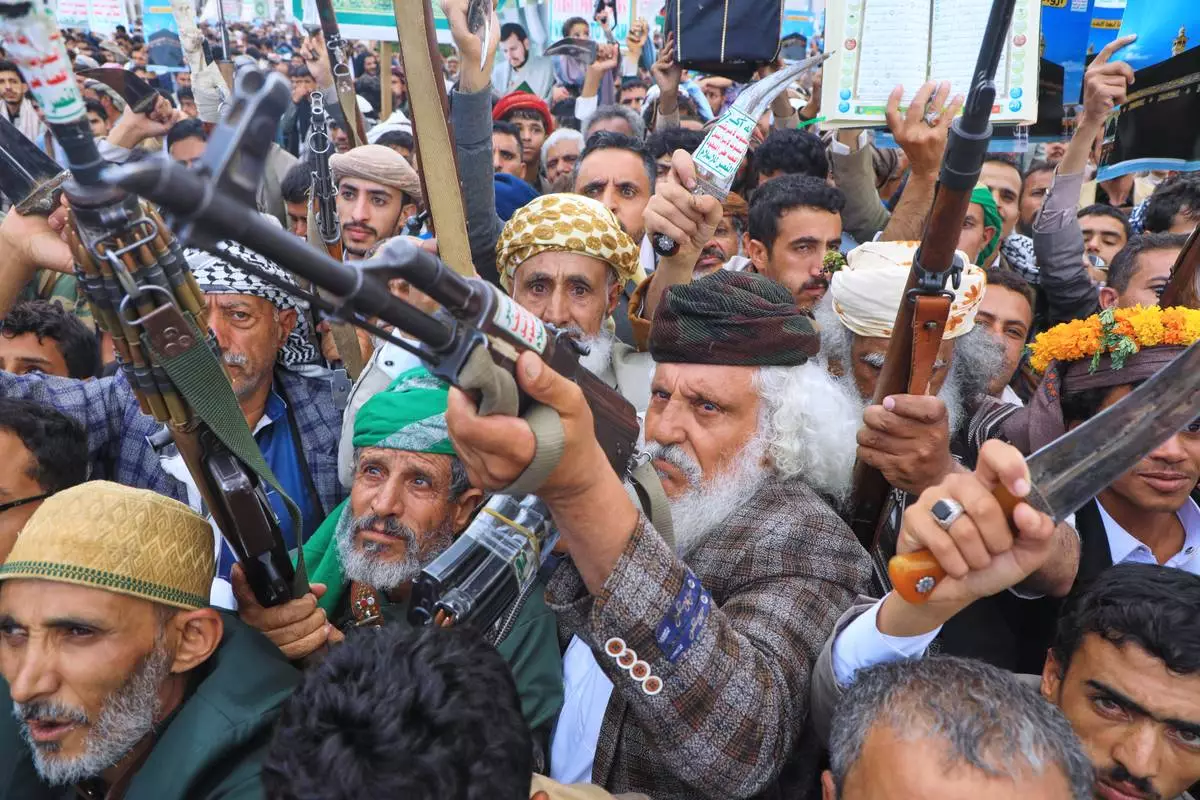
Supporters of Yemen's Houthi rebels raise their rifles during a rally in support of the group and to protest Saudi Arabia's accusation that the Houthis targeted Islam's holiest site of Mecca, in Sanaa, Yemen, Friday, Sept. 18, 2026. (AP Photo/Osamah Abdulrahman)

A supporter of Yemen’s Houthi rebels wears a poster showing the Kaaba at the Grand Mosque, tucked into a decorative sash above a dagger, during a rally to protest Saudi Arabia's accusation that the Houthis targeted Islam's holiest site, in Sanaa, Yemen, Friday, Sept. 18, 2026. Arabic reads, "Our souls are sacrificed for it". (AP Photo/Osamah Abdulrahman)

A soldier from Yemen's Houthi rebels stands in front of a giant banner of the Kaaba, during a rally to protest Saudi Arabia's accusation that the Houthis targeted Islam's holiest site in Sanaa, Yemen, Friday, Sept. 18, 2026. (AP Photo/Osamah Abdulrahman)