Chinese enterprises are accelerating their international expansion, rolling out next-generation electric vehicle batteries, autonomous transport, and AI consumer tech across leading European trade exhibitions.
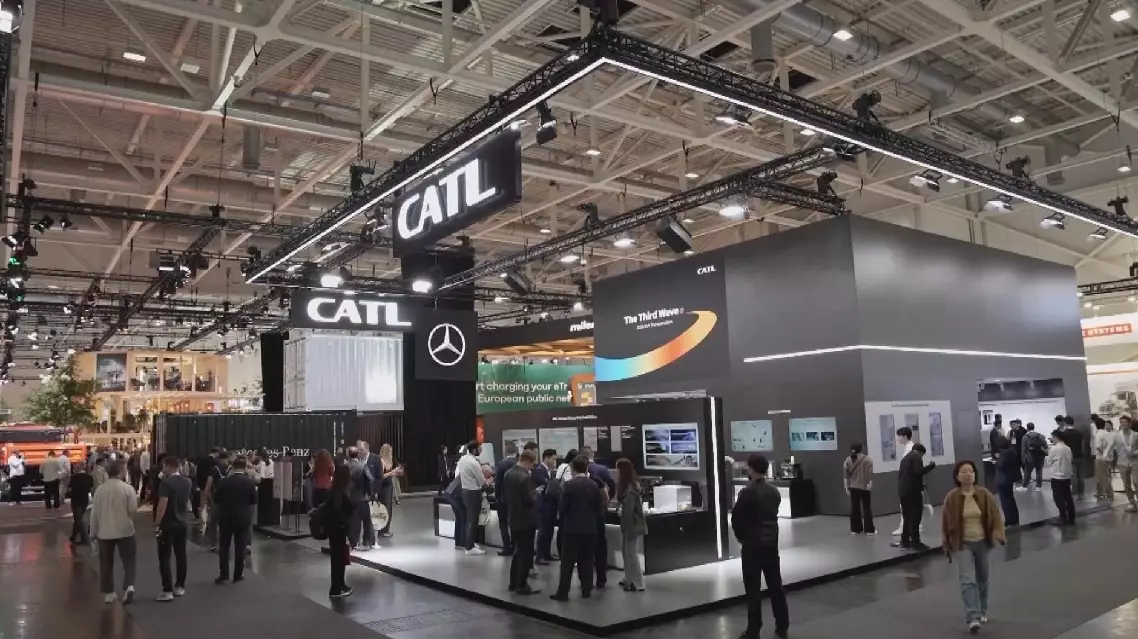
At the ongoing International Motor Show (IAA) Transportation 2026 in Hannover, Germany, held from September 14 to 20, more than 300 Chinese companies are showcasing their latest offerings.
They have brought not only multiple vehicle models but also technologies and solutions covering power batteries, intelligent driving, and logistics operations.
A leading Chinese battery maker unveiled a new-generation commercial vehicle battery solution, which enables a maximum range of 1,000 kilometers and can charge to 80 percent in just 25 minutes.
"The way we designed the product, the way we designed the battery is basically you can combine the same product in different applications to satisfy your needs without any necessity to have a single development for one model to another one," said Aleksej Kruekov, general manager of Overseas Service for EMEA (Europe, Middle East, and Africa) at Chinese battery manufacturer Contemporary Amperex Technology Co. Limited (CATL).
As Europe's logistics sector continues to grapple with a shortage of drivers, a Chinese company specializing in L4 autonomous driving has introduced a solution that can operate efficiently around the clock -- no driver required.
"This design is for the last mile of deliveries in an urban environment. That means we can deliver goods from stores to the customers or from wholesaler to stores," said Peter Salzberger, director of Business Development and Marketing for Europe at Neolix.
Chinese companies also have a strong presence in the consumer electronics sector. At the IFA consumer electronics fair in Berlin in early September, Chinese firms made up nearly half of the more than 1,900 exhibitors.
Additionally, they are working to bring more of their technological capabilities, product strengths, and even entire industrial ecosystems to global markets.
"TV's AIOS is different from the operating systems on phones or cars. A phone or a car serves one person, but a TV's AIOS serves the whole family -- so it needs to understand what everyone in the family needs. We believe a TV's AIOS must be able to perceive, think, communicate, and execute," said Li Wei, president of Hisense Visual Technology Co.
Chinese tech, manufacturing firms expand global footprint at European trade fairs
China's Fujian aircraft carrier has completed its cross-sea area test training over the past year, transforming from initial to full combat capability, said a Chinese military affairs expert.
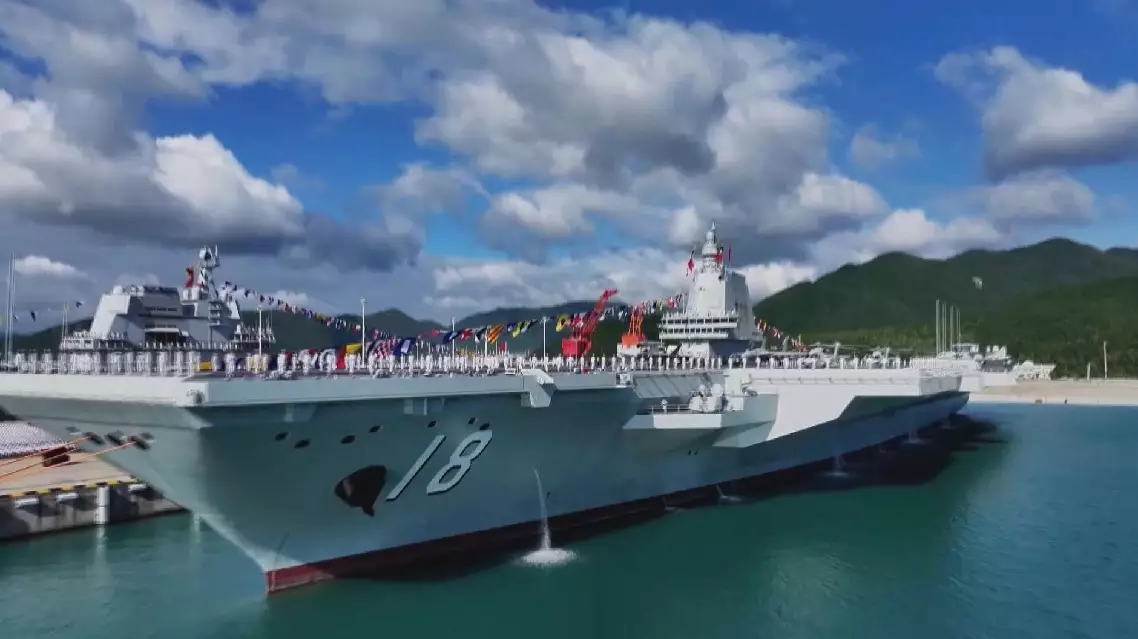
On June 17, 2022, the Fujian was launched and named with hull number 18, making China one of the few countries in the world capable of building large aircraft carriers. On November 5, 2025, the Fujian held its commissioning and flag-presentation ceremony at a naval port in Sanya. Just 13 days after commissioning, the Fujian carrier strike group conducted its first live-force training at sea. The year of 2026 is a critical year for the carrier's full transition from initial operational capability to full operational capability.
"'Initially forming combat capability' means the Fujian carrier can sail normally, the carrier-based aircraft can take off and land on the deck, and it can conduct basic formation training with escort vessels. 'Fully forming combat capability' means raising it from 'being able to sail, take off and land, and fight limited wars' to 'being able to fight high-intensity, all-weather, systematic and sustainable wars,'" said Zhang Junshe, a military affairs expert.
"Within one year of its commissioning, the Fujian carrier sailed south through the Taiwan Strait to the South China Sea and then north to the East China Sea and the Yellow Sea, completing cross-sea area test training. This demonstrates that the carrier has acquired the ability to operate in distant seas across different sea areas, with escort ship coordination reaching a certain level and combat capability initially formed," said Zhang.
"Within the same year, the Fujian completed catapult takeoffs and landings of multiple types of carrier-based aircraft, initially gaining full-deck operating capability. It then conducted live-troop formation training and multiple cross-sea area maneuvers. Coordination among formation escort ships has reached a certain level, and the carrier has developed an initial capability to conduct combat operations," he said.
As the world's first aircraft carrier using conventional-power electromagnetic catapult technology, the Fujian's electromagnetic catapult system, unlike the ski-jump takeoff of the Liaoning and Shandong, allows the carrier to flexibly organize the takeoff of different aircraft types, including the J-35 stealth fighter, J-15T heavy fighter and KJ-600 fixed-wing early warning aircraft.
"The Fujian is equipped with electromagnetic catapults and electromagnetic arresting devices. This is the carrier's most core and most watched technical highlight. Compared with traditional takeoff methods, electromagnetic catapult brings many changes to carrier aircraft sortie rates and formation operations. In the future, carrier-based drones can be deployed on board, and the carrier formation can conduct manned-unmanned coordinated operations," said Zhang.
The Fujian's commissioning in November 2025 marked the Chinese People's Liberation Army (PLA) Navy's entry into the three-carrier era. Over the past year, the PLA Navy has accelerated its transformation, with the three-carrier system as a hallmark.
"The real significance of the three-carrier era is not in having them appear together, but in rotation. Rotation means the three carriers cycle in an orderly way among the three states of 'duty-training-maintenance.' The three carriers strongly advance the PLA Navy's strategic transformation from 'near-sea defense' to 'far-sea defense,' with far-sea operations entering a new stage of normalized and systematic deployment. The Navy will continue to undertake far-sea missions such as escort, evacuation of overseas Chinese and humanitarian rescue, effectively safeguarding national interests and fulfilling the responsibilities and obligations of a responsible major country," said Zhang.
China's aircraft carrier Fujian transforming from initial to full combat capability: expert