South China's Guangdong Province is stepping up its efforts to make up for the manufacturing shortfall in its chip industry by expanding production capacity and developing homegrown design tools, shifting from a design-driven model to one supported by both design and manufacturing.
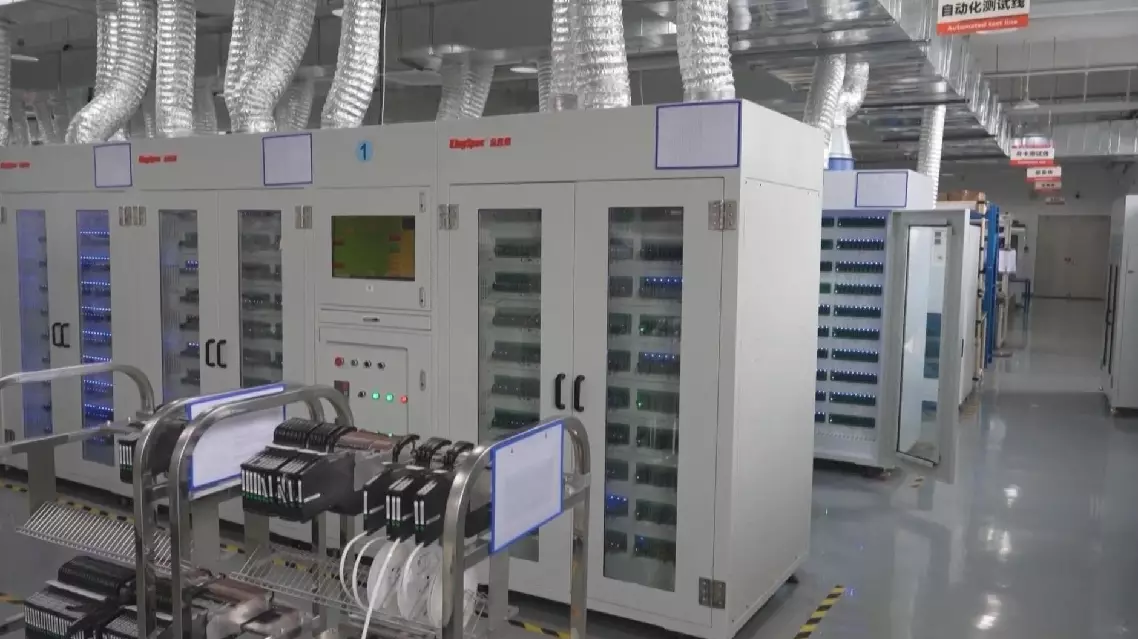
In a production workshop in Nansha District, Guangzhou City, a silicon carbide chip line is running close to full capacity. Silicon carbide chips are third-generation semiconductor power devices that can withstand higher temperatures and voltages while consuming far less power than traditional silicon chips.
The project is a flagship of Guangdong's "Qiangxin" (Strong Chip) initiative to reinforce the manufacturing link of the chip supply chain. With total investment of about 10 billion yuan (1.49 U.S. dollars), it is planned to reach annual capacity of 240,000 six-inch and 240,000 eight-inch silicon carbide wafers.
The company has now completed a full-range process platform, with products covering new energy vehicles, AI data centers, photovoltaics and energy storage, and consumer electronics.
"Our devices have been validated across the 400-volt and 800-volt platforms used in new energy vehicles today, and even in higher-voltage scenarios of 900 volts or 1,000 volts, and they are already being installed in vehicles in volume," said Xu Wei, president of Guangdong Ascenpower Semiconductors Co., Ltd.
Alongside production expansion, the province is also breaking the long-term overseas monopoly in EDA software, the fundamental design tool that directly supports manufacturing efficiency and technological progress.
A software company based in Shenzhen’s Longgang District has rebuilt core technologies from the ground up, gaining 100 percent independent control over underlying hardware resources, operating systems and business modules. Its self-developed EDA tool allows 100 engineers to work on circuit schematic design at the same time, cutting product launch cycles by more than 40 percent.
"Our software supports both on-premises and server-side deployment. Server-side deployment lets us make full use of server computing power to improve software performance, so 100 designers can work on schematics in parallel and shorten the whole product launch cycle," said Yuan Yi, head of the EDA division at Shenzhen Qiyunfang Technology Co., Ltd.
These advances are reshaping Guangdong's semiconductor industry, moving it beyond a system that relied almost entirely on design to one backed by both design expertise and solid manufacturing capacity.
Industry figures show that the push to upgrade the sector has delivered clear results, with Guangdong’s integrated circuit industry output exceeding 480 billion yuan in 2025.
"Shenzhen and Guangzhou are home to hundreds of AI chip design firms, and their biggest advantage is being close to the market. As 12-inch wafer manufacturing lines start production one after another, the local cooperation between manufacturing, packaging and testing is quickly gaining momentum," said Sun Rong, director of the Advanced Electronic Materials Institute at the Shenzhen Institute of Advanced Technology, Chinese Academy of Sciences.
"Focusing on key fields such as integrated circuits, new materials and industrial machine tools, we will further implement the 'Guangdong Strong Chip' project, as well as the chemical new materials and advanced equipment research program. We will plan and roll out more creative and pioneering measures, build and make good use of industrial innovation platforms such as national and provincial manufacturing innovation centers, and build Guangdong into an important source of independent innovation for China's manufacturing sector," said Zeng Jinze, director of the Guangdong Provincial Department of Industry and Information Technology.
Guangdong moves to close chip manufacturing gap with expanded production, homegrown design tools