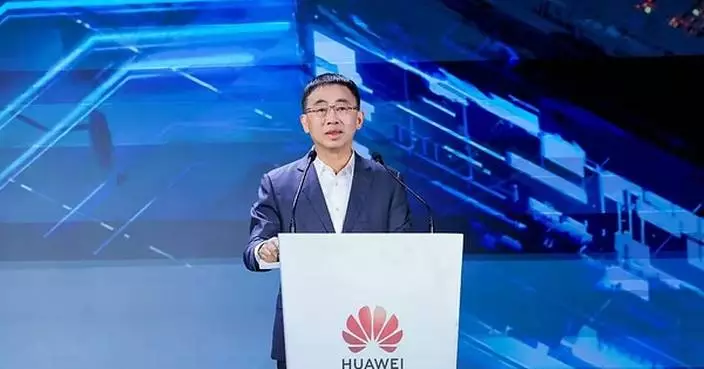
HONG KONG, Sept. 20, 2026 /PRNewswire/ -- At the recent Association of the Electricity Supply Industry of East Asia and Western Pacific (AESIEAP) CEO Conference, David Sun, CEO of Huawei Electric Power Digitalization BU, delivered a keynote speech titled "AI and Energy Empowering Each Other, Intelligence Unlocking a New Future for Electric Power." Commenting on the far-reaching waves of the global energy transition, Sun observed that the low-voltage side represents the primary battlefield for AI. He offered an in-depth analysis of the industry's current landscape and put forward a strategic vision centered on building six core capabilities, advancing systematic standards, and cultivating talent. This vision charts a course for the intelligent transformation of the electric power industry.
Low-Voltage Grid: A Critical Bottleneck in the Energy Transition
In August 2024, at the opening ceremony of the International Council on Large Electric Systems (CIGRE) Paris session, a speaker from the International Energy Agency (IEA) noted that grid infrastructure is becoming a key bottleneck for the global energy transition. Sun believes that the real challenge lies in low-voltage grid management and transparency. Currently, approximately 700 million people worldwide still lack access to electricity, including nearly 50 million in Asia, making universal electricity access a long-term mission. Meanwhile, China's installed capacity of distributed PV is growing rapidly and is expected to exceed 1 billion kilowatts by 2030. This explosive growth has made the systematic management of low-voltage services essential and shone a spotlight on the importance of power market transactions.
To address the century-old gap in low-voltage management, Sun emphasized the need to build six core capabilities centered around low-voltage transparency: observability, measurability, controllability, adjustability, tradability, and traceability. This is not just a technological upgrade, but a transformation of production methods.
Open Architecture and Solid Technical Foundation
David Sun noted that production methods are most critical. While professional capabilities still matter, what matters more is how they are rapidly combined to support the business, customers, and operational mechanisms.
He also stressed that the target communications network is key. Without communication, nothing can happen. Two global problems—low-voltage transparency and medium-voltage convergence—must be solved.
On digital architecture, he emphasized a layered, decoupled, and modularized design, along with on-demand cloud-edge-device collaboration for applications and data.
Finally, he noted that, building on real-time, high-quality data, AI is deeply integrated into the full power process, full-lifecycle asset management, and full-spectrum customer services, while also enabling innovation across the business.
Deep Integration of AI into Power Operations
During his speech, David Sun shared several practical achievements in the deep integration of AI in low-voltage operations. In the business operations of State Grid Corporation of China, labor costs were significantly reduced by the combined use of high-speed power line carrier (HPLC) communication technology, the anomaly analysis model, and the line loss analysis agent. By deploying the marketing ontology model, the company cut the customer service response time from hours to minutes. In markets outside China such as Brazil, the deployment of a microgrid management platform and a unified O&M center notably improved the accuracy of transformer district-level load forecasting. Furthermore, in daily frontline operations, the integration of VR headsets, an on-device small model, and a cloud-based large model significantly enhanced the safety and compliance of on-site work. These use cases demonstrate that digital and intelligent innovation, grounded in real-time, high-quality data, is driving power companies toward a new phase of greater operational efficiency and quality.
Reimagining Standards Leadership and Talent Development
In the process of bidirectional AI empowerment, open, consistent, and forward-looking systematic standards are crucial to driving technological innovation, industrial upgrading, and ecosystem prosperity. David Sun proposed that standards development should proceed within a three-tier framework of "indicators–architecture–technologies," and that standards should guide talent development, digital transformation, and sustainable business growth. Huawei has partnered with leading enterprises to establish the "Wittgenstein Studio" talent development program, which helps power companies lower the threshold for digitalization, unleash the creativity of power engineers, and enable each engineer to become a "Mini-CEO" who proactively embraces uncertainty. Only by turning power engineers into digital- and AI-savvy industry experts can the electric power industry achieve sustainable development as the new power system takes shape.
Huawei is driving the power industry beyond a single technological upgrade toward a dual transformation of production methods and talent structure. Moving forward, as open architectures become widespread and AI is adopted at scale, the industry will accelerate its transformation and build a transparent, intelligent, and sustainable new power system to maximize the value of every kilowatt-hour through bidirectional empowerment.
** This press release is distributed by PR Newswire through automated distribution system, for which the client assumes full responsibility. **

AI and Energy Empower Each Other: David Sun Outlines the New Future of the Electric Power Industry at the 2026 AESIEAP CEO Conference