WASHINGTON (AP) — A top Federal Reserve official said Monday that stubbornly high inflation and the renewal of combat in the Middle East in August were key reasons she supported raising borrowing costs last week, when she also penciled in a second rate hike for later this year.
Susan Collins, president of the Federal Reserve Bank of Boston, said in an interview with The Associated Press that she agreed with the Fed's decision last Wednesday to lift its benchmark interest rate by a quarter-point to about 3.9%. She also expects that the Fed will keep rates unchanged next year, she added.
“I did not see the inflation progress I was hoping to see,” she said. “Geopolitical developments suggest that we could continue to see additional pressures push on the energy side.
“There were reasons to see an increased likelihood of some of the scenarios in which inflation gets stuck above 2%,” she added, referring to the Fed's 2% inflation target, which it has not hit for more than five years.
Collins was the second Fed official Monday to outline their thinking about rates, along with Austan Goolsbee, president of the Chicago Fed, who spoke earlier in London and then addressed a roundtable of reporters. Both spoke about inflation pressures arising from supply shocks, such as the war in Iran, as well as from solid business and consumer spending.
Collins said data showing that hiring has improved also played a role in her decision to support a rate hike. Solid job gains can signal that the economy may be able to withstand higher rates.
Neither Collins nor Goolsbee have a vote on the Fed's rate decisions this year, but they participate in the meetings where rate changes are discussed. Goolsbee will have a vote next year, while Collins will have a vote in 2028.
Collins also said that businesses in her district, which includes Massachusetts, Connecticut, Maine, Rhode Island and Vermont, continue to express concern about high costs. Many of those companies expect they may have to pass rising costs on to their customers, which could push up measured inflation.
Goolsbee, for his part, said that the central bank may have to cause economic pain in the form of higher unemployment to combat stubbornly high inflation.
Goolsbee said that the Fed is facing a series of persistent supply shocks that have driven up inflation, including higher oil prices from the Iran war and tariffs. Typically, Goolsbee noted, the central bank would essentially wait for such shocks to fade and inflation to fall on its own rather than raise borrowing costs.
But faced with an ongoing series of persistent supply shocks, the Fed now has little choice but to hike rates, Goolsbee said. The increases are needed to lower consumer and business demand to a level consistent with reduced supply, he added, which should bring inflation back to the Fed's 2% target.
“The only way to bring inflation down is to raise rates and narrow the gap between supply and demand,” he said in a written copy of his remarks. “Forcing inflation back to target in the short run means pushing employment below target. ... In the short run, supply shocks force a difficult trade-off” between the Fed's goals of low inflation and maximum employment.
“It’s going to be painful,” Goolsbee said in later to reporters. “It would necessarily be painful.”
Goolsbee's comments contradict Fed Chairman Kevin Warsh's remarks last Wednesday at a news conference that took place after the Fed lifted its key interest rate for the first time in three years to about 3.9%.
“I don’t believe that we need to do harm to the labor markets to achieve our objective,” Warsh said last week.
The Fed generally fights inflation by raising interest rates to cool borrowing and spending. Historically, such rate hikes have often slowed growth and have even led to recessions.
Yet in 2022-2023, the Fed sharply raised interest rates and inflation did decline, without a significant rise in unemployment or economic slowdown.
Goolsbee also suggested while speaking with reporters that the Fed may need to implement more than just the one additional rate hike later this year that policymakers, as a group, forecast last week.
There are signs that surging investment in data centers for AI are also pushing up inflation, he said, suggesting that strong demand is playing a role, as well as the supply shock from oil.
If inflation mostly comes from supply shocks, then just one more rate hike could be sufficient, Goolsbee told reporters.
“And if we get evidence that convinces us that it’s coming from demand, then it likely would not be enough,” he said.
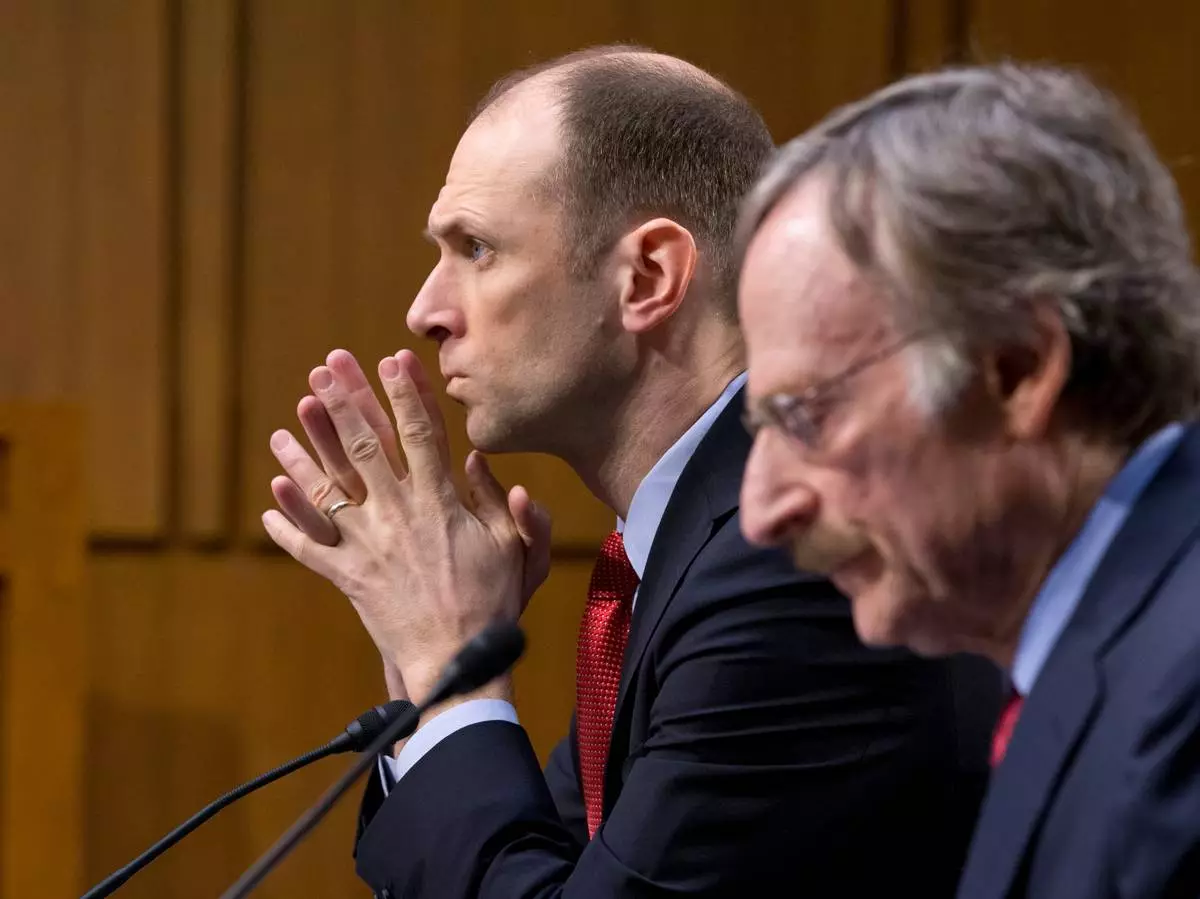
FILE - Austan Goolsbee, left, then-Council of Economic Advisers Chairman under President Barack Obama, testifies on Capitol Hill in Washingto, Feb. 28, 2013. (AP Photo/J. Scott Applewhite, File)